Brake Shoe Relining


I used these people many years ago when based in the Mid West.
They were efficient and trued the relevant drums, relined the shoes with suitable material for the weight and use of the bike and machined shoe lining to the drum.
Yes they will need a 'complete' package sent to them.

Additional experience has also taught me that a newly re-spoked drums/wheels are best run for a while before any machining of the drum is carried out and that the back plate needs to be in the best possible condition to get the best out of drum brakes.
Even the Triumph/BSA 70s Conical, (comical) drum can be made to function adequately. Especially if when tightening up the backplate there is no distortion happening or allowed.
The earlier twin leading shoe from the same manufacture can be made very effective for the bike its designed for.

I've no personal experience with Laverda drums.
Laverda drums are pretty sturdy, that's not saying they can't be destroyed... pretty rare though. Cracks at the spoke flange (especially the early ones without the reinforcing ) are more common than distorted drums. Those 'orrible pressed steel drums of the '40s and '50s distorted quicker than you could tension the spokes.

piet
 
Distortion was unfortunately the reason I had to ditch my Yamaha TZ 4LS front hubs (twice ... one I bought 2nd hand, the other NOS). If they hadn't ended up with hot spots I might still be suing one.
 
.But, the Laverda drum is nowhere as bad as it is often described, with decent linings and properly set up, it can perform on par with any Grimeca or Ceriani of similar size.

piet
You mean on par with half a Ceriani, because they only made 4LS brakes, and they perform a whole lot better than the Laverda brakes.

Marnix
 
Laverda drums are pretty sturdy, that's not saying they can't be destroyed... pretty rare though. Cracks at the spoke flange (especially the early ones without the reinforcing ) are more common than distorted drums. Those 'orrible pressed steel drums of the '40s and '50s distorted quicker than you could tension the spokes.

piet
Thank you for help understanding what we need to do to make the Laverda drum brakes as effective as possible - I've had several frightening moments where stopping rate did not meet immediate needs so had to take the escape route - to avoid hijacking this thread down a rat-hole I'll start another thread on how we might make them as effective as possible.
 
when Graham Binnion (of UK Egli fame) sadly now deceased, did my SF in the VERY early 70's he did as Piet shows, and turned oversize linings to fit the actual drum (which also had been turned true with the rim in place) , but he found the linings "chatterred" on the lathe, so he replaced the springs with a pair of "adjusters" made using a turnbuckle (that is a left and right handed threaded sleeve and two hooks, one LH and one RH) this "locked the linings on the stops solidley and gave much better results, there was only just enough slack to get the cable fitted to the drum/lever this was series 11 brakes, this was the best it ever got, but still couldnt stop it from high speed, 90 doen to 10 was OK but 10 to zero was terrifying and on one occassion caused me to crash into the back of a truck railgate at about 4 or 6 MPH, it was painfull, I can tell you, had it been a stop from 40MPH, it would probably have been OK,, largely my fault by not reading the road ahead enough, modern brakes? there would not have been any problem at all.
CLEM
 
This is one thing that bugs me (mildly) about the GT's front Grimeca - the 'judder' under heavy braking. Mild to moderate braking there's no sign, but when you really have to put the anchors on you can feel the judder through the bars. Ged said something about machining to true, and there being some place, one of the last, that still did it.

I'm living with it by trying not to get into a situation on the road where emergency stops are required. This virtually involves diarising maneuvers e.g. dear diary, travelling at a reasonable pace on Monday 12th at 3pm, junction 3000ft ahead, cover brakes and shave off sufficient speed on Monday 12th to arrive at junction for 3.05pm.
 
After making sure that the rim is properly laced, you need to find someone with a lathe that can take the complete wheel.
Then, skim the shoes complete with brake plate, preferably oversize, as described recently by Piet in the thread on drum brakes.
Paul
 
This is one thing that bugs me (mildly) about the GT's front Grimeca - the 'judder' under heavy braking. Mild to moderate braking there's no sign, but when you really have to put the anchors on you can feel the judder through the bars. Ged said something about machining to true, and there being some place, one of the last, that still did it.

I'm living with it by trying not to get into a situation on the road where emergency stops are required. This virtually involves diarising maneuvers e.g. dear diary, travelling at a reasonable pace on Monday 12th at 3pm, junction 3000ft ahead, cover brakes and shave off sufficient speed on Monday 12th to arrive at junction for 3.05pm.
Check drum run-out and rectify. Not as easy as it sounds, a large lathe is needed. Also check stanchion/slider clearance.

piet
 
Poor Hamish, you got smashed,! Don't worry, I'll still drink with you. Rear drum brake only works when the wheel is on the ground. So no problem them, see how Toprak stops his BMW.

My shout Hamish!
 
Poor Hamish, you got smashed,! Don't worry, I'll still drink with you. Rear drum brake only works when the wheel is on the ground. So no problem them, see how Toprak stops his BMW.

My shout Hamish!
I think there may have been some confusion, Marty, between getting a brake that you depend on (particularly on the front) to perform at its absolute best, I have double discs with four pot calipers for that, and having a rear brake that feels more effective than putting your feet down, Fred Flintstone style.
I'm pretty sure that when they built mine, at the Factory, they didn't machine the shoes to fit the drum and I was perfectly happy with them, then.
Forty-nine years and many miles later, on the originals, new shoes will, no doubt, improve the rear brake enormously.
I look forward to our next drink together.
 
Varying excuses and some laziness allowed me not to fit the relined shoes to my 3cE until three weeks ago.
Geez! What an improvement.
Despite not skimming the drum, and with a twin leading shoe tyro's initial setup, the braking power is phenomenally improved. So much so, that a great deal of unintentional rear wheel locking ensued, until I could recalibrate my left foot to caress the pedal, rather than stamp on it hoping for some small degree of retardation.
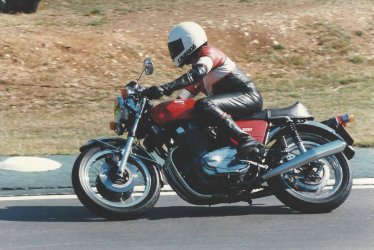
While I agree that, were it my front brake, I would go to far greater lengths to optimise its efficiency, I'm happy both that I've, finally, put the new linings in and that I have some time to get used to the vastly improved back braking ability before letting loose on track, at Brands Hatch, in July, for my first time in many years.

Brands Hatch pics 7.jpg
 
When I converted to left foot brake with its direct activation, it was savage, till the local distributor fitted stronger brake return springs. I never did hear if those brake springs were a Laverda part number and different from the softer springs fitted to suit the crazy 1200mm long right side brake cable my 3c came with. So, pre left side gear change bikes might have a different rear brake springs than right side gear change bikes? It was crazy in the wet; the slightest touch locked it immediately till those stronger springs tamed it down.
 
I’ve seen the cable run on a right side rear brake, Vince. I’m not surprised that it would be difficult to finesse the braking on one.
Mine is, and always was, very progressive.
It now feels like it was when new and, as far as I can tell, as powerful.
I had just gotten used to it being so ineffective and needed to recalibrate my inputs.
 
Your call, take care in the wet. When mine was bad, I had a dual-compound Bridgestone touring tyre on the rear. It was so dicy in the wet with the hard compound long-wearing centre section and that hair trigger brake.
 
I'm very wary of powerful rear brakes, especially on a track. Heavy braking usually (ie always) results in a light rear end, and locking up the rear is not a recommended riding practice! As long as my rear brake works enough at low speed to aid with balance I'm happy.
 
Back
Top