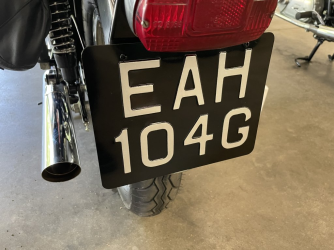
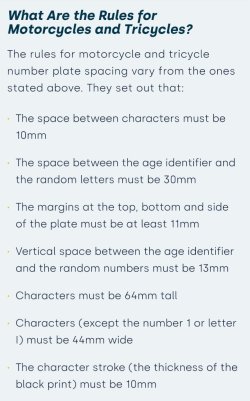
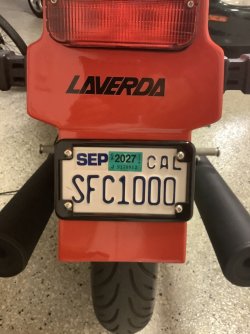
German motorcyclists fought for decades for smaller rego plates. Only with the transition to the newer EU-conformity type of number plate were sizes finally reduced to a more sensible and practical level. The previous type started at around 200mm min. width for bikes (the main grudge, height was not the problem), but this was almost impossible to attain with the available letter/digit combos and averaged at 240-260mm, up to 300mm depending on location. Only when extremely long combos were left over in large municipalities, were shorter combos actively reserved for bike rego. The serial combo actually starts at A-1 and would end at ZZ-9999 with the prefix letters denoting the municipal area/administrative region in which the vehicle is registered. Due to the recent history of the country, certain letter and digit combos are not issued. Of course, minimum distances applied side to side, top to bottom, making XXX-ZZ 9999 seriously huge. The location code could vary between 1-3 letters. If a vehicle was re-registered in another municipality, a new number would be issued and the old put on hold for 6 months before being eligible for re-issue. This made reception of a suitably short combo a question of luck. "Vanity" plates have been available only for a few years (longer if bribes were in play... or you had a friend, wife, girlfriend, husband or neighbours' cousin working at the department) with owners these days being able to search online for available combos. These can be reserved for a very reasonable fee (payable upon registration) for several weeks. The reservation is forfeited if not claimed within that period. With registration data finally being on the road to fully digital, it is now even possible to retain your old plates when moving house, or even retaining the previous plates when buying a bike from outside the area you live. This can save the bike owner up to €20 for the registration process, the administration fee ranges from €20-30-odd. Registration here has become a rather painlessly quick and efficient affair if you simply follow the rules. Digitalisation also ensures no combination is issued twice, something that occurred quite often in the analog days.
Minimum plate width for bikes is now 180mm and the maximum rarely exceeds 220mm these days thanks to a much smaller font size. This also allows more space for the "limited rego" info, TÜV validity sticker and the administration seal, the actual proof of valid rego. Non existant seal → invalid rego! Road tax evasion is another topic all together.
I was rather lucky with my 3C and the old 2-letter, 1-digit combo resulting in 220mm, but the new plate comes in at 180mm and looks far tidier, no longer sticking out like a sore thumb. It also made the formerly mandatory for international travel "D" redundant. Too lazy to peel it off, it'll fall off by itself... eventually.
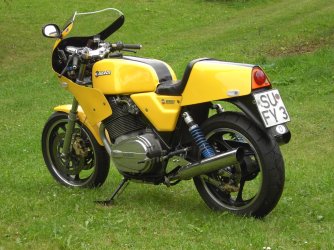
Honey, does my bum look fat in this?

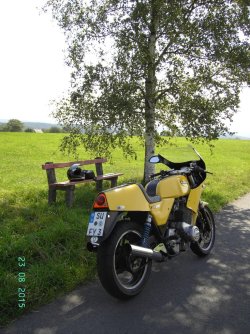
Not any more...

UK used to have really nice silver- or white-on-black plates in an acceptable size, the current yellow plates are just horrid imho. Perhaps if the UK rejoined the EU, lawmakers could be forced to review plate sizes to fall in line with other EU requirements, much to the advantage of brit bikers.
I'd be interested in how
your country handles vehicle registration and their numbers and how the codes break down. I remember in Victoria/Oz the plates being simple serial nos. starting at A-1 to ZZZ-999 with each state having different coloured plates. Dads' old Holden ute had GUN-748. Pretty strange how I can't seem to forget that. Same for my phone no. there...
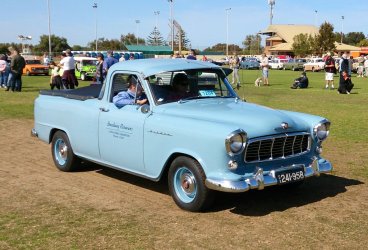 (similar to this, flogged from Wikipedia)
piet