3D Scanning

I find this 3D printing stuff interesting, but, my print capabilities amounts to me cutting a potato in half, cutting in a design, dipping it in paint and printing it out on paper, then I scan it to see how it worked out.

Whereas with 3D, it seems you scan it first???
Chris,

You could almost consider it a photo copy... ;)

3D scanning has been around for quite some time, but truely affordable scanners are fairly new on the market, excellent for replicating existing stuff.

Otherwise, the process is the same as for conventional manufacturing, ie, design, drawing, laying down tool paths... only it doesn't involve buying a chunk of billet alloy or steel, you fill up and switch on the printer and feed it your data, much the same as you'd feed the CNC mill. Another big advantage is that when a printer crashes, it won't cause a high-$ catastrophe like when a CNC mill crashes! Annoying, but it won't drive you into bankruptcy.

piet
 
For a real mind blower check out 3-D resin printing. Light beams flashed into a pool of resin to create the product as opposed to an inkjet printer that uses plastic. This video shows it being used as part of a homemade hydroelectric project to create a very large clear part. The resin is solidified in the tank with light and then cured with a different wavelength in another machine.
 
cool!
some file for this?
Are you referring to an App? On Apple App Store, there are plenty of 3D scanning apps. One to start with could be Scaniverse, it’s free to use with some basic features. I think the leading apps are Polycam and Kiri engine. They require registration and if you want the app with all its features, it is a paid app.

edit: Lidar is included in Iphone 12-17 Pro/Pro Max versions.
 
Last edited:
That will be game changing‼️
Still a bit small at 80x80x100 build size, but it's certainly a start. The first desktop FDM printers weren't any larger, look where they are now!

Hadn't realised the metal powders used were so hazardous, lots of hurdles still to be taken til we can print our new carburettors at home. ;)

piet
 
I have been watching Hustler Minibikes NZ online and they are making aluminium inlet manifolds as well as stainless exhausts and a steering tube with frame stubs with 3D printing. The possibilities are interesting and endless!
 
I have just acquired a basic Creality 3-D scanner, given to me by my son-in-law, who lost patience with it.
Once the winter settles in and I have time to spare (no flying!) I will have a go at it.
The scans as such will not be accurate enough for engineering purposes, so I expect to use them as reference geometry for Autodesk Fusion 360 CAD models.
Once I have figured the workflow out, I will probably buy a proper scanner.
Then print the resulting models using my trusty Prusa MK4S.
I will post some files for all to use one of these days - footrest rubbers, headlamp bracket rubbers etc..
All of which I have printed and are now on my bikes.
 
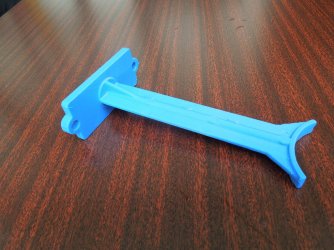
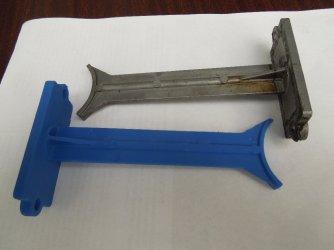
Printed directly from a scan file;
DSCN2054.JPGDSCN2060.JPG
Rough print but dimensionally correct.

Also did the 500/MkII/120° ignition cover but forgot to photograph that before passing it on.

piet
 
Scanning or reverse-engineering a specific part in 3D is not a major challenge nowadays. The real challenge is manufacturing a part with mechanical properties similar to those of the original.

Currently, stainless steel 3D printing offers good mechanical properties and reliability, as do certain plastics (ABS and polyamide are fine; I have no experience with rubber-like materials or similar compounds).

Die-cast aluminium has significantly better mechanical properties than 3D-printed 6061 aluminium.
 
Back
Top