
You are using an out of date browser. It may not display this or other websites correctly.
You should upgrade or use an alternative browser.
You should upgrade or use an alternative browser.
Marzocchi Fork Seals, 1 or 2 seals?
- Thread starter Steve G.
- Start date

martymoose
Hero member
- Location
- Sydney, Australia
One seal with a spacer, to stop it moving. The spacer can be an old seal, with the inside cut out.

Somewhere about 25+ years ago I found the correct size pair of twin lip seals, like you're thinking, just took out the top seal, left in the bottom ones. put in the new ones on top. Still dry as a bone and no stiction issues.That’s what I was thinking, to leave the lower down seal in place, to prevent a single seal
“Walking” up, down, or banked sideways.
Last edited:

henrywillms
Hero member
- Location
- Canada
One seal, no spacer, never moved, never leaked. In past used a spacer but found not needed.


Steve G.
Hero member
Actually, it looks like Wolfgang sent me a much more substantial and much deeper double lip seal , than the twin very thin double seals. I’ve installed one already, quite happy with the firm installation. Actually, much caution was given that very minimal “prying “ should be avoided. I decided to take it to my favourite vintage/classic motorcycle shop locally (Shail’s Motorcycles), where they used a nicely set up slide hammer with a hook to safely remove the seals, and used a perfected seal tap to tap the new one in. I shal rebuild it now, very happy so far.
Now I shall have to make the decision on fork oil viscosity!!! Opening up a can of worms I’m sure!!
Now I shall have to make the decision on fork oil viscosity!!! Opening up a can of worms I’m sure!!

The Sock
Hero member
- Location
- London, England
Now I shall have to make the decision on fork oil viscosity!!! Opening up a can of worms I’m sure!!
Oh! goody, an oil thread!
That'll produce an instant consensus.


Ian Short
Full member
- Location
- Cambridge Ontario
Once your spring rate is correct the oil viscosity plays a fairly minor role, 10W vs 15W, you're not likely to notice a difference. Unless you have done signifcant valving changes and have exceptional feel....... Perhaps your real name is Steve CrevierWell, I’m a big guy, 260ib, so thinking of going up to 15w fork oil
.
Steve G.
Hero member
Well, I do live around 5 miles away from Steve Crevier, but barely 7.5% of his skill. Actually here’s a picture of Steve sitting on my Norton last summer!Once your spring rate is correct the oil viscosity plays a fairly minor role, 10W vs 15W, you're not likely to notice a difference. Unless you have done signifcant valving changes and have exceptional feel....... Perhaps your real name is Steve Crevier


Tippie
Hero member
- Location
- Dr?bak, Norway
1. Springs to suit your weight, measured with sag.
2. Oil to suit the springs.
Too light springs and heavy oil is not the way to go.
2. Oil to suit the springs.
Too light springs and heavy oil is not the way to go.
Steve G.
Hero member
Forks are rebuilt, everything went very well. Now I’m ready to install new fork oil from the top, I’ve loosened the handlebars and the guage/dash unit. Everything is nicely safety taped off, and liberally use of towels to prevent cosmetic issues.
I did some serious digging through the old forum entries on fork oil install from the top. And came across a 2005 thread talking about the top cap, using 12mm hex to remove, and notably, the tiny slotted screw down below that, very interestingly acts as an air vent for fork movement! This forum has great info!!!
I’ll be making sure these are especially clean !!
Marzocchi fork caps | LaverdaForum
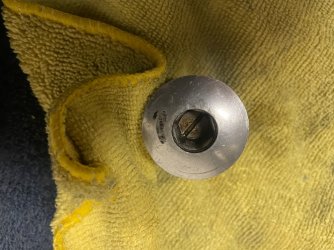
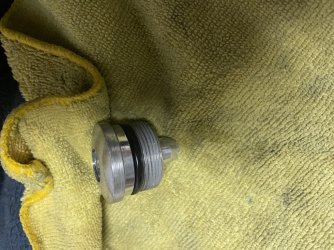
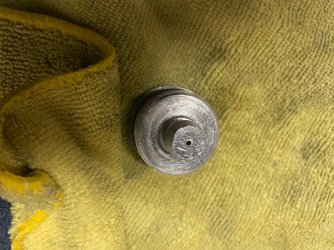
Steve G.
Hero member
Ok, im
Learning more. There is a one way valve and spring in the main cap.
Marzocchi top cap | LaverdaForum
Learning more. There is a one way valve and spring in the main cap.
Marzocchi top cap | LaverdaForum

Garbrand
Full member
- Location
- Eelde, Netherlands
Hi All,
Marzocchi top nuts have a central screw in them (slotted head). Below the screw is a very small hole, leading to the fork chamber.
Is there a hidden the purpose for this screw? I can only imagine that it is used to relieve pressure/vacuum and thus control the volume of air in the air-spring. Thus offering a bit of tunability for the air spring. You could even create a low pressure situation to prevent top out bumps by loosening then tightening the screw when the forks were compressed a bit.
Any further thoughts on the reason the screw is there?
- paul-haggis
- Replies: 20
- Forum: Breganze Technical

piranha-bro2
Hero member
- Location
- Melbourne
Most 'modern' forks employ the air gap as a way of creating extra spring tension under compression, probably aiding in bottom-out prevention. The Marzo and Ceri valves do the complete opposite - they exhaust air as the forks use up their max available travel . Probably saves on fork seal replacement by eliminating the extra pressure created by a 'closed' system, but the concept of an air gap is not relevant in any way with that valving system. Yes, they probably aid in top-out prevention.

Dellortoman
Hero member
- Location
- Tasmania, Australia
How does that work Quentin? They're not valves in my Jota's Marzocchi forks. They're just countersunk plugs with an O-ring seal, so they can't exhaust air during operation. It's only a M6 (or M5?) thread in the fork cap so I doubt any kind of valve would fit in there. My bike originally left the factory in 1976 with Ceriani forks. The Marzocchis were fitted by the previous owner circa 1978. Maybe there are other versions of the forks that have pressure relief valves, but I can't think of any useful purpose for such a device.
I have later 38mm Marzocchis on my 1985 Ducati MHR Mille, and they have Schrader valves for pre-pressurising. The specified pressure according to the manual is only something like 4psi (don't quote me on that - I'm relying on dodgy memory). I dunno how you'd actually go about pumping them up to 4psi though. I reckon you'd need a special hand pump with a gauge fitted. There's only a small air volume inside the fork so a compressor would over-inflate them in an instant. Maybe half a stroke of a bike pump would do it, but then how do you measure the pressure? If you stick a pressure gauge on the valve, it would let most of the air out just taking a reading. So I've never bothered with pressurising them. I don't reckon 4psi would make any difference to suspension performance anyway. I suspect the purpose of having some positive internal pressure is simply to avoid having a negative pressure that could suck dust in past the seals. All I've ever done is press the valve stems occasionally to release any built-up pressure (or vacuum) so that both fork legs are at the same pressure.
I have later 38mm Marzocchis on my 1985 Ducati MHR Mille, and they have Schrader valves for pre-pressurising. The specified pressure according to the manual is only something like 4psi (don't quote me on that - I'm relying on dodgy memory). I dunno how you'd actually go about pumping them up to 4psi though. I reckon you'd need a special hand pump with a gauge fitted. There's only a small air volume inside the fork so a compressor would over-inflate them in an instant. Maybe half a stroke of a bike pump would do it, but then how do you measure the pressure? If you stick a pressure gauge on the valve, it would let most of the air out just taking a reading. So I've never bothered with pressurising them. I don't reckon 4psi would make any difference to suspension performance anyway. I suspect the purpose of having some positive internal pressure is simply to avoid having a negative pressure that could suck dust in past the seals. All I've ever done is press the valve stems occasionally to release any built-up pressure (or vacuum) so that both fork legs are at the same pressure.