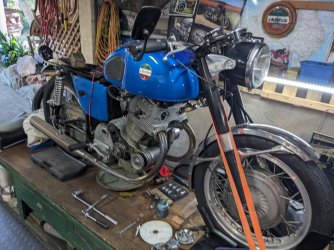
1968 750 GT ignition

martymoose

Hero member
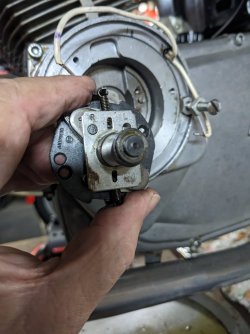
Hi guys, back to the GT that has been on my bench for a couple of years now. The ignition timing is roughly 10 degrees advanced, instead of turning the light on at TDC. This is with the points plate turned to the end of the slot. With the plate on the mark it's more like 20 degrees. Before I pull the primary cover to check the timing marks, the bob weight assembly has 2 settings by the looks of it, marked R and L. The assembly is set up on R, is this correct?

Cheers
Marty
 

Attachments

  • PXL_20241228_021901876.jpg
    PXL_20241228_021901876.jpg
    110.6 KB · Views: 27
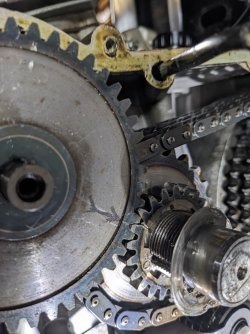
This is what I reckon it should be, if you look closely that line on the crank gear is angled, someone with a cold chisel? I will assemble loosely tomorrow and see if I have points adjustment. Beer o'clock now.
 

Attachments

  • PXL_20241228_062249253.jpg
    PXL_20241228_062249253.jpg
    176 KB · Views: 39
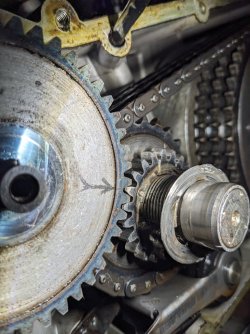
There are no reference marks on either the advance mechanism or the points plate. The advance as you can see can only fit one way. The 0 on the drive sprocket is not a timing reference afaik, pretty sure it to indicate fitting for meshing of components. The older models have fewer teeth on the ignition/oil pump drive and may have different markings, but on all the later ones I know there is a very faint etching on the smaller drive gear that can match the arrow on the larger driven one (there can also be matching punch mark dimples on the crank and the drive gear). At TDC the keyway on the oil pump drive shaft that the ignition mounts onto should face directly vertical. Regardless of that, if you have what seems like one tooth too advanced (with the points gap set correctly) you can retard it a tooth by simply pulling out the small gear and rotating the driven gear one tooth anticlockwise (so it opens the points later) regardless of where the marks are, as those marks are not always easy to make sense of.
 
Last edited:
  • Like
Reactions: IAG
Marty,

The "o" on the crank gear should correspond with one of the crank splines that has a similar marking. The crank gear should have an etched arrow, this is, as Tippie has stated, often very faint and difficult to see. The arrow should align with the arrow on the pump gear. Once all this lines up, you should also see the single punch mark on the pump gear at close to 12 o'clock.

EDIT!!

The stamped "o" is indeed a calibration marking, anything from "-10" to "15" can be found! An "o" etching may be found ON THE OTHER SIDE of the gear! The arrow will also be on that side. The calibration mark was fitted ex-factory towards the engine centre and not visible once fitted.

Took a bit for this to dawn, sorry. Working with the wrong side of the gear makes it all a bit confusing.

As somebody has been in there before, do check the gear mesh between the 2 gears. There should be the slightest amount of play felt at the pump gear. If no play is felt, the crank gear should be swapped for one with a lower/higher number (don't remember which way to go in the case of "o", sorry). Same applies for too much slack. With too little/no play, the gears will emit a horrendous scraping noise with the engine running!

piet
 
Last edited:
  • Like
Reactions: IAG
and it was only the very evry early ones that had the slower oil pump gearing, probably none later than 1969
CLEM
 
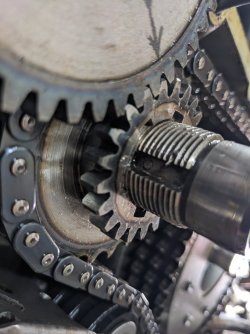
Gears are 22/44. Found the corresponding 0 which puts the marks out but keyway on the oil pump gear now at 12 o'clock which gives me correct adjustment with points opening at TDC. Hard to measure but backlash on the gears feels ok.
 

Attachments

  • PXL_20241229_003143941.jpg
    PXL_20241229_003143941.jpg
    122 KB · Views: 25
Back
Top