750 SF2 piston and cylinder wear

TeddyG

Hero member
Location
Portland Oregon
Greetings once again,

This posting ties into my earlier post about leak down test procedure (which Ive figure out). The leak down test showed no hissing anywhere and the compression was 160/150.
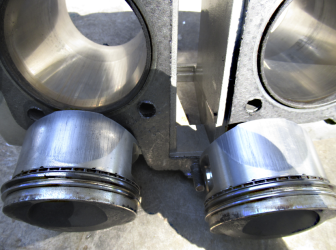
After seeing wear marks on the cylinder walls w/ a boroscope and getting a few opinions (including here), I took the top end apart and see excessive wear on the Ross Racing forged pistons and the cylinder walls, with the wear primarily on the intake sides of the pistons and cylinders. The bike came to me w/ 15,000 miles and was running poorly. I had the cylinders rebored to .5 over pistons by a local mechanic that 3 local Laverda owners recommended. I've ridden the bike @ 1600 miles since the rebuild, changed the oil at the 300 mile break in, and again after 1300 miles using 20/50 mineral oil. A fingernail can catch on some of the scratches. So far, the mechanic feels the problem might be a faulty oil pump or crank not delivering enough oil. For now I'm giving the mechanic the benefit of the doubt, but what say you engine builders? Taking the bottom end apart is less than appealing, and I don't know of any other local reputable vintage bike mechanics. I have the Green Book and will see if the oil pump is accessible for testing.

Thank you
 

Attachments

  • wear.png
    wear.png
    1 MB · Views: 48
The pics seem to reinforce my theory that you might be suffering oil starvation up into the cylinders - and your mechanic has correctly picked up on this. If those pics are as it was on dismantling (ie no cleaning), it looks VERY dry, possibly confirming the starvation theory. So one positive is that he's highly likely to be worthy of his reputation! I'm not sufficiently versed in determining oil as the culprit, but maybe others more knowledgeable can chime in.

Assuming a lubrication issue, potential reasons could be crank oil slingers full of 'silt' and blocking the oil holes in the crank pins that feed through the big ends and exit to feed the underside pistons and cylinders. One of the downsides of purchasing any used bike is you don't always get its true history. 15,000 miles and requiring a rebore sounds crazy, so either the mileage is a lot higher or there was an oil issue already.

I rebuilt an SF motor on which someone had done a beautiful job of line-boring the middle main bearing journals and sleeving them, inadvertently completely closing over the oil feed from those journals into the slingers. The owner had a major engine failure and one of the rods was bent beyond a right angle and the piston completely destroyed ... it may have started with a big end seizure or a piston seizure or a combo of both, but lack of oil was 100% the cause. Personally I think an oil pump would have to be totally ratted to be the culprit here - your cams and rockers would dud out long before your crank/pistons.

So the next question is: how do you check oil flow to the slingers and beyond (without pulling the crank)? As an aside, your woes might explain why you have mentioned a few times that 'these motors are noisy'! On a crisp motor, the only noise I hear is chains whirring. I feel for you - you've done everything right with this motor and obviously spent quite a few pennies. If you can sort this, I'm sure you'll be very impressed with the 'new' version.
 
Sad tale, but it's happened before; I remember reading about a famous member here who had, I think, 3 rebuilds on a twin before finding its root cause. It take emence intestanal fortitude to break through similar issues; guess how I know.
 
Not discounting the oil issue at all. but are the carburetors set properly, ie. if running too rich the excess petrol will wash down the bore walls on the carby side of the bore. Are the chokes closing off correctly?. Are the floats sealing off at the correct height?. What I all ways do when stopping the bike is to turn off the petrol taps and run the engine untill the carbs empty.
Just saying.
 
Thank you all!
When I received the bike w 15K miles it barely held an idle and needed lots of mechanical work. The carbs were completely rebuilt w/ new slides, cables, choke plungers, all new internal parts, float height checked, synched, K&N air pods, new gas spigots and inline filters. The b8es plugs burnt clean after several plug checks and I always turned off the gas spigots after riding or temporarily parking the bike. But the bike was running a bit rich which I thought better than too lean. There is some carbon build up on the pistons and they appear clean in the photos since I wiped them down to examine them. The idea of gas washing down the bores along the carbs makes total sense.
The cams and followers were coated with oil and no signs of heat discoloration, which counters the oil starvation theory.
I immediately changed the oil that was totally black and cleaned the screen- I wanted to rinse it out w kerosene but was told not to do that.
I now have to get the piston to cylinder clearance verified that should be 0.003" for the forged Ross pistons.
Unfortunately I don't know of another local reputable vintage bike mechanic to help me sort this out and determine the cause of all this, but thank you again
 
The cams and followers were coated with oil and no signs of heat discoloration, which counters the oil starvation theory.
I immediately changed the oil that was totally black and cleaned the screen- I wanted to rinse it out w kerosene but was told not to do that.
It doesn't discount the oil starvation theory at all. The feed to the head and the cams is totally separate from the feed to the slingers/big ends/cylinders. It may be that oil isn't the issue, but don't discount it because there is oil up top.

Did you wipe oil away from the bores and pistons before taking the pics or is that the way they came out?
 
Thanks guys,

To better see the damage I wiped off the oil on the pistons and cylinders before taking the pictures, but there was oil on them when I removed them.
The rings were new and gapped by the machinist who had the Green Book and I’m assuming he also followed the Green Book clearance specs, although I need to find someone else to check the measurements since I don’t own the measuring calipers. He was also aware of the forged pistons expansion. The thin bottom ring is delicate but doesn’t appear to be broken.

So it appears to be either oil starvation, excess gas from carbs, or incorrect bore or ring gap.

Stupid question but are there replacement cylinder sleeves available- the original pistons are in good shape and could be re- used.
 
Thanks guys,

To better see the damage I wiped off the oil on the pistons and cylinders before taking the pictures, but there was oil on them when I removed them.
The rings were new and gapped by the machinist who had the Green Book and I’m assuming he also followed the Green Book clearance specs, although I need to find someone else to check the measurements since I don’t own the measuring calipers. He was also aware of the forged pistons expansion. The thin bottom ring is delicate but doesn’t appear to be broken.

So it appears to be either oil starvation, excess gas from carbs, or incorrect bore or ring gap.

Stupid question but are there replacement cylinder sleeves available- the original pistons are in good shape and could be re- used.
It's the middle ring on the lh piston that appears cracked.
Petrol washing the cylinders won't be responsible for that kind of damage.
Cylinder liners are available or can be made by a competent machinist.
Forget the green book clearances which might be way too loose for modern pistons.
One must presume that the boring and honing were properly done as in "straight down the bore" and that the liners are properly seated?
Paul
 
Back
Top