Advice for race exhaust end cans

Maitland

Senior member
Hi all,

Getting around to silencing the bike for next years track outings and was wondering what experience others might have had in this area with a triple.

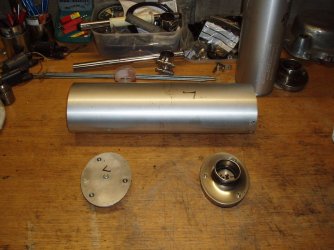
I have a pair of gutted Ducati end cans, the maximum outlet is 48 mm using the original end plates. 1 5/8" - 41 mm link pipes from the collector to the cans, then into perforated tube through the cans and out the other end.

The options for perforated tube are (I'll use metric, I can no longer get my head around or visualise imperial) to continue at 41 mm, or expand to 44 mm or further to 48 mm. The bigger the exit does not necessarily mean more noise, Simon has something like 70 mm on his Yam and hasn't broken 100 dB yet. Does any one have any idea what effect smaller or larger diameter in the end can might have on performance?

Noise, or rather the lack of it is the priority, performance is nice but no good if I can't race. 

Maitland.
 

Attachments

  • XS650.jpg
    XS650.jpg
    99.5 KB · Views: 37
  • End can 1.jpg
    End can 1.jpg
    80.2 KB · Views: 23
From what I know (and that is very little I must say), the diameter at the end does not affect performance dramatically, it is more the question of the overall setup of the exhaust. First of all you need to remove as much resistance as possible by smoothing any curve or joint out as much as possible. Second, an ideal exhaust is designed to a point where the gas-flow of one downpipe leads first to a vacuum in the other pipes and ideally, during the filling of the cylinder, makes the gasflow to build up a slight resistance so that cylinder almost gets filled from two sides if you will. This supports gas-exchanges, give more filling and higher compression which leads to more power. For that you need:
-the right length of downpipes
-smooth joints of the 3 exhausts at the right place
-a tapper that makes the gas expand and causes ideally an underpressure (or at least a reduction of pressure)
-large exhaust cans that have enough volume for the hot gas to expand
-end diameter that allows the gas to find the way into atmosphere without to much resistance

Noise reduction is a constructive element INSIDE the cans, not so much of the back-plate (except for those cans that do not have a noise reduction construction inside - such as the Jota cans or the 3-1 megaphone). Basically there are two different ways to cut down noise, one is damping material (absorption - all "open exhausts" use this method, like Termignoni, etc.) and the other one is using a plate in the way of the gas flow which causes the gas to find a different way through holes and brake the noise that way (reflection - mostly used on cars today and some bikes; 1000 SFC f.e. had reflection exhaust cans). Typically the absorbtion type of exhausts are used for performance bikes. For making them road-legal, a "dB-eater" is used, basically a Helmholz tube that causes the sonic waves to be reflected at the back-plate, turn their direction 180? and build up a "contra-wave" if you will, which has ideally an amplitude 100% opposite of the waves that are on their way to the backplate. Basically a mixed design of absorption and reflection.

A cone-formed backplate was often used also to build a kind of interims solution between open exhaust and reflection. I was told that f.e. the factory experimented with different lengths of cones on their 3-1 exhaust and found several HP and NM by changing to a little longer cone with a little less than 45?. Wonder why they changed to a shorter one (over the longer one of the SF1) on the SF2 though, maybe for noise reasons...

Hope I do not get beaten up from the experts for being to far from truth, but that's how I learned the little I hope to know.

HTH
 
Thanks for that Lothar, gone are the days when my brother and I played with Ducati singles and 250, 305, 350 Honda CB 72 / 77s. Dad would thumb through his Phil Irving 'Tuning for speed' and calculate the optimum length for us. So much simpler with single pipes.

Scouting around the web hasn't helped that much, too many variables make things too complicated, so I'll go for the largest bore, easier to reduce than enlarge.

Maitland.  

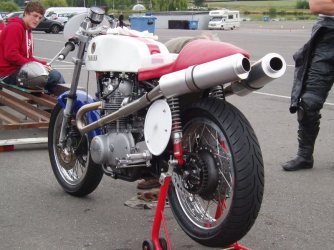
Just for the hell of it, a picture from Mallory test (out for a thrash) day :D Dad and Simon.
 

Attachments

  • Mallory2011.jpg
    Mallory2011.jpg
    102.6 KB · Views: 49
Hi Maitland - I used to use almost any sort of megaphone or modified silencer with all the baffles removed - the outlet was always in the region of 38mm, but the main part is to have a good length of secondary pipe that's not less than 50mm diameter. The photo is of my post classic 1200 racer - silencer is an old suzuki thing a friend gave me - never liked to overspend! Always passed scrutineering - mind you that was in1999 - Regards - Phil
 

Attachments

  • racercol3,.jpg
    racercol3,.jpg
    101 KB · Views: 72
you wouldn't guess how much of an exhaust design is try and error, even at professional companies. They have their standard diameters, lengths etc. and test a lot. Experience builds up and shortens the test cycles over time, but still, without at least 4-5 tries, you won't get to the optimum. Especially not on a multi-cylinder engine where two or more pipes are joined together. To many variables...
 
THanks Phil,

Like the exhaust Phil, cheep and cheerful, thats me all over :D Recon I'll go for 48 mm and work from there, easier to reduce the bore than expand.

There is a GSX 1100 in the CRMC superbike class with everything on it I fancy having a go at, though a lack of horses and skill may be a problem :D. Don't happen to have a spare frame and tank to help the cause do you?  :D ;)  

I have been talking to Phil Joy about cams and he is suggesting a profile sightly milder than the C4 for our twisty circuits. personally I prefer fun and lunacy, so cams might end up a little wilder than he suggests :D

Cheers,

Maitland.  

Just for the hell of it, a picture of a nice GS.
 

Attachments

  • GS1100.jpg
    GS1100.jpg
    74.6 KB · Views: 59
Thanks Geoff, I'm not so sure now as it only manages a three star rating. I read it can be difficult finding replacement visors, when / if you do they can be as much as ?85.00 :o

sharp.direct.gov.uk/testsratings/roof-r010-daytona

Site should be useful to anyone shopping for a new helmet.

Maitland.
 
Hi Maitland

thanks for that helmet rating link. I have book marked it for future use.

Bloody hell, my supposed top of the line Arai Quantum purchased two seasons ago only got a three star rating due to poorer side impact ratings, and my supposed top of the line Shoei 1100 got a five star rating but did not get top ratings in all categories.... :o

reading the rating system, the difference between the best helmets is that they allow up to a maximum of 275 g's to your brain, while the worst rated helmets allow in excess of 500 g's through to your brain. Scary stuff.

also, oddly enough, the very very top rated helmets from the point of view of allowing the least amount of force through to your brain, and there are not very many of them, are not high priced helmets, they are inexpensive helmets like the Shark RSX, HJC HQ1, the Nitro Aikido (at only 70 GBP), the Caberg Trip, and three of the Bell Helmet line which are slightly higher priced.

Paul LeClair
 
I agree Paul,

Real bummer to find you've (generally, not you specifically Paul) spent 500 quid on a helmet only find out it aint worth 70 safety wise  ??? >:(
   
What are the companies making helmets thinking? Surely they have test rigs of their own to check the helmets performance. Makes me think maybe they figure shaving 40g to claim a lighter helmet is more important than protection.

Anyway, my shark got a 4 star rating, dropped to yellow on side impact and cost ?90.00 from our local bike shop in the sales :D :D Good for next season by which time it will be three and a bit years old and time for a new one.

Maitland.
 
Hi Maitland,

On Phils bike you can quite a long length of outlet pipe comong from the can. This is a good thing. Within reason - the longer the better. It tidies up the gas flow before it leaves, and thus reduces turbulent 'gas rush' noise.

Gas-rush noise can be a significant contibutor to overall dB(A) levels. So make sure all your internal pipe ends are neat and also ensure you have no pipes (or raw edges) 'facing' the gas flow. This is espcially true near the rear end of the can.

Paul H
 
Ah, exhaust, got sidetracked for a while there. I ordered the tubing today, hopefully it will arrive in the next couple of days, will give me some thing to play with next week as I'm off work.

Thanks Paul.

Maitland.
 
The anti dive works well -  also it means the forks can be shorter without the mudguard hitting centre exhaust pipe under severe braking - ground clearance on a Saxon/Motodd is much more than std Laverda so not too much of a problem either - Regards - Phil
 
Back
Top