Bosch Magnetic Pickups

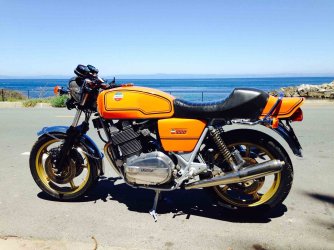
I've spent the last 18 months dismantling and remantling a 77 Jota (thanks I know it shouldn't be orange, but I like orange). It was cosmetically rough and didn't run. Now, I like the look of it, and more importantly have got it running after about a 5 year rest with the previous owner. I have upgraded to an electronic ignition (DMC2) and new charging coil. I have had problems starting the bike and when it runs it runs well, then rough then well again. I have chased absent, sparks and weak sparks throughout the ignition system. One problem transpired to be a new but duff sparkplug. Anyways my favourite candidate for causing the problem are the magnetic pickups. The wires to both had their insulation crumbling to dust and the copper wires are a little frayed and tired looking. I folded the metal reteining tangs back to examine as much of the wire as possible and note that when I reposition the wires, the sparks can be made to be big and fat and in other positions they are weak miserly tired things. In other positions the spark is gone. I have tried using liquid insulating material on the wires with no improvement (why the fuck they put the wires to and from the detector do close, I will never know, it invites shorting) So my question to you fellow Laverdistas is.. has anyone successfully renewed the magnetic detectors, or am I doomed to replace the entire unit (which looks like about a $500 enterprise)
 
Richard,

The early type pick-ups are almost indestructable, you'll have to drive a tank over them.  Renew the wires completly and they should be OK for a further 3 decades.  The insulation crumbles for quite a length within the sheathing due to the heat it is exposed to, rather common to have the wires shorting here as well as around the pick-ups.  Make sure you get the polarity correct, otherwise it will be impossible to time the ignition correctly.

To replace the pick-ups you'll have to dissolve them from the potting and rewind them yourself, they are an integral part of the alternator stator plate and were never meant to be replaced... or last as long as they did!

piet
 
Great looking bike, well done Richard! As you know there are many ignition/alternator upgrade options available-I installed a Sachse-Redax system 20 mos ago (Red now sells an improved system) which replaces existing ignition/charging system wiring. Not to take liberties w/ your pocketbook, but installing a system on a high caliber bike like yours is value added as well as more reliable IMO.
 
Richard,
As our Series 1 ignition system upgrade does away with everything that came from the Bosch factory it just happens that I have a very large box full of the original Bosch systems.
Send me your postal details and we will send you a decent replacement for a minimal sum.

HTH

 
Guys thanks for the input. This PM I took the risk of burrowing into the plastic/ rubber of one pickup to see if I could excavate some solder points from where I might rewire the pickups, the process of removing the insulation and chasing the wires into the depths totally screwed the fragile windings of the pickup. I came back in the house ready to be polite to the Mrs (I told her naively, I had done spending) and to open the fridge door, then saw Red's message which has cheered me up no end. A PM will be on its way lickety spit. THANKS !!!!!!!!!


Attachments

  • photo-61.jpg
    photo-61.jpg
    147.6 KB · Views: 87
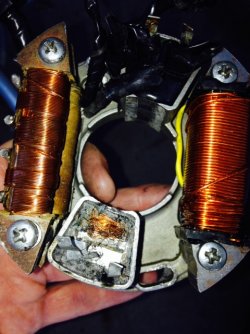
Hey Richard, here's some info you didn't ask for. But now that you've shown us your stator, it appears to be information you need.

If you're running a Witt intion, you don't need those two piggy-back coils on the left side in your photo. One of which was used to power the old ignition, the other is a crude voltage reulator.

Running an aftermarket ignition puts a significant additional load on your charging system because it's powered from the 12V system rather than the dedicated alternator coil. That means the (marginal) charging system will struggle if you use your headlight regularly, so you really need to boost its output.

So chuck the double coil in the bin and fit another charging coil like the one on the right (in your photo), which will double the output of your alternator. It's a simple bolt-on modification. If you get Red to send you a stator plate with a charging coil on it, you can use the coil you already have on the other side. You will also need to fit a regulator/rectifier if your bike doesn't already have one, which is unlikely if you're running the original charging system. The original little black box that the alternator wires go to is just a rectifier, with no regulation function.

As for which regulator/rectifier to choose, most of us use a Shindengen 530-12, but there's no particular reason to use that one, other than they are fairly common because they were used on a lot of Jap bikes. Any regulator will do as long as it's rated for about 25A. 3-phase or single phase, it doesn't really make any difference.

If you use a 3 phase R/R, just connect each of the alternator coils separately to two of the phases on the R/R (leave the 3rd phase inactive).

You can use a single phase R/R if you want to, or if you happen to have one lying around (eg. a Ducati R/R).  The stator coils are located 180 deg apart on the stator plate. So you might expect them to be 180 deg out of phase. But they re actually synchronised in phase because there are 4 permanent magnets in the rotor, so each coil has a magnet passing it at the same time. If you use a single phase R/R, wire the alternator coils to the R/R in parallel with the yellow and yellow/black wires matched up.

The R/R will replace the old rectifier, so the charging feed to the battery, and earth connections use the same wires. I's a dead simple job even for the electrically challenged :)

Some R/Rs have an additional wire (I think it's brown on the SH530) which is a voltage sensing wire. The reason for that is so you can wire it into the system on the on the switched side of the ignition switch so the R/R measures system voltage there rather than at the battery. That way the R/R will adjust its output to take account of (some) voltage losses in the wiring harness.

Cheers,
Cam
 
the unit we are about to post Richard is one of the later BTZ systems which already has the 2 x charging coils on it

good advice though on the regulator, forgot that bit, he may need to change his unit

but in his first post below he states he upgraded the Bosch plate with a new charging coil ?
which charging coil did you change out Richard ?

 
Richard K said:
Again thanks for ALL advice. The coil on the right is the new one. The one pn the left is original

That's not an upgrade, it's just a coil replacement. You should have put the new (upgrade) coil where the double coils are.

If you still have the old (single) charging coil that you removed, and Red is sending you 2 more, then you're going to have an abundance of charging coils. You might be able to find homes for the spare ones on the forum if anyone is converting from the old Bosch HKZ ignition to Witt DMC.
 
Dellortoman said:
That's not an upgrade, it's just a coil replacement. You should have put the new (upgrade) coil where the double coils are.

If you still have the old (single) charging coil that you removed, and Red is sending you 2 more, then you're going to have an abundance of charging coils. You might be able to find homes for the spare ones on the forum if anyone is converting from the old Bosch HKZ ignition to Witt DMC.

Additional charging coils are supplied with CDI replacement DMC II systems.  This, and the supplied ignition coils, is what makes them more expensive than the systems for the Mk II engines.

piet
 
Back
Top