hi all, 1971 sf 750 clutch problem, any pointers would be appreciated, used bike 2 months ago all worked ok , went to use bike a week ago lever resistance felt as per normal but clutch would not release, so I coasted down a slope with motor running to engage gear which worked ok, but even with the clutch lever pulled in clutch was hanging on, I rode for about 2 km giving it a work out to hopefully free up with no improvement, tried adjusting at clutch lever but no improvement, thanks brian

You are using an out of date browser. It may not display this or other websites correctly.
You should upgrade or use an alternative browser.
You should upgrade or use an alternative browser.
clutch not releasing
- Thread starter laverda74
- Start date

Laverdalothar
Hero member
- Location
- Germany
Brian, 2km does not warm the engine up enough to free the clutch. The oil needs about 20 km or so to get to standard temperature.
You can follow the brutal way some may suggest you or simply use some engine-cleaner to free it up and exchange the oil with good ones, known to avoid the clutch sticking (Motul 20W50 mineral f.e.). Louis has some procycle Oil system cleaner that I used. It took a while though still and also needs the engine to be at working temperature already to free it up. If you can start and drive the bike around without clutch, you should
-warm the engine up properly (at least 10 - 15km)
-add the additive
-ride again with the bike, pulling the clutch, opening the throttle and braking with the rear-brake so that you make the engine pull on the clutch, that is hold back a bit by the brake. It should free up within 5-10 Minutes. Now go back and exchange the oil to Motul or similar good quality oil.
cheers

Dellortoman
Hero member
- Location
- Tasmania, Australia
Replace the clutch plates with Red's Kevlar ones. He does an exchange service for a very reasonable price. You'll never have a sticking clutch again.
hi all, the oil is 10/40 silkaline super 4, it wouldn't have done 300 km, I can start bike on the stand in gear , when clutch pulled in and foot on rear brake can stop the rear wheel but there is a lot of drag, don't believe it is clutch plates , I think the mechanism has lost some of its leverage , like I said lever feels exactly the same pressure, the lever by the front sprocket has free play, do these bikes have problems with the actuating push rod falling apart or something similar, just looking again the lever by the front sprocket is running out of travel when clutch lever pulled in so I believe the problem is the push rod loosing some of its length does this make sense?? thanks brian

helicopterjim
Hero member
- Location
- near Lone Butte, BC, Canada
laverda74 said:it wouldn't have done 300 km, I can start bike on the stand in gear , when clutch pulled in and foot on rear brake can stop the rear wheel but there is a lot of drag, don't believe it is clutch plates
Ride it for half an hour and see how it is then ...... when it is warmed up fully, pull the clutch in and rev the motor a bit.
Don't assume it is anything else until you have done this .....

Laverda SF
Hero member
Pull the Clutch Disc's and burn them with a Torch, Wash them with Lacquer thinner then heat them in your wife's oven. Scuff them a little with coarse sand paper. Change the Oil to a Dino 15/405w Diesel Oil - No Synth Oil.
Your Oil choice fucked it up!
Use something like Rotella, DelVac or AC Delco 15w40 - If want to spend more try Valvoline 20w50 VR1.
Never have had to replace the Clutch Disc's or the Clutch Springs on my SF in over 40 years considering it's a Wet Clutch.
Your Oil choice fucked it up!
Use something like Rotella, DelVac or AC Delco 15w40 - If want to spend more try Valvoline 20w50 VR1.
Never have had to replace the Clutch Disc's or the Clutch Springs on my SF in over 40 years considering it's a Wet Clutch.
Dellortoman
Hero member
- Location
- Tasmania, Australia
laverda74 said:I can start bike on the stand in gear , when clutch pulled in and foot on rear brake can stop the rear wheel but there is a lot of drag, don't believe it is clutch plates
OK, so your clutch is not sticking, it's dragging. Not fully disengaging.
I'm familiar with the mechanism in the triples, and as far as I know they're pretty much identical to the 750 twins.
Yes, the pushrod assembly can self shorten in a couple of ways.
There are a couple of bearing balls to separate the pushrod elements so as to allow the clutch end to spin while the lever end doesn't. These balls can collapse or overheat and melt into the ends of the pushrods. The pushrod ends can wear too.
There's also a square bar inside the clutch itself. This bar transfers the movement of the pushrod to the clutch pack. It's a little beam that straddles across the centre of the clutch, perpendicular to the pushrod. The pushrod bears against its centre, putting it in a bending load situation. If the bearing balls have failed and the toggle bar rotates against the pushrod, the rod will bore into the bar until it is weakened so much that it bends when you pull the lever.
You need to pull the clutch apart, poke out the pushrods and balls to see if they're OK, and check the little square bar. Replace anything that looks dodgy. If it all looks serviceable, then perhaps your friction plates are a wee bit too thick for the length of your pushrods. There's no adjustment to take up any slack at the clutch actuator in the right side gearbox cover (bit of a design flaw in my opinion) so you need to fix it with longer pushrods or a shim to go between the little square bar and the clutch pressure plate. I used the latter method with mine and it works fine.
Laverda SF
Hero member
Sticking Clutch Vs a Dragging Clutch - Right On Dellorto: Maybe the last guy that owned the bike lost the MARBLE in the Tranny Case Clutch Servo Rod.
Could be as simple as a Stretched Clutch Cable witch is about to break off at the Bar Lever.
Could be as simple as a Stretched Clutch Cable witch is about to break off at the Bar Lever.

laverda74 said:hi all, the oil is 10/40 silkaline super 4, it wouldn't have done 300 km, I can start bike on the stand in gear , when clutch pulled in and foot on rear brake can stop the rear wheel but there is a lot of drag, don't believe it is clutch plates , I think the mechanism has lost some of its leverage , like I said lever feels exactly the same pressure, the lever by the front sprocket has free play, do these bikes have problems with the actuating push rod falling apart or something similar, just looking again the lever by the front sprocket is running out of travel when clutch lever pulled in so I believe the problem is the push rod loosing some of its length does this make sense?? thanks brian
Don't know where on the planet you are located, 10/40 oil may be OK in a mostly cold/mild climate like Alaska or Siberia, but generally, these bikes require 20/50 mineral oil of a decent quality.
From your description, it seems your clutch actuation has lost most of its mechanical lever advantage. Either you have an issue with the throw-out components that Cam described, the clutch plate pack is too thick or the cable/lever assembly wrong/worn or damaged in some manner.
Generally, the clutch actuation on Laverdas is quite reliable, just doesn't stand up well to too much abuse. Wear on the individual components adds up to a lot of slop which can make things a bit dodgy.
piet
Laverdalothar
Hero member
- Location
- Germany
can't see how this mechanical wear can happen when the bike operated normally when you parked it and 2 weeks later this fault apears, but hey - who knows...
If it is a mechanical collapse of the ball-bearings or the push rods, it is as said before easy to repair by just exchanging the damaged components. The route cause is mostly people keeping the clutch lever pulled and first gear engaged at the traffic lights or pulling the lever at high speeds and not shifting down but just breaking. It also happens very often (at least with the hydraulic clutch) on an acceleration type dyno when you pull the clutch at the top revs and keep it pulled to measure resistance. This causes the components to be operating at two different speeds if you do not keep the engine speed up but simply let the revs drop. Backwheel still spins at high speed, engine goes down to 1.000revs roughly and pushrods/balls in between heat up and weld together...
So - First thing i would do is take the shifter and the clutch cover off carefully (make sure you do that in neutral for easier assembly afterwards), pull out the outer pushrod carefully and see if on one end you see a ball melted/welded to the push rod. If not there is no way avoiding to open the primary cover, removing the primary chain and taking the clutch off to see if the little push bar has the wear described above. Good thing is, while you are at it you can replace the clutch plates, too, as recommended here (make sure you take a note which sequence the clutch and steel plates had...).
Don't replace the push-rods with the wrong materials, please!!! I have tried it once and it will wear faster than you could think of! I think the right material is called "silver steel". after cutting it to the right length and machining the edges a bit, you should heat-harden the ends... Or you simply buy the right components from OCT, Haerter, Wagner or who ever is closer to you. put a lot of oil on it before re-installing. IIRC, they get oiled by the a hole in the mainshaft of the gearbox once the engine turns.
Make also sure you use the right oil (20w50 mineral) as said before. It needs to be one that is designed for Motorcycles as engine oil does not need to cope with the forces in a gearbox. Motobike oil does...
good luck!!

Tippie
Hero member
- Location
- Dr?bak, Norway
How old and worn is the cable, as has been mentioned? Start at the top and work down. You could see if levering the actuating lever at the selector cover gives better release of the plates, seeing how far it can travel before bottoming out should tell if balls or ends of the rods are squashed. Open up the clutch if you end up at the bottom and nothing has helped. Sitting for two weeks should not suddenly f@ck your clutch, and thinner oil causing clutch drag (?!), I doubt it.

tom3c75
Hero member
- Location
- Cape Town South Africa
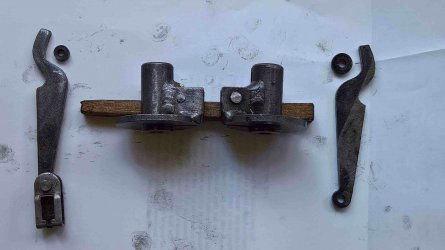
I've had a clutch disengagement problem on my 3C when the small wheel on which the clutch cable arm in the gearbox cover pivots, wore. Ran out of cable adjustment and needed to replace the wheel.
However, I found that the dimensions of the wheel on later triple models, e.g. 3CLs, Jotas etc., was slightly bigger (12mm diameter, I think) than that on my 3C, and also that the pivot pin in the clutch arm body was differently positioned. See attached pic.
I needed a slightly smaller wheel or, if I used the 12mm wheel, I needed to use its corresponding body. Using the bigger wheel with my original body resulted in insufficient clearance between the clutch rods in the main shaft and the gearbox cover, preventing the cover from being fully tightened down.
I explained this difference to Wolfgang when I tried to order a smaller wheel. He said he was not aware of any wheel/clutch arm body differences across the triple range. Strange.
Tom
Attachments
Laverdalothar
Hero member
- Location
- Germany
Tippie said:...and thinner oil causing clutch drag (?!), I doubt it.
the viscosity of the oil has nothing to do with a sticky clutch, it is the oil quality that has. Some are designed to run with clutches, some not.
dja982
Full member
- Location
- aberdeen scotland
How does the oil know?

How indeed 8) just rememberdja982 said:How does the oil know?
Oh thats right I hate Castrol goes back to the early 90's in the UK playing with Alfa's
I made a pushrod out of silver steel and it lasted 10 minutes. If you lose 1mm in length, bearly 1/32inch for those that like this or a tiny bit in length its toast. These rods need to be case hardened or tool steel I guess to handle the point load. I seem to remember 107mm is the length but don't quote me. Where is that Mark Muir bloke then you need him, he knows I think.

piranha-bro2
Hero member
- Location
- Melbourne
Any developments on this? I would agree with Tippie. If the clutch cable is fraying in any way it will limit travel at the actuation end - too easy to check before going nuts on pushrods, covers and clutch assemblies - particularly as it wasn't a problem until very recently.