Installing Smart Turn System

cbertozz

Hero member
Location
Australia
So I know how much you guys love my wiring so here goes...

I've fitted the smart turn system and all works as expected with ignition on, until I turn the engine on.

When the bike runs there is something causing a glitch in the power - cause the device to lose power - even when I wire it direct to the battery for earth, and a direct supply off the Battery.

Any ideas what could be happening to rob power away or cause interruption? If it's a clue it sometines works for a few secs and then stops.

Thanks in advance
 
Wondering whether it could be related to the RH switchblock - remembering the issue I had with that horn going off when I pressed the starter button.

Other than this bike is operating normally.
 
Did you ever get someone who knows what they're doing to sort out that rat's nest under the seat?
 
Yes and no. The original bugger kept moving the dates so the original guy no, but someone else who know what they are doing have it the once over and made a couple of changes but left the relays. The bike runs absolutely fine, everything works but this is different.
 
Might be electrical "noise" from the ignition system upsetting the STS. I would have expected a smart product to have filtering circuitry to protect its little brain. Might be worth asking the suppliers of the STS if they've come across this sort of thing before.

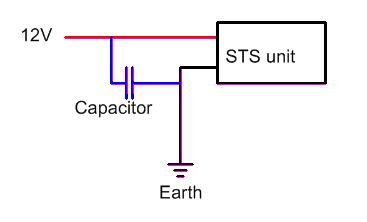
You could try putting a smoothing capacitor across the power supply to the unit. Start with about 100uF and see if that works.
 
When my bike has all components working especially electricals I don't muck with it. But it seems you like a challenge. I do like my push to cancel blinkers, they get pushed a lot, to be sure there not flashing for nada.
 
Dellortoman said:
Might be electrical "noise" from the ignition system upsetting the STS. I would have expected a smart product to have filtering circuitry to protect its little brain. Might be worth asking the suppliers of the STS if they've come across this sort of thing before.

You could try putting a smoothing capacitor across the power supply to the unit. Start with about 100uF and see if that works.

They say they have tested it on many bikes but mine was mounted on top of the coils so who knows. They didnt seem to think it was a thing but they also seem willing to troubleshoot it with me which is good. Is a smothing capacitor something that fits over the wires?
 
cbertozz said:
Is a smothing capacitor something that fits over the wires?

No. You're thinking of an RF suppressor. A capacitor has to be electrically connected as shown below. Don't worry, no DC current will flow through it so it won't short out the power supply. One way to think of a capacitor is that it's something like an insulator to DC, but a conductor for AC, so it will dump any AC voltage spikes to earth. It needs to go as close to the STS unit as possible so as to minimise any voltage induction in the wires between the capacitor and the STS.

Capacitor value needs to be chosen for the current flowing to the device and the frequency that you want to filter out. Lower frequencies need higher capacitance. It's all a bit hit and miss because we don't know what frequency the thing is sensitive to, nor what frequency the noise is in your wiring system. Actually, the frequencies in bike/car electrical systems are generally a lot higher than you get in 50 Hz mains powered devices. Alternators and ignition systems can generate anything between  2000 to 30000 Hz. Induced voltage from HT coils can be much higher frequency than that because of the typically spikey wave forms.

I guess the unit will be pulling about 2 amps on average to drive your indicators.  So as I mentioned, try 100uF to start with. Hopefully that'll get rid of the high frequency interference. If that doesn't work, try 1000uF to target lower frequencies.  As always, be prepared for failure. I may be barking up the wrong tree entirely  ::)
 

Attachments

  • Cap.JPG
    Cap.JPG
    14 KB · Views: 3
Dellortoman said:
No. You're thinking of an RF suppressor. A capacitor has to be electrically connected as shown below. Don't worry, no DC current will flow through it so it won't short out the power supply. One way to think of a capacitor is that it's something like an insulator to DC, but a conductor for AC, so it will dump any AC voltage spikes to earth. It needs to go as close to the STS unit as possible so as to minimise any voltage induction in the wires between the capacitor and the STS.

Capacitor value needs to be chosen for the current flowing to the device and the frequency that you want to filter out. Lower frequencies need higher capacitance. It's all a bit hit and miss because we don't know what frequency the thing is sensitive to, nor what frequency the noise is in your wiring system. Actually, the frequencies in bike/car electrical systems are generally a lot higher than you get in 50 Hz mains powered devices. Alternators and ignition systems can generate anything between  2000 to 30000 Hz. Induced voltage from HT coils can be much higher frequency than that because of the typically spikey wave forms.

I guess the unit will be pulling about 2 amps on average to drive your indicators.  So as I mentioned, try 100uF to start with. Hopefully that'll get rid of the high frequency interference. If that doesn't work, try 1000uF to target lower frequencies.  As always, be prepared for failure. I may be barking up the wrong tree entirely  ::)

Thanks Cam, even if it doesn't turn out to be that I owe you to try it :)

Must be something like that so we please start there
 
Vince said:
When my bike has all components working especially electricals I don't muck with it. But it seems you like a challenge. I do like my push to cancel blinkers, they get pushed a lot, to be sure there not flashing for nada.

Yep I think the same just before I take everything apart again  :LOL: :LOL:
 
SimonR501 said:
Would it not be simpler to move the turn signal unit unit away from the source of the interference (the coils)?
Like under the seat?

If physical shielding is the issue then yes. If the interference is in the wiring then maybe the other solution works. Going to work through it with the STS team
 
Back
Top