Laverda 1000, fairing fixing question

  • Thread starter Thread starter Restomoto
  • Start date Start date
R

Restomoto

Guest
Hi,

Maybe you can help me again.

I have Laverda 1000 and she will have Imola Ducati 900ss half fairing. I have the front fixing bracket ( Laverda paradies), which seems to suit perfectly. I wonder have any of you some experiences what is the best way to fix the right and left side of the fairing so that in driving situation the vibration of the fairing would be the as little as possible. What would be the best place in frame or in engine to fix the " home made" side bracket and where is the best place to fix the bracket in fairing. I got the information that the other end of the fixing bracket can be fixed to the cylinder stud with high nut ( in both side of the engine), but I do not know......

I appreciate your views,

Ciao,
Erkki
 
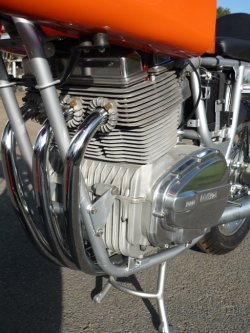
How I did it, couldn't find a better photo. Brace is fixed to coil bracket?

support.JPG

 
Erkki,

If you have a BTZ (battery transistor ignition, as opposed to the earlier CDI) triple, the fairing bracket can be bolted to the brackets to which the ignition ballast resistors are/were mounted.  This is the method used by the factory for these bikes, I can supply NOS brackets (I think... need to check).  These emerge horizontally from under the tank and can support the fairing wings by whichever method of fixing you consider correct.

If you have an earlier bike, well, you're on your own.  Lots of possibilities, usually quite complicated due to the lack of space between frame, cambox and tank.  Usually calls for removal of the bracket when cam cover lifting time comes around.

Another variant is to use the outer 7mm head studs as a fixing point.  I use these and my brackets do not interfere with the cam cover upon removal, but then, my fairing does cover a bit more of the engine than the Duc SS item.

piet
 
Hi Scott and Piet,

Thank you of your advise.

Mine is 1974 Laverda 1000 3c with HKZ ignition. Now I got good information: First of all the side bracket should be fixed under the sides of fairing. I can use oil cooler's fixing points for the bracket. I belive that Piet's proposal is the one I think first, if I manage to build the bracket. Scott's proposal was nice also and I think that also because of more easier brackets ( more easier to build). So lots of hours in the garage to come...

Thank you once more and Merry Christmas and Happy New Year 2013.

Ciao,
Erkki
 
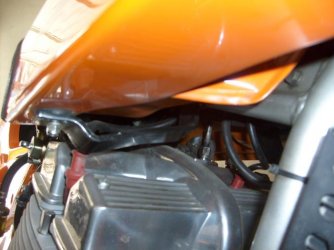
Here is a photo of a bracket made from the flat steel, and mounted on the resistor mountings, as Piet described.
Boba
 

Attachments

  • S6300268res.JPG
    S6300268res.JPG
    73.3 KB · Views: 77
On my SF2 I thought I might run a pair of fairing mounts from the rear, outer rocker cover bolts, but came across an interesting thing.

All of the rocker cover bolts are capped with yellow waxy/rubbery stuff.
(Almost like a seal to show that it has never been removed).

Anyone come across this before?
 
Dale,

The yellow "waxy/rubbery stuff" is actually a nyloc insert that is continued over the bolt/stud end and indeed constitutes an oil seal.  Lubricant is supplied to the head via the stud holes, so the studs need to be sealed to avoid leakage.  A normal domed nut is often used but these just as often bottom out on the studs, especially if the correct thickness copper washers are not fitted.  Today, closed nyloc nuts are available with a metal dome pressed into place, don't break off as the originals sometimes did.

piet
 
Second attempt at posting.
This time with re-sized photo's.

A further question about fairing mounts:
I am about to get my frame prepared for paint, and will set up the front mount first.

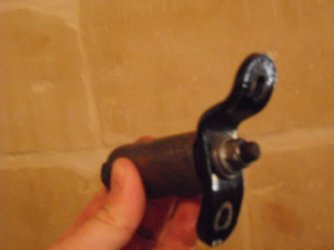
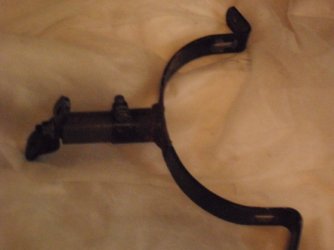
I have a SFC style mount consisting of a rubber cylinder on a bracket that bolts onto the steering head, and a semi-circular bracket (for the headlight) on a clamp/tube to slip over the rubber cylinder.
Similar to the one in the Laverda-Paradise catalog.
(Hopefully a pair of photo's have attached.  Sorry about the grainy quality).
I suspect that I will add a pair of braces from the base of the mount to the top of the fairing at a later date.

I have not seen a standard setup before, and assume that it is simply a couple of bolts welded to the onto the steering head tube to take the bracket.
Is that correct?
Does anyone have a picture to use as an example?
Is there a particular measurement to follow for the height of the mountings on the tube?

Thanks
Dale
 

Attachments

  • DSCF3076.JPG
    DSCF3076.JPG
    142.8 KB · Views: 21
  • DSCF3075.JPG
    DSCF3075.JPG
    143.6 KB · Views: 23
Dale said:
I suspect that I will add a pair of braces from the base of the mount to the top of the fairing at a later date.

I have not seen a standard setup before, and assume that it is simply a couple of bolts welded to the onto the steering head tube to take the bracket.
Is that correct?

The fixing points on the frame consist of a pair of internally threaded stubs, about 15mm OD, 20mm long, M8 thread, welded to the steering head.  To determine their position, you might want to make a mock-up to see how your fairing fits best.

As standard, the top of the SFC fairing was not supported at all.  The factory just let it flap around in the wind with the windscreen bubble giving it a bit of stiffness!  Early factory fairings had thin metal rods/tubes laminated to the insides to afford rigidity.  Works well and very elegant.

piet
 
sfcpiet said:
Early factory fairings had thin metal rods/tubes laminated to the insides to afford rigidity.  Works well and very elegant.

piet

in a mail-chat I had with Marnix he ones refered to them as "rips". Looking at them, that really fits well  ;) They look like rips of a grayhound. Well - they are....  :D
 
Yes Grant, ribs.

Either rods or thin tubes were laminated along the insides, from the side of the head-light cut out to the upper "ears".

I have a seemingly original SFC fairing that has the front bracket solidly laminated to it.  Unfortunately, the fairing has lost most of its lower "ears" at some stage.

piet
 
Back
Top