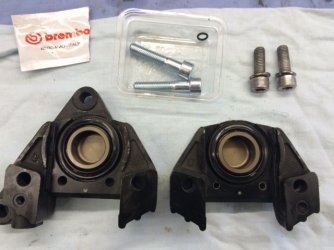
Loctite on caliper bolts

tonywest

New member
Location
South Lakes
Parts arrived last week for the brake re-build. I've just put in the fresh seals and new pistons but have halted at the point of putting the  split halves back together. Should I use some kind of Loctite on the new bolts that are supplied with the kits? If so any recommendation for here in the UK? Thanks guys.
 

Attachments

  • Caliper Halves.jpg
    Caliper Halves.jpg
    101.9 KB · Views: 16
Not necessary.  I use a little of the special grease that is included in the seal kits on the threads only, mainly to prevent seizure.  Has worked fine for the past 30-odd years...

piet
 
I always wired the cap screws of the calliper body and also lock wired the cross pins for the pads, and the hex bolts onto the fork legs, a sensible thing for race bikes  but not needed for a road bike, I have only just about got out of the habit, and I stopped racing in 1987.
I still use a fully wired up rear calliper though, mainly because the rear brake on TOG is so pathetic and only gets used for holding the bike stationary at uphill stops.
CLEM
 
Never used loctite, never had a problem.

In fact, rather than using a locking fluid, I do the opposite and lubricate the threads with an anti-sieze grease when reassembling. The reason is to avoid the situation described below.

When dismantling old calipers that haven't been apart for years, I've found some of those caliper bolts siezed almost beyond recovery. The last one I did a couple of weeks ago was a real bastard to get part. I was tempted to give up and throw it in the bin, but I didn't have a spare so persisted with it. After several heating/cooling cycles and the use of a rattle gun, it eventually gave up the struggle. It took about 2 hours to get both bolts out!

 
I am wondering why you are wondering, but anyway

As a race bike is under the most stress it is ever going to be under it is used to

A: keep the important bits in place so they don't come off while your racing, imagine losing a front caliper, dumping all your oil on the track, losing a axle, get the picture?

B: To keep debris off the track, imagine getting a bolt or nut getting flicked up at 200 plus, will definitely hurt, can possibly kill

So in a nutshell its for your and everyone else's safety

 
mar said:
Exactly
Back to the point.
Use locktite

I think your missing the point

In a race scrutineering situation they don't have time to check if you used Loctite on all your nastys, they can however see in about 10 seconds if all your required nuts are safety wired

Lets not confuse RACE with STREET applications....
 
I heard a story (rumour?) that some bloke at a race track forgot to tighten up his caliper bolts after a tyre change, and his caliper came loose in a race. That's the reason they now require the bolts to be wired. Some scrutineers insist on it, some don't.

I've never heard of a properly tightened caliper bolt coming loose.
 
I acquired a 1975 CB 750 bike yesterday and the front brake caliper piston were stuck on making turning the f/wheel impossible.

I slackened off the two caliper bolts, They were nice and tight but once I had cracked them off the bolts came out like new.

I was the previous owner of that bike . I had copper eased them in place 5 years ago.

We reap as we sow :))

Joe
 
Dellortoman said:
I heard a story (rumour?) that some bloke at a race track forgot to tighten up his caliper bolts after a tyre change, and his caliper came loose in a race. That's the reason they now require the bolts to be wired. Some scrutineers insist on it, some don't.

I've never heard of a properly tightened caliper bolt coming loose.
Pay attention!
That WAS my point
 
As someone who has done a bit of race bike prep, I'd say the real advantage of lockwiring is not to actually keep it from coming loose, but to quickly see what's been tightened and what hasn't.  You tighten then you lock wire, or, if you're coming along and wiring later on, you check the tightness before lockwiring.  Every time.  On my bike all the fluid plugs, suspension fasteners, brake fasteners and sprocket fasteneres are all wired.  After some (often rushed) work on the bike, you can see at a glance that all is ready to go.

Alternatively... a fair proportion of bikes on the track - at least at a historic meeting - are heaps of old shite prepared by people with little or no mechanical knowledge.  In that case, a bolt that is lockwired will in theory at least not entirely fall out even if the retard didn't tighten it.

:D
 
breganzane said:
As someone who has done a bit of race bike prep, I'd say the real advantage of lockwiring is not to actually keep it from coming loose, but to quickly see what's been tightened and what hasn't.  You tighten then you lock wire, or, if you're coming along and wiring later on, you check the tightness before lockwiring.  Every time.  On my bike all the fluid plugs, suspension fasteners, brake fasteners and sprocket fasteneres are all wired.  After some (often rushed) work on the bike, you can see at a glance that all is ready to go.

Alternatively... a fair proportion of bikes on the track - at least at a historic meeting - are heaps of old shite prepared by people with little or no mechanical knowledge.  In that case, a bolt that is lockwired will in theory at least not entirely fall out even if the retard didn't tighten it.

:D

The requirement to lock wire several "new" things incl caliper mounting bolts came in quite recently in NZ and this argument came up repeatedly in forums here. All I can do is repeat what I said there, You are trying to tell me that a piece of 20G wire can hold a bolt torqued up to around 20/25 ftlb ? Do you know the breaking strain of a good 20G wire ?
All it does is tell you - when it's broken - that the bolt has moved. For that purpose you may as well do what I believe Tom Arter did and use copper wire...
When a scrutineer looks at it - and I scrutineered at the top level here for years - all it tells him is that it is lockwired. Nothing else. No guarantee of it even being tight...
Personally, i use anti seize on both caliper half clamping bolts and the mounting bolts too.
But of course all here are free to do as they please.
 
The way I see it Greg the lock wire strain will only need to be enough to keep the bolt/nut in position.
So! Out of 25ft/lb it might take 5ft/lb or less of EXTRA strain on the wire on top of the torqued bolt to keep it there.
Put it this way, we lock wire a lot of bolts on bits and pieces that go into our reactor at work and not one has ever failed to my knowledge. Loctite is used sparingly, usually on a non-stressed part.
 
I'd be the first to admit to no first hand experience of reactors...shades of "I'm not a mechanic" lol.
But i've not seen many reactors running down a bumpy road at speed lately.

My understanding of a torque setting is that it takes that equal amount of torque to undo a bolt so if something comes undone then it's seen an undoing torque equal to that used to do it up. If i'm wrong feel free to correct me.

Then of course there'a high frequency vibration...anyone on here who's raced a TD/TR/TZ will verify that lockwire does not stop bolts coming undone - or disappearing, taking the broken lockwire with them.

Surprising how divisive this topic is. The extra lockwiring was brought in here, partly to assuage health and safety and partly to fall into line with overseas regs. IMO it does not improve health and safety one jot - but it does give that appearance which to the officialdom is all that counts....
 
GregT said:
My understanding of a torque setting is that it takes that equal amount of torque to undo a bolt so if something comes undone then it's seen an undoing torque equal to that used to do it up. If i'm wrong feel free to correct me.

That's right, 25ft/lbs to do up and 25ft/lbs to undo (in an ideal world, but perhaps a bit more), so 25-25 = 0
So the bolt doesn't undo even with a hefty tug due to friction at the bolt head, all we need to do is provide a small force on top to prevent loosening.
Even so the wire is merely a safety device to prevent disengagement of fasteners.

The amount of twists per inch and wire gauge is strictly specified in our application at work (also on aircraft). Too many twists and the load path is rejected as the wire is compromised and will be brittle.

 
Back
Top