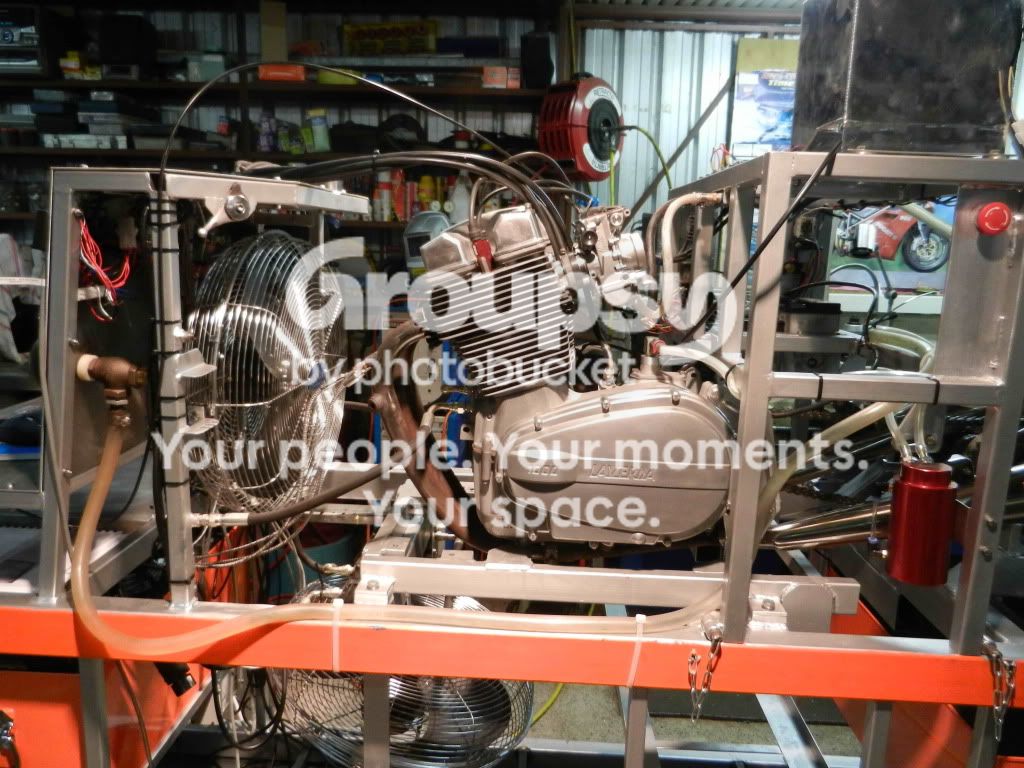
new workshop toy

Hello Cam,
                    You certainly have the hands on  ( actual research ) to know the effects that are being discussed here.  Been sussing it over in my mind as to reasons for the readings at RM's Dyno,  we all know Red and helpers are no beginner at this.  He is reading something,  and like you i wonder any number or all,  of what is occurring.  If the presence of the internal sensor is altering the characteristic and or gas flow properties,  or it is so good it is measuring peak thermal mass ie un-burnt/burning mixture due to higher back pressure,  between probe point of interference and combustion chamber.  So many imponderables,  hypothesis etc etc.

  Emissivity of differing surfaces is well known these days in regard to non contact thermal measuring devices.  There were tables with correction factors floating around some where.  Anyway,  with a TC probe and non contact thermal device in hand and the dyno at work,  Red can create his own correction tables,  even throw in the internal probe data onto a spreadsheet.  Can bring a Fluke industrial grade twin TC hand held meter to confirm readings on the Dyno,  what i calibrated the IIS TC model against.


  One key point is that no matter the actual exhaust gas temperature,  it is all but dissipated by muffler outlet,  ie you can hold your hand against the exhaust gas pulse comfortably.  That is some "thermal loss" over a matter of milliseconds.  Suggests the actual thermal inertia or mass of the gas is very low,  extremely low i would suggest.  Interested in your thoughts,  even though we are both engineering tragic(s),  well better speak for myself... you may well have obtained a better place than me, grin.

  Regards from John. 
 
All my experimentation used contact thermocouples. Non-contact devices weren't available to me. Either the uni lab in which I was working couldn't afford optical pyrometers or they hadn't been invented back in those dark ages!
 
John, you have lost me with all this techo talk, I'm just a dumb driller

have been discussing Dyno results with a few people worldwide who are Dyno "experts" and they are surprised at the "low" reading of the EGT probes
though as I explained to them the current readings are without engine load so they sound correct
when we fully load the engine up we expect to see above 700C easily and quite possibly up to 850-950C on the EGT
is not uncommon to see these figures and higher on big block Chevy engines when running under full load

as for the transference of heat, beats me, not my field

the positioning of the EGT probes has them so their probe ends are within 50mm of the exhaust flange directly in the exhaust gas flow
all 3 EGT probes are reading within 20C of each other so there is nothing wrong with the sensors
also, they are the grounded version
 
No need to sell yourself short Red,  none of us will buy that at any price.... :LOL:

  Trouble with consensus enquiries is that you get good and not so pertinent information.  The approach i took was with a similar air cooled older low reving engine as the Laverda,  and retain a proper engineering analysis from reputable individuals and their organisations.  This CAFE site provided this in details i could only dream of.  Am in no doubt many tuners tune modern or high performance engines,  alas even in a high state of tune the Laverda is not going to qualify for modern performance ( yes shout me down all you folk in the stands....grin ).  Therein it follows that while probable that the Laverda engines should exhibit similar properties to main stream dyno fodder,  it is not the case as far as i am concerned.

  Agree readily that many is the motor that have markedly different measured performance like EGT,  am not willing to lump the Laverda motor into that pool of knowledge.  Know your well busy,  yet a quick perusal  of the graphs alone for the CAFE URL will help no end assess the Laverda motors in context.

  Rather the best fit and form,  that matched predicted and monitored performance for the Laverda was the air cooled Aero engines of old, and/or similar vintage to the Laverda engines.  It is this type of data ( CAFE )  and only this data,  i use to produce matching performance parts or systems for the Laverda motors and associated systems.  Ducati and MG are similar for most parts though not identical i have found.  The exhaust PDF is a real eye opener,  even though i doubt a better era produced system than the JOTA pipes was possible. Really really like those silencers, predictable on many Laverda performance motor/ignition combinations.

  The probe on the header is single ended TC? Did i read that correctly.  Requires some care the implementation for those types,  more so in a congested HT rich environment,  like a Laverda engine.  Sticks nose into your business.....  :(. 


*** Just a notion of engines under load condition.  Actual peak thermal output from a burnt or partial burnt mixture would be static i would estimate ( will check data later ) just the volume or frequency of hot gas that changes, ie long interval between combustions means a lower "heating" effect on headers etc,  as the revs increase the frequency of hot gas exposure increases and hence the average heating effect is raised of a unit of time. This will be seen as higher and higher EGT,  though the peak instantaneous heat value is the same per pulse.  It is this that makes me think your measure point is showing a peak heat value,  not a subdued average like i measure and perhaps other test beds like the CAFE lab data,  again just a thought and not a for sure perspective.

Regards to all John.
 
Red John and Cam,at the very least Reds dino has as expected opened a can of worms,actual solid measurable data type worms.This is getting good.
 
I can't compete with Cams thesis or Johns knowledge in the instrument field - however!
All of the thermocouple pockets I have ever seen on Power Station steam systems have the pocket terminate at the centre of the pipe. The tip of the TC is always in contact with the bottom of that pocket in the centre.
Similar with gas turbines - to my knowledge Tmax is measured at the centre of the gas stream on exit from combustion chamber, not on the surface.
So there must be a pretty reasonable difference between surface temp. and fluid temp. (even with insulation). Thus the true temperature of the fluid is in the centre of the stream?
 
G'day Simon

My guess is that thermometer pockets extend into the centre of the pipe because that's the default design. That is, in the absence of any other information, that seems the most logical solution and it'll work for pretty much all flow conditions. There's no disadvantage in putting them there so there's no reason not do it, even though in most cases it's not necessary.

Flow in pipes in industrial and commercial applications is nearly always turbulent because designers are trying to maximise the flow rate and minimise the diameter to save on plant costs. So in reality the fluid will be thoroughly mixed by the eddy currents and will have a pretty flat temperature gradient across the diameter of the pipe.

Cheers,
Cam
 
slotted Davo's engine into the bench today, hooked up everything except MAP and AFR, will hook them up once we balance the carbs
not in tuning mode yet, need to bed the rings in so just going through start up procedures
sounds good, quite engine I think, open Mikuni Flatslides would drown out Leonard Cohen they suck that hard
fascinating to watch the crankcase pressure drop as the rings bed in, was maxing out the readings for first few mins and then the pressures started to drop
huge difference in signal though compared to the 120 which were very stable, the 180 engine crankcase pressure is all over the place like a whores draws

dare I say what the EGT was on this engine at this stage  ???
running ~620C @ 1,750 rpm, not revved the engine yet, only has 4.6 mins on it so far

off to watch some racing tomorrow, nothing now till next week
Go the Laverda's

DPengine.jpg


redax5 said:
fascinating to watch the crankcase pressure drop as the rings bed in, was maxing out the readings for first few mins and then the pressures started to drop
huge difference in signal though compared to the 120 which were very stable, the 180 engine crankcase pressure is all over the place like a whores draws

Looking good Red!  (goodjob)

No real surprise, there's always 1 versus 2 pistons falling and rising, pressure will rise and drop accordingly.  Less differential in the 120s, lot easier to control, nearly like a conventional in-line 4.

piet
 
Looks sweet Red, Thank god someone in this thread is doing rather than talking 8)
 
when was the last time this engine ran Davo ?

Shajota donated his Starter Motor to your engine to get it going, I'll get yours reconditioned next week

 
redax5 said:
when was the last time this engine ran Davo ?

Shajota donated his Starter Motor to your engine to get it going, I'll get yours reconditioned next week

I think the crank seized in 1989 or 1990 (nup was 1991, not much difference but, still 20+ years). The quote I got at the time was way beyond my mature age university student budget so the engine had been sitting in bits in boxes since. Have only just started to catch up with the requirements of the better half (like a house to live in and an income big enough to service the mortgage) so the bike had to wait, sadly.

Just remembered, starter motor was dodgy from brand new and was fixed on warranty once but I think that all they did was try to isolate it to stop it earthing out. Put a rubber sleeve around it as well from memory.

(Also spent 2 years working in major casualty departments and a term of orthopaedics - sort of put me off bikes for quite a while so there wasn't a strong urge to get it back on the road. Woke up one morning and thought - shit, I'm going to die anyway sometime, better get on with doing the things I enjoy)
 
Back
Top