NGK Beware

Golgother

Hero member
Hey All

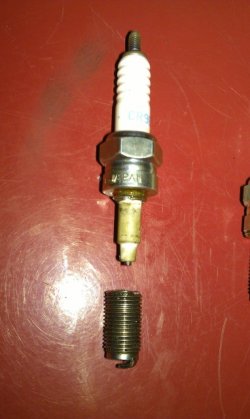
According to another site, there has been a recent spate of imitation NGK plugs put into circulation.

They are prone to shear when fitting, leaving the spark plug thread stuck in the head.

There are no further details on performance

There have been a number of instances of failure, using plugs bought from a famous web auction site as well as previously trusted suppliers.

See attached picture and web link.

http://www.slideshare.net/athangal/distinguishing-fake-ngk-spark-plug

I have no idea about the validity of these claims, but thought I'd bring the allegations to your attention.

                                        Cheers
                                              Matt  
 

Attachments

  • spark plug.jpg
    spark plug.jpg
    103.6 KB · Views: 33
There are planty of fake NKG around , til now most in eastern countries.
Snice begining of 1990is we in (Croatia) have all cind of fake sper parts on market as: clutches , brake discs , oils etc.
Usualy by stores that are nto original parts sellers .
 
I had a new 'NGK' collapse as I was extracting it from the head on my racer not so long ago. Fortunateley the shards of ceramic fell around the outside of the plug hole and I was able to gingerly lower a screwdriver with a blob of grease on the end to pick up the debris before any of it fell into the combustion chamber. The plug came off eBay from a reputable supplier but who knows where he'd purchased them from?
 
I had a plug rusted solid into the head on my Zane, it
facilitated dropping the motor out,getting the head off and paying for the thing to be removed, probably the original plug by the look of it, only on 13'000 kms as well. Mmmm, properly serviced by its former 55 owners?  "Like Fuck!".
 
The plugs may not be fakes but as another poster said just produced out "out of factory".

I suspect and ideed have said, the infamous 3M chain was such an item. Renold have gone away
from putting England or UK on its chain, wonder why?  :-X, whereas iwis still proudly bears the
name GERMANY. It is almost impossible to say for sure where stuff is actually made even from
well known sources and brand names. Toyota and more recently Maganeze Bronz have found to
their costs how cheap outsourced parts can hurt you.

I just add that even with the "made in Germany" legend it does not always mean top quality :D :D.
Invoices from manufacturers used to have a statement on, either "manafactured within the EEC" or
"manufactured outside the EEC" perhaps this could be shortened for inclusion on the actual product.

Andy 
 
I remember years ago a Japanese town was stopped from renaming itself Sheffield so it could stamp Made in Sheffield on it's stainless cutlery.
 
The 'Made in.....' stamped on items is absolutely meaningless these days, as not only is it routinely used on fake products, it also does not legally have to mean that the item was completely sourced or manufactured in that particular country.  For example, it is quite legal for an item to be made in say, Pakistan, but as long as some part was sourced from another country - e.g. the raw material from Germany - it could then have Made in Germany legitimately stamped on.

Proving that an item is genuine can be very difficult indeed, particularly if its real weakness is the material specification; in such cases, what chance does the average consumer have of spotting a fake - none I'd say!

Andy 
 
Totally agree Andy.

On invoices it stated where manufactured, something to do with taxes I think.

Some countries levied more taxes on goods depending where they were made, however
I have not seen it recently. I used to have to it when sending goods to Europe and funnily
enough to USA !!!!
 
Andy Mac said:
The 'Made in.....' stamped on items is absolutely meaningless these days, as not only is it routinely used on fake products, it also does not legally have to mean that the item was completely sourced or manufactured in that particular country.  For example, it is quite legal for an item to be made in say, Pakistan, but as long as some part was sourced from another country - e.g. the raw material from Germany - it could then have Made in Germany legitimately stamped on.

Proving that an item is genuine can be very difficult indeed, particularly if its real weakness is the material specification; in such cases, what chance does the average consumer have of spotting a fake - none I'd say!

Andy 

Got quite heavily involved in Country of Origin Markings recently and it varies quite considerably depending on which country is selling the end product. Am originally from the UK and agree, it's not worth too much in UK but in the US the laws are much tighter and legally stating "Made in....." can give you some sense of security...note I said "some" ;)
 
DIN standard also has a lot to answer for.

In my field, guess what....chain, the DIN standard is a minimum standard and based
basically on breaking load. Typically the European makers made product to a quality
much higher than DIN, but that entailed extra costs so most dumbed down to DIN.

The reason I sell iwis is that they kept making to the "pre DIN" standard and it shows
both in appearance and life. How long they will keep doing this in the face of cheap
DIN standard product flooding the market I have no idea, but when it does I will
retire for good. :( :( :( :( :( :(

I gues it must be the same for other products.

Andy

The Chain Man but for how much longer
 
Back
Top