Petrol tank sealing problems

a10steve

New member
Please forgive me for going back to a subject that has been covered many times already but despite having had any number of problems with fuel tanks I have never been so hacked off as I am now.
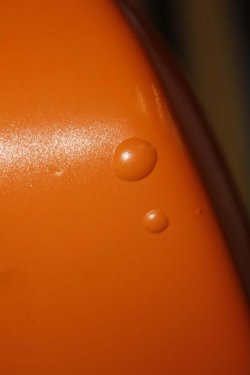
The reason I am so annoyed is that not only has fuel attacked the POR 15 I sealed the tank with it has also attacked the 2K paint.
I don?t want to come on here and just rant, I?m after advice, the paint and the POR 15 have both softened and are coming away the tank has had petrol in it for one week. I have in the past tried all sorts of treatments the only one that worked was POR 15 in my old A10 but that?s not had new fuel in it since last year, has the amount of ethanol in UK petrol gone up recently?
What I am after is advice that will get me on the road.
 

Attachments

  • 1.jpg
    1.jpg
    31.9 KB · Views: 20
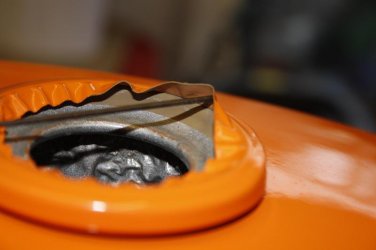
I would remove all the paint from the filler neck.
The problem is that the fuel vapour attacks and gets under the edge where the paint stops, not by going through the paint layer itself.
I get my painter to stop the paint at the edge of the filler cap and then hand paint over the 'join' where the paint layer stops and then there is bare metal with internal tank sealant (clear) to encapsulate the open edge of the paint.
I hope that is clear enough.
This way you can save the rest of the paintwork on the tank.
The filler cap area is hidden by the cap anyway.
I don't know how you will fix the delaminating POR15 inside the tank without having to chemically remove it with solvents, or mechanically remove it with metal pieces and lots of agitation.
 
2k Acrylic does not like petrol. Looks like your painter has gone right up to the edge of the cap hole with the paint. Best to stop well short of the filler hole with the paint then spray the laquer right to the edge so it seals the paint and prevents fuel coming into contact with it, the petrol will just creep under the paint otherwise. Might be able to fix the paint by scalpeling back to some sound colour coat then sealing the edge with laquer. Not sure why the internal coating has come off, I try and avoid them unless absolutely necessary, if I do use a sealer I use Flowliner.


    Keith
 
I did the paint myself, I didn?t worry about the 2K near the petrol as the POR 15 covered that area, I used sealer because of leaks in the tank and fuel has now got through to them and is screwing up the paint under the tank.
I can see me having to get the tank brazed up and starting over again with the paint.
 

Attachments

  • 2.jpg
    2.jpg
    39.3 KB · Views: 11
Steve, I'm with the boys on the filler cap. That's just asking for problems ..Although very easy to be wise after the event.

Last spring I noticed my 1975 BMW R90 tank was going rusty inside particularly on the inside upper surface which makes sense I guess. It was migrating to the float bowls so I wasn't best happy with it..

I drained the tank and washed it with hot water and detergent several times before rinsing with water . I bought some Oxalic acid powder from ebay and made a solution up. I put this inside and let it slosh around for a few days. I lived with the tank in my kitchen and every time I went past it I would slosh it some more.

Then I rinsed it thoroughly and refilled it with solution and repeated the sloshing about bit for a couple of days..ie every time I went in the kitchen I gave it some attention...

I drained it again and rinsed..I wasn't over impressed as there was still a rusty feel to the roof of the tank,,,So I made another solution about 3 x stronger  and sloshed that about for a day or two. That seemed to do a good job.

I rinsed it again and let it dry thoroughly.

I thin poured in about 100ml of KURUST ( the stuff that looks like milk ) . I sloshed this around for a day or so.

I rinsed this out with hot water and let the tank dry out.

Then I rinsed with a litre or so of fuel and discarded that.

Fitted the tank , Filled it up ..Rode 1500 miles around Ireland..no probs,,Came home...Rode another 1300 miles around Ireland ,,No probs..came home...Rode 500 miles to Northern France at Remembrance...No problems...


I'm not a chemist but it worked and worked good..

joe
 
My tank didn't have splits or holes ( BMW ; ) ...but it had got cruddy inside Grant probably due to being left nearly empty in a cold/hot garage for a long time.

The great thing about Oxalic acid is that it is not particulalry hazardous and you are allowed to put it down the drain...

I'm not keen on tank sealers. I wanted to get to the seat of the problem and kill the rust and not just cover it up...

Incidentally Oxalic has the ability to pull rust through a painted surface without removing the paint. I tested this on an old tin plate Triang Lorry and it did work amazingly.

If ppl in UK need tanks repaired then Henry Irving at Alumacraft, Aldridge in the West Midls  is the man...I can't recommend him enough.

joe

 
I don't think Oxalic Acid is as not hazardous:

Toxicity and safety[edit]

Oxalic acid has toxic effects through contact and if ingested; manufacturers provide details in Material Safety Data Sheets (MSDS). It is not identified as mutagenic or carcinogenic; there is a possible risk of congenital malformation in the foetus; may be harmful if inhaled, and extremely destructive to tissue of mucous membranes and upper respiratory tract; harmful if swallowed and causes burns; harmful, destructive of tissue and causes burns if absorbed through skin or in contact with the eyes. Symptoms and effects include burning sensation, cough, wheezing, laryngitis, shortness of breath, spasm, inflammation and oedema of the larynx, inflammation and oedema of the bronchi, pneumonitis, pulmonary oedema.[18]

In humans, ingested oxalic acid has an oral LDLo (lowest published lethal dose) of 600 mg/kg.[19][dead link] It has been reported that the lethal oral dose is 15 to 30 grams.[20]

The toxicity of oxalic acid is due to kidney failure, which arises because it causes precipitation of solid calcium oxalate,[21] the main component of kidney stones. Oxalic acid can also cause joint pain due to the formation of similar precipitates in the joints. Ingestion of ethylene glycol results in oxalic acid as a metabolite which can also cause acute kidney failure.
 
I just didn?t think about the filler cap at the time, it looks like it?s going to be industrial paint stripper, brazing, Oxalic acid and then KURUST or something similar it?s even more annoying that I only noticed this when I went to put some fuel in to start it after more years than I am going to admit to?. I have to say that I could not resist the temptation and fired it up  :D
 
Grant said:
I don't think Oxalic Acid is as not hazardous:

Toxicity and safety[edit]

Oxalic acid has toxic effects through contact and if ingested; manufacturers provide details in Material Safety Data Sheets (MSDS). It is not identified as mutagenic or carcinogenic; there is a possible risk of congenital malformation in the foetus; may be harmful if inhaled, and extremely destructive to tissue of mucous membranes and upper respiratory tract; harmful if swallowed and causes burns; harmful, destructive of tissue and causes burns if absorbed through skin or in contact with the eyes. Symptoms and effects include burning sensation, cough, wheezing, laryngitis, shortness of breath, spasm, inflammation and oedema of the larynx, inflammation and oedema of the bronchi, pneumonitis, pulmonary oedema.[18]

In humans, ingested oxalic acid has an oral LDLo (lowest published lethal dose) of 600 mg/kg.[19][dead link] It has been reported that the lethal oral dose is 15 to 30 grams.[20]

The toxicity of oxalic acid is due to kidney failure, which arises because it causes precipitation of solid calcium oxalate,[21] the main component of kidney stones. Oxalic acid can also cause joint pain due to the formation of similar precipitates in the joints. Ingestion of ethylene glycol results in oxalic acid as a metabolite which can also cause acute kidney failure.

Ha ha, Grant I told ya I wasn't a chemist.....Ok It isn't hazardous as Radium or Conc Sulfuric Acid ! 

If you swallowed 30Grams of table salt it wouldn't be good ( statement not backed up by scientific experiment ! )

anyway, I am still alive..I still breath  :P
 
As far as health and safety go I think I would be more concerned about the combination of a Monty, a can of easystart and my nuts  :o
 
It was POR-15 Fuel Tank Sealer that I used it was recommended as its American and apparently they have had ethanol in their fuel for longer than us and a higher amount.
For now I think I will get the leaks brazed and then consider my options, I have used a number of supposedly ethanol proof sealers and have not found one that works yet.
By the way I just realised I forgot to say thanks for all the advice, so thanks for taking the time to reply  :)
 
Just found this on the POR 15 website
?U.S. STANDARD FUEL TANK SEALER was formulated and developed in our own laboratories due to the demand for a high-tech sealer impervious to all fuels, including the new Stage II fuels which have a high alcohol content?
 
a10steve said:
As far as health and safety go I think I would be more concerned about the combination of a Monty, a can of easystart and my nuts  :o

UNDER NO CIRCUMSTANSES use Easy Start or any other ether based magic in a can shit in a performance motorcycle engine it will try to start backwards and wreck the sprag clutch. If it won't go without a lung full of ether then there is probably something else wrong with it. I once bought a very nice low milage GPZ1000RX for buttons because someone had Easy Started it and done the starter clutch, got to split the engine to fix them, mended it sold it and made a couple of quid but it was only broke because of the ether.

  Only good for one thing the devil ether  :D

    http://www.youtube.com/watch?v=c8Gfq6BwYj4


Back
Top