Ross pistons - correct bore clearance?

beauchemin

Senior member
Wolfgang is away, and I forgot to ask him what piston clearance I should be using for a street motor.  This is for a set of 75.5mm Ross pistons.  My engineer is recommending 0.0015"  Would appreciate your advice - thanks.
 
beauchemin said:
My engineer is recommending 0.0015"

OK, I questioned him, and it turns out I've misquoted him.  He said he wanted to get them as close as possible to the correct clearance before contacting me for the exact clearance (I was out of town.)  I suppose it is a simple matter to remove another .0015" with the hone?
 
Well, that's a relief! 

I'd be guided by Red's experience of 3-3.5 thou, which ties in with Robjota's on that thread, and also what Ross have said.  FWIW, I experimented with 5 thou using stock cast pistons - a bit clattery when cold!  Interestingly, I was told to adhere to strict running in guidance when I had a set of Asso forged pistons fitted...so there's clearly a risk of running too tight, and too fast!

I'm sure Keith, Piet & Red will be along soon.....
 
Hi Chris

for a 70's Japanese air cooled four, typical piston/bore clearance is in a range of 0.032 MM to 0.055 MM, which converts to a range of 0.00126 INCH to 0.00216 INCH.

your machinist is thus still above the bottom of the range for a typical 70's air cooled motorcycle engine, I wouldn't be too hard on him.

if I found a bore/piston clearance of 0.003 INCH (0.0762MM) on a 70's Japanese motorcycle engine like the four cylinder Kawasaki's I am fond of,  I would be looking at replacing the pistons for next oversize, as that clearance is significantly larger than largest permitted spec on a 70's Japanese air cooled motorcycle engine.

on my last Kawasaki engine build, with 1 mm oversize pistons and rings, for my 78 Kawasaki 650 engine, I had the machinist go as close to 0.0013 INCH as he could. Turned out to be a nice running and quiet motor.

I think if you tried even 0.015 inch on your Laverda motor as your machinist is suggesting, especially with the non factory ROSS pistons, you would be skirting the edge of piston seizure in the bores as the ROSS pistons expand more than the stock pistons do, sort of like when you fit stainless steel valves to a Laverda (which expand more than stock valves) you have to use a more generous valve stem/guide clearance.

your machinist is going to tell you that 0.003 inch piston/bore clearance is too loose. For a 70's air cooled Japanese motorcycle engine he is completely correct.

with both Ross and Red saying 0.003 inch piston/bore clearance, I am thinking that is what I would likely go with in your shoes, although the temptation for me remains to stay just a tiny bit "tighter" in the bores, but then who knows what is safe, so 0.003 inch is likely what it should be set to..... I did go 0.0025 inch initially on my RGS "1200" build with J & E pistons, but didn't get many miles on it before a rod bent for other reasons, and one of the cylinder liners had to be  replaced (from the bent rod smashing it) and re bored, with the remaining two liners re honed, all to around 0.003 inch or slightly less, and it is a "happy" motor.

Paul LeClair

ps - wouldn't it be an easier world if everyone just went metric? Drives me wild here in western Canada trying to find metric fasteners even though we are and have for a long time been officially a "metric" country. I was talking to my machinist today on the spec for my 72 Triumph car engine, tough discussion when I have to mentally convert all his INCH speak to metric.......

 
Paul LeClair said:
ps - wouldn't it be an easier world if everyone just went metric? Drives me wild here in western Canada trying to find metric fasteners even though we are and have for a long time been officially a "metric" country. I was talking to my machinist today on the spec for my 72 Triumph car engine, tough discussion when I have to mentally convert all his INCH speak to metric.......

In my experience imperial is still used widely in some industries, and probably will be for decades if not forever for some things, especially when dealing with pipework, flanges, bolts.
We are supposed to be metric too! But still have miles, yards and occasionally temperature is quoted in Fahrenheit (for those citizens that need more than 40 years to get used to Celsius).
 
I think to remember that the factory settings for the Assos was 0,08mm from new  :o . I also think to remember Roger from OCT in Germany told me that he is doing 0.05 on Assos, but only if the customer promises to run the engine in at least 3.000, better 5.000Km (which would take me - 5 years...  :-[ ).

Scott has sent me the original specs for 1200 pistons me thinks as PDF. If you like, I can search for it and send it to you. Not sure though they do count for 79mm pistons, as they are made for 80,4mm ones and I think the clearance might be different there. Not sure though...
 
On Laverda with Asso i have 0,05mm no problem.
On Bakker Kawasaki Z1000 engine from 84 , german REC coated pistons mehanic who was building this made mistake 0,03mm on all 4 cilinder. Runed in 1500km on street , first race 2 midlle pistons stuk and havy oil out on brether and rear tire (lucky no ecident). Later on i found that 2 outer pistons should be 0,06mm and 2 i the idlle 0,08mm, this is what we do in engine rebuild with new (again ) REC pistons, now i works perfect.
4 cilider jap engine, 2 midlle cilinders are hoter than 2 outer.
 
Nothing stays the same forever - forged pistons are a very good example. Wiseco for example have changed their recommended clearances quite a bit as different forging dies have come into use and different alloys too.
From memory a Wiseco piston of around 75mm bore now has a recommended cold clearance of around .0025in which is a lot less than previously....In the time I've been using Ross forgings their clearances have come down too.

Japanese cast pistons as quoted by PLC are another case entirely as they are done in high silicon low expansion alloy and have always required tighter clearances.

I have no experience with continental forgings.
 
Chris asked about Ross pistons specifically, no point relating tales of Jap pistons or anything else.

Listen to Red. He uses Ross pistons and has built more than a few engines recently with them.
 
Most if not all piston manufacturers take this into consideration and machine the clearance into the piston, if the nominal bore is for example 75.5mm them bore and hone to 75.5mm and clearance will be correct.

  Keith
 
Hello all, very lucky for me that this subject has risen. My engine builder is ready to start work on my Monty race engine that has the very same Ross pistons and will be bored to the same size.

I would appreciate a definitive answer to this one especially as it is a race motor

I am just having the liners removed prior to a little tweaking then re-fitted prior to the rebore and hone

Is there information from Ross or should I rely on the experience from the UK racers and the lads down under

Your guidance is appreciated
 
the only pistons we stock and sell are Ross pistons so this is what we do now as we recently tightened the clearance up slightly

Ross recommend all bores up to 88.25mm to have 0.0762mm (0.003") clearance but they also make note that certain engines may require tighter clearances but do not say how tight, one of the engines mentioned is air cooled lined alloy blocks, thus Ross are describing a Laverda barrel
all the Ross pistons that we stock have ceramic coatings on their crowns thus the thermal expansion of the piston is reduced which means we can tighten the clearance to 0.06mm

are your pistons coated or bare alloy, changes the figures required ?
for race engines/track bikes we add 0.0125mm (0.0005") to the clearance, thus we would hone to 0.0725mm clearance on a Monty engine to be used on a track

you cannot use or quote original Laverda factory figures on modern forged pistons no matter what brand as the original Mondial pistons are cast, totally different animal in all ways
 
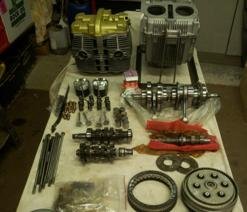
Hello again, my Ross pistons are ceramic coated as shown in the picture on the bench


Attachments

  • Engine on bench.jpg
    Engine on bench.jpg
    12 KB · Views: 213
An 'Acknowledged' Laverda 'Specialist' in the UK some years ago bored my SF3 barrels and supplied a pair of truly superb Ross pistons to suit. He 'gapped' the rings and inserted the assemblies in the bores for safety in transit plus for simple re-assembly of the motor. Within one hundred miles the bike slowed down significantly enough for me to be concerned and to request 'rescue' by a motoring organisation. On dis-assembly (again), using a set of feeler shims, a 'coarse' method I know but nevertheless not too inaccurate, I found that there was less than 2 thou. of an inch clearance at the piston skirts with 'high spots' being highlighted. After taking advice from another source I had the barrels honed out to give 3.5 thou clearance which the engine seemed happy with.
As an aside I had the barrel of my old H***a 250RS rebored to accept a 'genuine' piston and the acceptable 'cold' clearance was 1 thou of an inch which without rings the piston still had to be pushed down the bore being unable to fall under it's own weight. The bike ran perfectly at that.
 
Gents - thanks for the input.  I'm going with .003"

As Keith mentioned, the clearance is built into the piston's nominal size.  The interesting thing is that my machinist measured the implied clearance to be .0035", but when I called Ross they said to use .003".
 
Back
Top