rusticles...in my tank

jotajoe

Hero member
Location
Warwickshire UK
I'm after a little advice from guys who may have restored a fuel tank at some point.

I have a fuel tank that has surface rust inside it. It isn't badly pitted or flaking..It's just got a layer of rust which feels gritty to the touch.

I've taken it off the bike and drained it and now I am looking to restore it nicely...

This is a 1975 R90/6 tank but I have posted in this section as it is relevant to Laverda tanks too..Hope that is ok...

All sage advice gratefully received : )

joe
 
Joe, check with the folk that make the tank sealant as sometimes they come in a kit with de-rusting agent too.
Try Tank Cure for example.

Alternatively pop a solution of citric acid in the tank overnight (hot water makes it work faster). Not too acidic and leaves a nice surface for coating, which I would advise you to do or it will return.
 
Put nuts and bolts in the tank and shake it about for a day or two.
Then rinse and coat inside with phosphoric acid.
Then never leave it empty for prolonged periods.

Paul
 
Joe, Evapo-Rust, the Caswell's tank deruster (http://www.caswellplating.com/restoration-aids/evapo-rust-rust-remover.html) is absolutely the duck's nuts. It's a proprietary chelating agent that won't dissolve the remaining metal in the tank, just converts the rusty steel back to iron. For best results (if it's really badly rusted) you should soak the tank in the Evapo-Rust solution for several days, although they reckon it's pretty much done after 6 hours. It won't hurt the base metal like citric acid will. After you've drained the solution (you can reuse it a number of times) you still have to get the loose particulate stuff off the inside of the tank (even when it's converted back to iron) or it'll goo up your fuel taps and carburetors. I used a generous handful of sheetmetal screws and several hours of vigourous shaking, followed by generous rinsing with a hose (to get all the loose stuff washed out), drying with a couple of alcohol rinses, then rinsing again with the Evapo-Rust solution and air drying the solution onto the inside of the tank. Forms a rustproof coating that's a good base for a sealer.

And the Caswell's 2 part epoxy sealer (http://www.caswellplating.com/restoration-aids/epoxy-gas-tank-sealer.html) is also great too, I don't know what Pommy fuels are like these days but the Caswell's stuff in my tank shows absolutely no signs of softening or whatever after 6 months, despite whatever devil's concoction US oil companies choose to foist on us as petrol. Just mix equal parts, pour into the tank, plug up the holes, slosh it all around for a few seconds, drain whatever excess, and let it polymerize. With a bit of hot air it's dry in 2 hours.
I had a rusty Honda tank that had effectively put the bike off the road, so much rust the needle valves wouldn't seat and it was hydraulic locking almost every time I went to start it. After the Caswell's treatment (and cleaning the carbs); not the slightest sign of trouble. It's also available in red (Dragon's Blood!), black and blue, don't know why you'd want colour on the inside of your petrol tank but there's no accounting for taste :D.

Ken
 
Thanks guys for your advice which I am reading avidly ! Fortunately for me the BMW tanks of this era are very substantial so it is fully reclaimable.

.This is more to stop the process as there is plenty of metal there. I know the previous owner kept it in a lockup in Gloucester for a year.

When I collected it it was on reserve..I missed the last fuel station in Gloucester as it was on the wrong side of a dual cabbageway and had a most entertaining ride up the Fosseway back into Warwickshire....Couldn';t find a petrol station open as it was late evening ...she went onto to reserve so I flicked onto one side only and then I gained a rather close empathy with how Fred Noonan and Amelia Earhart must have felt looking for their landing strip !

The Fosse really does go on and on and on and I was visualizing myself having to hide the bike in a hedge and thumbing home.  A petrol station finally hove into sight around Bourton in the Water...

I needn't have worried as when I drained the tank on Saturday I discovered that there is a two gallon reserve..ie one gallon per side...Blimey that is useful,,,!!

Thanks again,

joe
 
Paul Marx said:
Put nuts and bolts in the tank and shake it about for a day or two.
Then rinse and coat inside with phosphoric acid.
Then never leave it empty for prolonged periods.

Paul

I'll end up with Arms like an East European shot putter !! ;)
 
Wrap it in a blanket and stuff it into/onto a concrete mixer.  Tie it down firmly and let it spin for day or 2... no effort at all.  Might need to re-position it after a couple of hours to let the abrasives reach every nook and cranny.

piet
 
Hi Joe

I was told a broken car widescreen works very well as an internal agitation cleaner - the little squares of glass do a good abrasive job apparently.

Never tried it though. Could be messy? Naturally, the sharp corners and edges of the glass would break off as they did their work.

Paul
 
here's another untried (for a tank) process...electrolytic de-rusting - all you need is a battery charger, washing soda, a steel electrode that fits through the filler and water...maybe a rubber stopper to hold the electrode
I've done this several times to parts that can fit in a 5 gal bucket and it works well. My original experiment was on a rusty spoke and after 7-8 years of sitting in my toolbox it hasn't rusted again...it does seem to leave a protective layer although it had to be cleaned off.

I'm waiting for a rusty tank to try it on, but I've also attached a tank to a pipe and used wood blocks with a hole for the pipe and spun the tank with a box of screws inside kinda like roasting a pig....but less fat. :P
 
Thank you so much for your tips  :)

Have you been watching " Waking Frankenstein" ?  :D

The wood spit is a good suggestion..I'm sure I'd end up in Intensive with the former  ;)

cheers

joe
 
sfcpiet said:
Wrap it in a blanket and stuff it into/onto a concrete mixer.?  Tie it down firmly and let it spin for day or 2... no effort at all.?  Might need to re-position it after a couple of hours to let the abrasives reach every nook and cranny.

piet

How will the 25mm nuts and bolts get into the corners? And even after a minute, I reckon the tank would ressemble a 16 year olds acne.
 
Don't use 25mm nuts and bolts... ::)

Broken glass or stone grit work nicely, and gets into corners.  Done it to de-rust severely rusted tanks, big flakes are removed quite quickly.

The same procedure with lead shot results in a nice inner coating as well.

piet
 
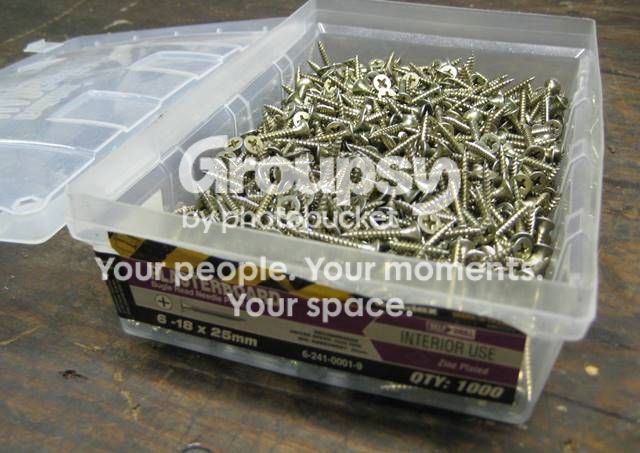
bugle head needle point screws x 1000. throw the lot in with a 1/2 litre of kero.
IMG_2033b.jpg

find yourself a shady spot under a tree, and slowly toss the tank about. careful like.
a few times a day for a couple of days is all it took to clean up Clyde's tank.
cheers
, i didn't try and roll the tank, but tossed it back and forth, end to end, and side to side, to get the bunch of needle points to slam into the sides of the tank wall, not slide across it. i got a nice smooth looking peened finish on the inside.
 
The real benifit to using drywall screws is they are magnetic so they can be fished out of the nooks and crannies easily. Finding glass or lead magnets is sort of difficult. For sealing the Caswell stuff is the way to go.
 
chrisk said:
Well ........ how the hell are you going to get that plastic container in the filler hole? Worse still, get it out again??  :D

Use an ethanol blend fuel and run it through the engine  :LOL:
 
Back
Top