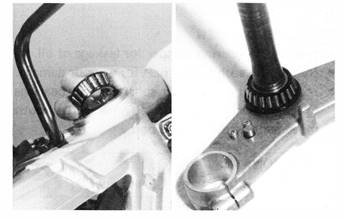
Steering head bearing adjustment - SF

Smartv11

Full member
Location
Meopham, Kent
Just tweaking the steering head bearing ahead of a MOT on Saturday (timed to miss that wedding >:()

any way, when do I know its 'just right', I mean should I expect a tiny amount of play to occur from the forks themselves when pulling back and fore on fork bottoms??

I've tightened up and reduced the play that was there, but I'm also reaching a point where steering is stiffening up a bit, but still have a tiny amount of play.

the bike is a 1970 SF and has freshly installed bearing following rebuild, so may be I need to be a bit braver with tightening??

Any tips please.

Paul
 
think about that when you has adjusted the nut above the bearing and all feels good when you fix the nut above the triple clamp the lower nut will be pushed downwards in the thread and will increase the pressure in the bearings. It is quite sensitive to find the point where there is no pressure in the bearings and a real free movement of the steering. 2-3 mm movement of the lower nut can make it different.
Lift the front wheel and find the exact point. I did it yesterday. During a test ride with my triple SFC i found some knocking in the handlebars during heavy breaking. To much play in the headstock- so I adjusted.
Should be no play and the fork will turn by its own weight to the side. Hobe its fine now.
Needs some patience.
 
If testing it by rocking bike back and forth with some brake lever pressure, ensure you not mistake any brake pad play as head bearing movement. It can be misleading.

 
chrisk said:
If testing it by rocking bike back and forth with some brake lever pressure, ensure you not mistake any brake pad play as head bearing movement. It can be misleading.

thanks, but wheel is off the ground, and forks grabbed by the axles!!

'gently drop to the stop plate each way of it"s own free will', or 'Tighten till play disappears' hmmm that's  my query, I'm trying to achieve both :-\
 
For what it's worth, this is my understanding: the forks should drop smoothly but not fast enough to 'bounce' off the stops.
 
What I found was you need to hold the bottom nut with a thin pushbike spanner while tightening the top nut or both will turn. It takes a few goes to get right.
 
Read a Japanese workshop manual that recommended overtightening the steering stem after fitting new bearings and turning bars a few times to help fully seat the bearings, then back off to leave slight resistance.  Can't find the article now, but the GSXR manual suggests a 200-500 gram force applied to the end of the handlebar is the correct setting to just start moving them from their straight ahead position.  So this confirms the idea that a very small amount of preload is desirable.

I used to spend ages with just the triple trees installed to remove free play but not apply preload. Always difficult with sticky grease on new bearings masking the feel of things. Decided recently that this is not the best approach and have opted for a smidgeon of preload. IMHO, it's difficult to judge this with forks & wheels in situ - must buy a spring balance and try the GSXR method!

By detecting slop at the bottom of the fork legs, you're at risk of feeling play between stanchion and leg as well as any in the steering head.
 
Heaps easier with the wheel out. What Andre said is VERY important. I?d back off until it?s obviously loose then begin tightening. Look for a slight resistance AFTER you?ve tightened the top nut down. A large thin spanner as used on bicycle headsets is ideal to prevent the bottom nut from turning while locking the top nut.
 
Rob said:
Can't find the article now, but the GSXR manual suggests a 200-500 gram force applied to the end of the handlebar is the correct setting to just start moving them from their straight ahead position.  So this confirms the idea that a very small amount of preload is desirable.

I used to spend ages with just the triple trees installed to remove free play but not apply preload. Always difficult with sticky grease on new bearings masking the feel of things. Decided recently that this is not the best approach and have opted for a smidgeon of preload. IMHO, it's difficult to judge this with forks & wheels in situ - must buy a spring balance and try the GSXR method!

I think the GSXR triple clamp bearings are like my SV1000 triple clamps. Tappered at bottom, and a ball race at the top.
Not a roller bearing at the top.

And, somewhere on here (a couple of months ago) someone posted the torque figures for Laverda nuts and bolts, off a Laverda spec sheet.
I actually made mention of how tight the the steering stem was, which surprised me.

 
chrisk said:
...

And, somewhere on here (a couple of months ago) someone posted the torque figures for Laverda nuts and bolts, off a Laverda spec sheet.
I actually made mention of how tight the the steering stem was, which surprised me.
It's for the top nut only.
Very slight preload for two tapered rollers, even less if upper is ball type on Laverda.
And this setting must be achieved after the top nut is tightened, tightening the top nut tightens a littlebit more the bearings because blacklash of the adjustment nut thread is pulled to the opposite direction. Therefore the adjustment must be a littlebit looser before tightening of the top nut. Naturally inspection of the correct setting must be done after the top nut is tightened.
 
"Naturally inspection of the correct setting must be done after the top nut is tightened"
And on the earlier bikes, after the pinch bolt on the top clamp (which the top nut goes through) is nipped up.
 
Rob said:
Read a Japanese workshop manual that recommended overtightening the steering stem after fitting new bearings and turning bars a few times to help fully seat the bearings, then back off to leave slight resistance. 

I do have quite a bit of experience of this in my field of work, one of the gearbox types I have worked on has two taper roller bearings similar in size and configeration to our motorcycles.

The procedure we work to says that when new taper roller bearings are fitted the the gearbox they should :

1). Be packed with grease to 40% capacity.
2). Be torqued to 40ft/lb first to ensure that the bearings are fully seated.
3). Then release the lock nut fully.
4). Once that has been done the locknut is re-torqued to 15 to 25 lb/inches to preload the bearings - the important bit is the word 'inches', which is a very, very light touch indeed!
5). Even then, there may be a bit of stiction in the bearings, so a gentle knock back and forth of the spindle may unload the bearings a little and allow free movement with no free play.

The only downside of that is most people don't have a lb/inches torque wrench, so a gentle and accurate touch may be needed instead.
 
SimonR501 said:
...
1). Be packed with grease to 40% capacity.
...
On lathes or similar equipment grease lubed bearings are filled about 1/3 of the capacity, they may start to heat up if packed with too much grease. Steering bearings can be packed 100%, slows dirt and humidity getting in. Standard procedure on many workshops. If I remember correct this was also said on SKF's directions which I have seen myself.
 
Back
Top