Triple engine oil level check procedure

Fair enough Piet  :)

My ole 81/180 with that crappy crossover never took more than 2.7ltr of oil for a regular oil change ( removal of drain plug only)

Same with my new 76/3cl and 73/750. In fact 750 more like 2.5ltr  8)
 
hooksey said:
Fair enough Piet  :)

My ole 81/180 with that crappy crossover never took more than 2.7ltr of oil for a regular oil change ( removal of drain plug only)

Same with my new 76/3cl and 73/750. In fact 750 more like 2.5ltr  8)

Strange.  I fill in 3 litres as default in both twins and triples, has always worked out fine.

Dipstickshould be unscrewed and resting upon hole on the twins, hanging vertically in the hole (loosely placed, the dipstick cap ends up at about half-way up the incline) on triples.

piet
 
"Although all triples have basically the same crankcases, the 120? LH gearchange models (not to be confused with 180? models using the crappy cross-over linkage) have slightly less capacity because the shifter housing has been omitted."

my learned friend Piet is of course correct, but what the knows and has not posted is that there are many different patterns of crankcase evolving over the years, just for starters, there are the twin webbed or triples webbed, 5 bolts across the front joint or seven in the same place, none of these affect the oil capacity, these are things that show, but inside there are differences where the oil flows from primary case back to sump, which might, then there are pre oil cooler or with oil cooler, this affects the capacity but not the level in the sump, its all very interesting, but I am fairly sure that there is more than on triple dipstick length (anyone confirm) but also that if you had the wrong one , you probably wouldn't even notice.

CLEM
 
Clem,

I've just gone through all my triple parts lists.  ALL triples list the same dipstick, part # 61 904 045.

750's used # 61 904 004, 500/600's used # 61 904 231.  The mid-60s 125/150 4-strokes used an outwardly similar dipstick, this is #33L.

The 750 item evolved at some stage from a simple round bar with grooves to the common stamped, flattened bar with ridges.

It can safely be assumed different part #'s will have different lengths.  Couldn't be arsed at the moment to go into workshop and actually measure the differences... :D

piet
 
I don't blame you for that Piet, but you have proved that "the level" is the same on all triples, only the quantity can vary,+ or - minus oil cooler, 180 or 120 etc, doesn't matter anyway,the (triple) dip sticks are all the same, but small twins and big twins will have dipsticks that can be transferred to triples and cause a bit of grief, so I have just measured a triple dipstick and the high line is 220mm from the first bit of plastic that you come into contact with, going up the stick.
CLEM
 
A fair bit of oil stays in the primary on 3Cs where the ability to cross between the main case and the primary is restricted. If your keen its worth dropping the primary chain adjuster to allow this 3 or more hundred cc to drain out. Check the new level for a while as it takes some time to refill. Later models don't have this restriction I think, brains trust?
 
Adding to this topic and curious to know...........Does the oil in the primary case get recirculated within the pumped oil system ? or does it just sit there?

Having done 3 or 4 oil services now would i have, in a sense dirty old oil still splashing around in there that would only be removed by either removing the primary adjuster or the cover itself?

Steve
 
The primary oil transfer between the main case and the primary but its a lot slower on early models, later models even have a solid line that directs oil flow to the primary chain itself. My 3c has a few small holes in the case wall that allow flow, later models have way more flow between these. I think later models don't have a sealed bearing on the left crank end, not sure on that.
 
Schurminater said:
Adding to this topic and curious to know...........Does the oil in the primary case get recirculated within the pumped oil system ? or does it just sit there?

As Vince implied, it depends on the age of your engine.

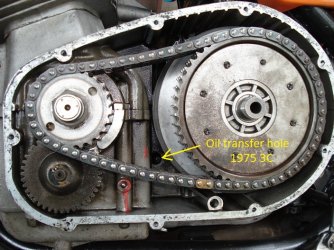
The photo below shows the oil transfer hole between the gearbox and primary case on a 1975 3C. It's above the level of oil that sits in the sump, so oil doesn't drain out of the primary case when you pull the sump plug. Nor does it flood in when you refill the engine with oil. The only way oil can get into the primary case is whatever drains in there from the oil feed to the left side main bearing on the crank. The primary case will only ever fill up to the level of that transfer hole, through which it drains back into the sump. I presume that was to provide an oil bath to lubricate the primary chain.  To do a full oil change on those bikes, you need to pull the primary chain adjuster bolt out to drain the chain case. Then when you refill the engine, you should lay the bike over on the left side to allow oil to flow through that hole to re-fill the primary case.

Later models have a transfer hole at the bottom of the primary drive housing, directly below the one shown in the photo (near the floor of the case) so the oil levels in the sump and primary case can equalise. I don't know when that change was made, but my RGS had the low down hole. I presume it was done that way when the primary chain oiler jet was added, so that the chain actually gets a squirt of oil on it, rather than letting it run in an oil bath.

There are more knowledgeable people on here who will be able to tell you when they changed from the high level transfer hole to the low level one.  Or if in doubt, pull your primary case off and have a look.
 

Attachments

  • oil transfer hole - primary case.jpg
    oil transfer hole - primary case.jpg
    192.1 KB · Views: 50
Cam, that 3C appears to have been running the original triplex primary and clutch rubbers when that photo was taken (2010?).    What sort of mileage had it done?  I changed my clutch rubbers at about 100,000kms, and they were still in fair condition.  A testament Laverda quality and durability.
 
tom3c75 said:
Cam, that 3C appears to have been running the original triplex primary and clutch rubbers when that photo was taken (2010?).    What sort of mileage had it done?  I changed my clutch rubbers at about 100,000kms, and they were still in fair condition.  A testament Laverda quality and durability.
I was going to check my clutch rubbers soon, but maybe I'll wait, my early 3C only has 2K miles and the clutch works perfectly, it actually has the lightest clutch pull of any Lav that I have felt without an easy clutch, If isn't broke don't fix it.
 
Thanks guys,makes for interesting reading for us who want to learn and maintain our Laverdas as Best we can.
Personally looking at the 1980 Jota engine,having replaced the 2 outrigger bearings yesterday i found the single hole on the output shaft bearing housing but as expected there wasn?t one on the crankshaft side.
The chains are obviously well lubricated but just made me question how and when it gets there and whether it?s circulated?
I will have a check to see where the transfer hole is located.

All interesting stuff. (bigthumb)

 
tom3c75 said:
Cam, that 3C appears to have been running the original triplex primary and clutch rubbers when that photo was taken (2010?).    What sort of mileage had it done?  I changed my clutch rubbers at about 100,000kms, and they were still in fair condition.  A testament Laverda quality and durability.

It had done about 100,000 km at the time that photo was taken. It's now 9 years later and I dunno what the mileage is but it's still running the same chain.

It's my brother's bike that I referred to a few days ago in the thread about primary chains here https://www.laverdaforum.com/forum/index.php/topic,98794.0.html. 

As others on this forum who know him will attest, his philosophy is that if it ain't broke, don't fix it. He wears his tyres down until the air inside starts to show through. He only replaced the rear sprocket when the teeth had worn down so much that there wasn't enough left for the chain to engage with. We were on a ride with some mates and he said he thought the clutch was slipping, but closer inspection revealed the chain to be slipping around the sprocket!  If he has a choice between fitting a new part or an old beat-up or half worn out part, he'll fit the old part because it "still has some mileage in it".  Sometimes I find it a bit frustrating if I'm working on his bike for him, but it's his bike so who am I to tell him otherwise? The bike is still going, which I suppose is a testament to the reliability of Laverdas.
 
Back
Top