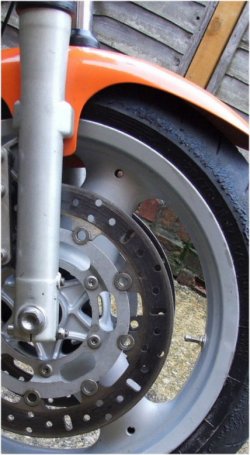
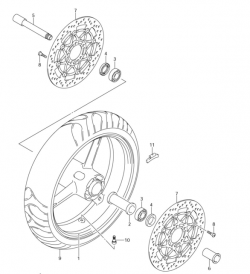
triple rear wheel spindle lengths ?

troutbishop

Hero member
Hi can anyone tell me if the rear wheel spindle length is longer on the wire wheel bikes than the cast wheel bikes ?

                                              cheers Kev
 
laverdakeith said:
Yes it is, by about 15mm.


    Keith
That the same with the front? I've got to mate 38mm ceriani forks with 4LS grimeca drum wire wheel and seems about that short..
also figuring out the spacers is a pain..
Don
 
scuderia said:
laverdakeith said:
Yes it is, by about 15mm.


    Keith
That the same with the front? I've got to mate 38mm ceriani forks with 4LS grimeca drum wire wheel and seems about that short..
also figuring out the spacers is a pain..
Don

No, as the fork leg spacing remains.

Difference at the rear is the dummy axle holding the sprocket assembly to the swingarm, making a slightly longer spindle necessary.  1000SFC is longer still due to the box section swingarm.

piet
 
Don't want to be too pedantic, but surely it is the width of the swingarm that dictates the length of the spindle.  :D
 
Davo said:
Don't want to be too pedantic, but surely it is the width of the swingarm that dictates the length of the spindle.  :D

Dear Too Panantic, Better add a little room for tentioners, washers and a couple of nuts too! I don't know if you blokes realise it, but them nuts actually have a purpose: To stop the L/H washer falling off the left side of the spindle, the R/H ............ yep you're getting it now! 

Seriously, this brings me to another point: If the front axle has only one nut, why does the back axle have two??? (Apart from holding the R/H washer on)
 
Gawd Chris, for a bloke who's always having a shot at other peoples' spelling, yours is pretty crap! "tentioner" really? ???

Why does the back axle have two nuts?
1. It's cheaper to cut a thread each end than turn down the whole length of a thicker shaft to leave a larger diameter head.
2. So you can pull it out from either side
3. To maximise clearance past the exhaust muffler
4. Same reason blokes have two nuts, because it's the manly way to do things.

Cheers,
Cam
 
so why make the front hard and expensive

i believe you a merely clutching at straws Cam

That line could be in another thread also  ;)
 
The reason the spindles are of different design front to back is to make assembly of the front fork cheap and easy. The front could be the same as the rear but it would involve very precice manufacture and individual shimming of the spindle spacing to get every fork to run parallel when the wheel bearings are clamped, not realy viable so that is why the bearings and spacers are clamped to one fork leg while the other fork leg is free to float and find its own best position on the spindle, that is also the reason you should always bounce the forks before tightening the pinch bolts.


  Keith.
 
Really Keith?? To which side do they clamp on one fork? And, if you rely on them "finding their best position", and therefore rely on the pinch bolts to hold the lazy fork true, why have a nut? Doesn't make sense to me.

However, I do have a Kawasaki Suzi front end that do as you suggest, but neither have a retaining nut on the outside of the fork, as it would be superfluous.

Mate, not wanting to split hairs, simply asking if I am missing something.
 
On you kawawhatever the wheel spindle screws into a thread in the oposite leg, same job as a nut if you think about it. All motorcycle telescopic forks are assembled in this way.


  Keith
 
laverdakeith said:
On you kawawhatever the wheel spindle screws into a thread in the oposite leg, same job as a nut if you think about it. All motorcycle telescopic forks are assembled in this way.


  Keith


Attachments

  • 20mm.jpg
    20mm.jpg
    73.1 KB · Views: 18
Keith, mate....... Both Kawasaki and Suzuki forks have nuts, yes, but they have no hex, and the spindle has no head and an internal hex. So the tighten actioning is: Place nut into the fork receptacle, tighten pinch bolts. Then put the wheel into position, slide the stepped spindle into the other fork and in through the bearings, then tighten, once tight into the "nut" tighten the pinch bolts on the spindle end.

This is the difference: Both M's & C's clamp the spacers and wheel bearings in place, via the spindles head and the nut.
As always, I am happy to be corrected.
 
Keith, I had a look at a 3CL front spindle this morning, and I see now exactly what you are saying.  :-[

The bossed end of the spindle floats in the right fork (and now understand your comment about the entire unit being clamped to one fork), until the pinch bolts are tightened on the floating end.

For some reason I always thought the bossed end of the spindle clamped the outside of the fork. Thanks for clarifying that.
Shit, now there are two people I know of on this forum that are smarter than me!

In regard to the Suzuki and Kawasaki front ends: they employ a similar system, however, both the "nut" and the spindle float, the spindle is stepped and than means it has no spacers to worry about. The "nut" has a boss on it to stop it from moving inwards, and that's why you insert it, then nip the pich bolts up, and then insert the spindle and tighten, then give a few sharp bounces on the forks and then tighten the pinch bolts.
 

Attachments

  • sv1000frontwheel.png
    sv1000frontwheel.png
    167.6 KB · Views: 9
Back
Top