Normski
Senior member
- Location
- Devon, England
Hi, can someone tell me what angle the valve seats should be cut too on an early Breganze 750 head.
Thanks Norman
Thanks Norman


I meant what is the angle of the cut for the valve seat? so 45 degrees it is then - thanks Phil, we were fairly sure but wanted to check before removing metal.phil37 said:Do you mean "What angle are the valves"? or just the std 45 degree cut for the valve seat? I ask this in case you are using a milling machine with swivelling head to hold seat cutting device - Regards - Phil

Normski said:.....but the head is for a slowish roadgoing bike so as per factory would be enough.
Laverda SF said:The most important thing is keeping the valve as high as possible in the combustion chamber or at factory specs. If you sink the valve you loose air flow big time. The original SF seat is to say the least, unlike the SFC, rather wide and blunt with heavy valves - not really designed for power much above 7000rpm. You can pick up another 1000rpm and say 15 more Hp with the STK cam incorporating Jenkin Valve Spec's, lighter oversize valves and stronger springs. You will have to re-jet the carbs richer to make up for the increased breathing.
Normski said:... but the head is for a slowish roadgoing bike so as per factory would be enough.
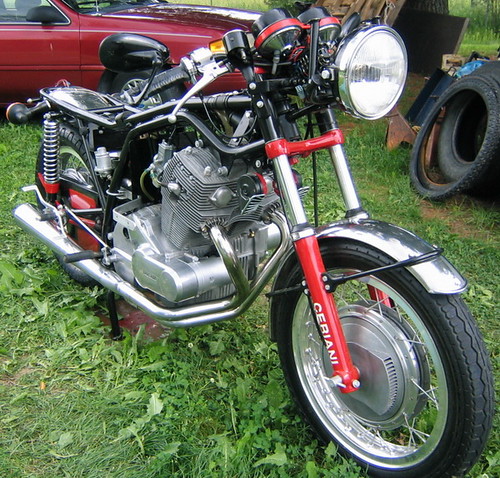
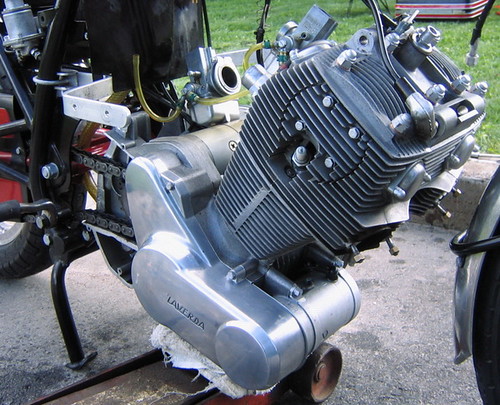
Hi SF - Not sure i follow you there? Poor old Normski will be regretting he asked a simple question soon - best we leave it at that - regards - PhilWhat's the matter Phil - Don't like the way my motor fell out leaving the carbs to hang - LOL
phil37 said:Poor old Normski will be regretting he asked a simple question soon - best we leave it at that

Interesting post. I'd like to implement this on my own, I'm from Germany, so a few questions: what camshaft do you use, where do I get the valves/springs, maybe a website/order number? Do I have to change anything on the crankshaft - SFC like? For the pistons I use Asso 10:1. Thanks in Advance DieterWith the original small valves there is not much room for 3 angles as the port drops at 90 degrees just about right after the 45 degree seat. Most shops just touch up the seats (providing their not damaged) and reface the valves. This leaves the seats away too wide for clean performance in my opinion and changes the installed height.
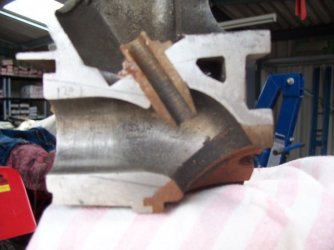
An ideal 3 angle cut would be something like this> For the INTAKE: 22 to 25 degree entry cut with a 45 Degree seat say .060" wide followed by a 70 Degree cut .130" to .170" wide (Depends upon the port diameter and material you have to work with) to the final 90 degree cut into the port. For the EXHAUST: say 25 to 30 degree entry cut with a 45 degree seat .080" wide followed by a series of cuts into the port say 60 degrees .080" wide then 70 degrees .060" wide, 80 degrees .060" wide followed by the final 90 degree cut approx diameter of the port. Again, you have to consider the bowl port diameter when designing the cuts accordingly as to where you want to position the seat relative to the size of valve head. For the exhaust, rather then finishing off with the 90 along the valve stem axis, I will make the 90 cut tilted toward the port floor by some 12 to 14 degrees for a straighter shot then widen the port floor around the elbow.
Keep in mind the design of multiple cuts is limited by the material you have to work with and a larger Valve gives you more lee-way. I always do some minor bowl porting to determine the size of the port diameter before selecting a Valve diameter.
For the Intake you leave the 70/90 degree edge sharp - Helps atomize the in coming fuel mix. For the Exhaust use something like a brake cylinder hone to round off and blend the edges of the 60/70/80/90 cuts to form a venture right to the edge of the seat.
As I said it's hard to do with the stock diameter valves because there really isn't enough material or the seat has pounded down. The benefits of a larger Valve are two fold. 1st if seat is sunk from pounding you have the material to seat the valve as per Mfgr specified install height - 2nd, you have the material to design multiple angles.
Many may question as to why I use such narrow seat widths. In time the seats will pound and widen on there own and last much longer. Secondly, I make the Exhaust seat wider in order to disperse heat. I've run heavy valves as big as 2.23"/1.90" with .060"/.080" seats in Big Block Chevys without issues based on this seat design, which by the way is Grumpy Jenkins Specifications and it works great in my SF.
You can buy Manley Extreme Duty Ultra Light Pro Flows with the specs or close to the specs you're after. It does not take much work on a lathe and valve-facer to make them work. In this matter if you contact Manley and they will, for a little extra cost, cut you a valve to your specs.
Lastly I recommend that you keep the valve margins as .060" to .080" for the Intake and .080" to .100" for the Exhaust. Hefty valve margins promote cooling as compared to a valve with a thin margin after they have been refaced numerous times. If you're stuck with resurfaced valves having sharp margins, stick them in a drill press, spin them against a file to widen the margin some what. Another thing; request that your machinist use STONES for all angle cuts where the 90 degree requires a cutter as a stone will chatter.If he won't - Find another machinists. Humm - I'm Old School and know a sharp stone does the job perfectly where a cutter not only gives a rougher surface but one slip and Ka-Put. There may be new cutters that can do the job but in my mind I would not trust them.
I've no problems hitting 8000rpm with stock cam, heavier 20 lb springs and open VBH 30A's. I don't go there much these days - Just content to cruise but planing to mount a set of 34's or 36's so I can use an Air Filter. I got the Carbs and have a brand new Bridgestone BT45 130/80V-18 just waiting for spring.
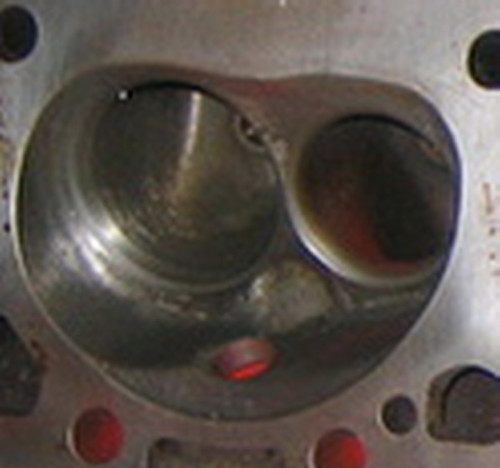
Obviously this is not a Laverda combustion chamber but a very poor PIC of my 1968 Grumpy Spec'd 291 SBC castings but it does demonstrate what Multiple Angle Valve seats looks like: