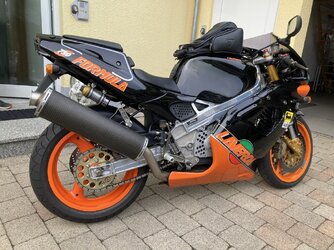
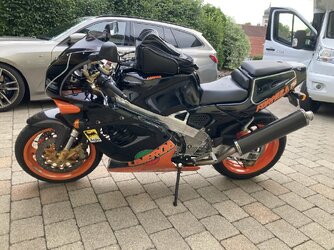
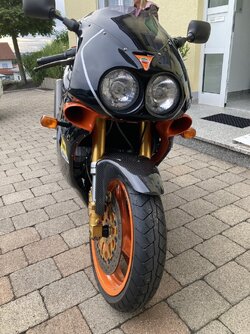
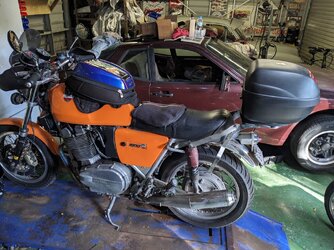
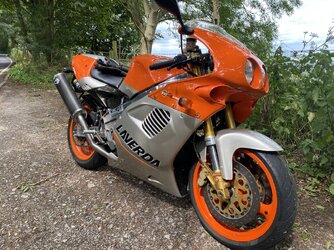
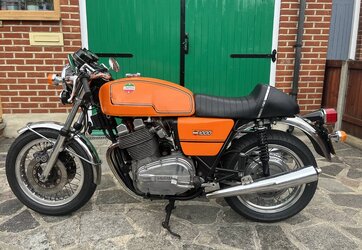
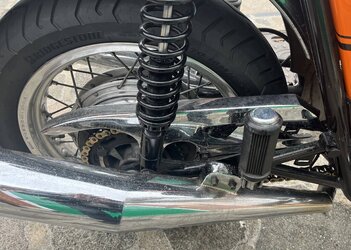
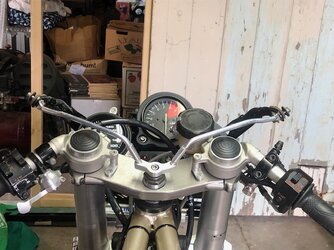
What did you do to or for or with your Laverda today?

Nice GTL Piet, what a great tourer that would be.
I never worried too much about pannier supports with the panniers I had but in recent years try and keep the luggage lower to match leg lift:ROFLMAO:
A couple of years ago purchased some dry bag panniers which are larger so best with some support. On the AE, as a temporary measure (hmm) I just attached a span of aluminium from the pivot point of the folding rack (longer bolt of course) down to the low point of my metal shock protector. Provides adequate support and easily detached. I might do something similar for the triple as I have more lengths of that light aluminium, just need to work out a solution to clamp it to the rack. At the risk of revealing too much back yard bodging, pic attached:unsure: (shoulda painted it black like Clem mentioned)
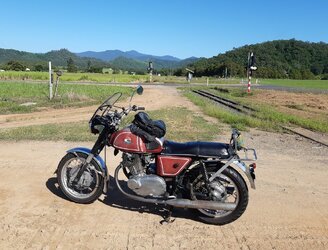
20230212_083451 (2).jpg
 
I REALLY like triangles.

Triangles are the key to making strong structures. I have an engineer mate (Andy Gadget, some of you might know him) who builds his racks and pannier frames out of little, short pieces of 6mm bar (or smaller). He creates masses of small triangles to form truss-type beams. His racks look like some kind of miniature bridge construction (if I find a picture of one, I'll add it to this post). They have a gazillion welds in them because all the little pieces (none longer than about 75mm) of thin bar are welded together at every node. There's always a minimum of 3 bars joining at a node, and sometimes as many as 6. They're immensely strong, but bloody ugly. If you've seen one of his creations, you won't forget it.

Vince: 25 x 3 mm flat bar is fine under a tensile load but not an ideal cross section for compressive loads. In the length you'd need to span from the back of a rack to pillion pegs, it would be at risk of buckling if the rack was heavily loaded. It's better than nothing though. You'd be better off using a tube (round or square section) for that sort of structural element.

I notice in Clem's photo, the strut down to the footrest mount does a kink around the shock absorber. While the kink is necessary to make it fit, it's something of a liability for a structural member under compressive load, as it can induce buckling. The kinds of loads that Clem described (crane bike on and off stuff, hang it from a workshop roof) would have put it under a tensile load, which it would handle way better than compression. Using the rack as a tie-down point for the bike would put it in compression. Clem's been welding lumps of steel together long enough to know what he can get away with, so I'm guessing it's quite thick-walled tube.

There are all sorts of methods for making strong luggage racks, like using large diameter tube, thick wall sections or solid bar, adding gussets, flanges, diagonal bracing, lots of triangles. If you're into making luggage racks, it pays to think about where the maximum bending loads will be, and how to deal with them.
 
That brace has a bolt fixing mid-length to the lower rack frame that takes any flex out in compression. I love tubes almost as much as Triangles but tubes are harder to bolt through without a flange. It would be a joy to have the ability to make simple clean structurally sound racks, pannier mounts or fairing mounts but I don't have that skill so that only leaves basic mods to whatever I can find that's already made for other model bikes that I can bodge to fit my situations. My rack was originally a Craven Rack for a Triumph that was sectioned years ago to be about half its original size width and length. Subframe and shock mounts and Pillion pegs are pretty similarly spaced on most twin-shock bikes to adapting to fit isn't that hard. My Fairing mount is half SS Bevel and half some BMW fairing mount grafted together. It's much easier to adapt stuff than start from scratch. Hope you find your mate's rack pic Cam, it sounds almost like the Bird Cage frame made for Gull Wing Murcs. Someone posted a pic of one of those made in Oz a while back, absolute Insanity but stunningly beautiful.
 
Last edited:
I agree with you entirely Cam, the bow in the diagonal is vital to clear the shock, the tube is not very thick as its only 20mm electrical conduit, I would guess at 2mm, I have never known it to change either when under compression or tension, it has been under shear a few times as well with the unladen bike on its side, largely getting saved by the carrier and the fairing, minimal damage on all occassions, and a few times riden away with scars but nothing broken, one of them during a high speed trial at Lydenn circuit in Kent. Its amazing what a pair of soft panniers full of clothes and other squashy stuff can save you from, but they were not on it when at Lydeen (obviously)
CLEM
Don’t you mean LYDDEN Hill you UFB?
And next time, don't fall off……
 
Indeed, it does! Engine upgrade already carried out by previous owner? Or is this something you have to take on your next open items list?
I think, there might be something to do, will see, had a phone call with Roger today….
 
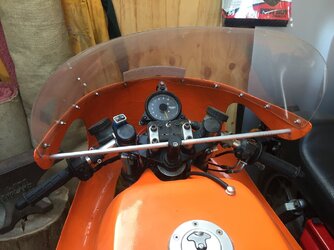
Trying to improve the stability of the fairing 'wings' which hold the mirrors. A bit too flexy so rear vision will hopefully be improved.Thanks to TC for some advice - if I'm not happy I'll have to go the 10mm alu bar route and try and bend it without a funky bending jig. Was a bloody challenge drilling and machining the angled holes in the centre plate!

My little Laverda badge will go over the top with double sided tape.
 

Attachments

  • Fairing stay.jpg
    Fairing stay.jpg
    127.4 KB · Views: 42
My 3c has a similar mount, pinch from a Bevel Ducati, mine is jacked approx 75mm higher off the steering head mount as the fairing is quite a bit higher than usual to avoid leaning down and producing back stress. One of the best mods I ever did was adding rubber grommets to all the fairing mounting bolt holes, that reduced vibrations a hell of a lot in the mirrors. Very nice to distinguish Taxis from Cop cars. The latest mod I added to the bike but it's a bit ugly is 25mm rubber door stop pucks under the mirrors jacking them up a bit higher to see past my elbows. I forgot to add you can get super flat needle roller bearings that can reduce any friction between the fairing pivot and the steering head bolt, there approx 3mm thick, 2 washers with really thin bearing needles between them and pretty cheap. I first saw them on the end of XT 500 swingarms to reduce any side thrush friction. I have fitted them to the Pantah and 3c fairing central mounts. It's probably a negligible load but every bit helps. This mount has been there for a few years and it was wearing a groove before a added these needle bearings.
 
Last edited:
Neat job Quentin. You've put some work into that little gadget. It's a bit more complicated than the ones I've made. But all I've ever tried to achieve with fairing supports going to the steering centre is to stop the fairing wobbling about. Never had the additional problem of mirrors hanging off the end.

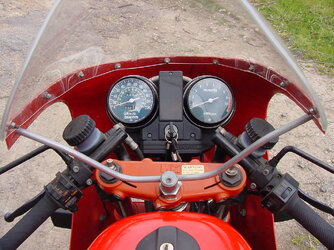
Your fairing actually has a frame in that area, but you need a pretty rigid support for mirrors. Mirrors are basically a weight cantilevered out on the end of a stick, which is pretty hard to hold still. I hope your nifty looking bracket gives you a clearer view of things behind you. If you do end up having to make something out of solid bar (like the ones below), a bending jig doesn't have to be any more complicated than some bits of wood screwed to a benchtop.

Edit: If you find you can't get a satisfactory rear-view result whatever sort of bracketry you end up with, you could abandon the fairing mirrors altogether and opt for handlebar mounted mirrors similar to those on the MHR below. You can't see the actual mirrors because the picture isn't wide enough, but you can see their supports clamped to the bars. I had to heat bend the mirror stalk to get a tighter angle the in the elbow so it would clear the fairing on full lock (which isn't much on the Hailwood) but those mirrors work pretty well.
The other option is bar end mirrors. Some love them, some hate them. I think they work well for seeing behind you, but they're a pain in the arse when manoeuvring in tight spaces.

Here's one I prepared earlier. Just for fairing support - no mirrors.
IMG_1942.JPG

Copied the general idea from the Ducati MHR bracket:
MHR instruments.JPG
 
Last edited:
I am not keen on bar ends, zero chance of getting through my shed doorway is why but with them being slightly wider and that extra millisecond it takes to use them is time away from looking forward. Nitpicking for sure, they're way better than nothing. Good mirrors are really important where I live in horror traffic in central Sydney.
 
I have 1 bar end mirror on the SFC to avoid drilling the fairing, otherwise, on my day to day bikes, I wouldn't use them, they're a hindrance for filtering through the stationary cars on the road around here.
Paul
 
Back
Top