
You are using an out of date browser. It may not display this or other websites correctly.
You should upgrade or use an alternative browser.
You should upgrade or use an alternative browser.
Steering head bearings
- Thread starter Edd
- Start date

chrisk
Hero member
- Location
- Brisbane, Australia
Must be a reason why Laverda went to tapered top and bottom on the later models.
Firstly: Fucken hell, he is back!
Secondly: Probably because they had no headlight ears to worry about.

CLEMTOG
Hero member
"Must be a reason why Laverda went to tapered top and bottom on the later models"
I stopped asking Massimo why certain changes were made in about 1992, because the usual answer was "It costs less money"
deleting one bearing type and doubling another probably made for extra buying power at a good rate. Might not have saved money, but could have prevented a rise, who knows? 5000 ball bearings and 5000 taper roller bearings, versus 10,000 tapers? I would have thought the tapers more expensive to make, but maybe not, because they are adjusted in situ unlike the balls
CLEM
I stopped asking Massimo why certain changes were made in about 1992, because the usual answer was "It costs less money"
deleting one bearing type and doubling another probably made for extra buying power at a good rate. Might not have saved money, but could have prevented a rise, who knows? 5000 ball bearings and 5000 taper roller bearings, versus 10,000 tapers? I would have thought the tapers more expensive to make, but maybe not, because they are adjusted in situ unlike the balls
CLEM
chrisk
Hero member
- Location
- Brisbane, Australia
"Must be a reason why Laverda went to tapered top and bottom on the later models"
The true fact is, the Ball Bearing Bird died a horrible death.
Are the taper rollers top and bottom the same type? If not then your economies of scale would be no different to balls at the top and tapered rollers at the bottom."Must be a reason why Laverda went to tapered top and bottom on the later models"
I stopped asking Massimo why certain changes were made in about 1992, because the usual answer was "It costs less money"
deleting one bearing type and doubling another probably made for extra buying power at a good rate. Might not have saved money, but could have prevented a rise, who knows? 5000 ball bearings and 5000 taper roller bearings, versus 10,000 tapers? I would have thought the tapers more expensive to make, but maybe not, because they are adjusted in situ unlike the balls
CLEM
bazzee

martymoose
Hero member
- Location
- Sydney, Australia
same size top and bottom

Andy
Hero member
- Location
- Auckland, roughly
Same on the RGS, although not on mine currently.Are the taper rollers top and bottom the same type? If not then your economies of scale would be no different to balls at the top and tapered rollers at the bottom.
bazzee

They do need to be properly seated before they can be adjusted properly, Vince. Omitting the seating washers/rings doesn't help much either...In my case, it took multiple attempts to get the adjustment right with 2 tapers. Maybe a pro would get it right quicker, I think seating the bearings without over-tightening them just isn't an easy job.
What many are missing here is that very few Laverda headstock bearing bores are truely round! Almost all of the machines on which I have replaced the steering bearings showed at least the top bore to be seriously oval, triples more so than others. Surely that can't all be crash damage... I assume the factory (Verlicchi?) ballsed it up when welding these frames, possibly in an attempt to save a further few pennies. Normally, the bearing seats would be machined AFTER welding. Maybe they did do this, but there was still so much tension within the frame that it pulled the freshly machined holes oval. Looking at how the frame spine meets the headstock, this is a definite possiblity.
Unfortunately, I never had appropriate tools to measure the actual roundness of the installed bearings, so cannot comment on how much of the frame deformation was actually carried over to the bearing. Nor did I have the time or leisure to go into such depths, one cannot re-invent the fucking wheel every working day... But, as the ball bearing equivalent has a far thicker, sturdier outer race than the tapered variant, I'd assume the ball bearing to be a lot less afflicted by any out-of-round of the frame bore. Strangely, the bottom bores always seemed to be a lot less affected.
Apparently this is not a phenomenon specific to Laverda. The firm of Emil Schwarz here in Germany offered "special" bearings as a work-around for this problem on many other marques. These were bearings with reduced OD, which were then held in place with adhesive instead of a press fit.
Anyway, my point is that with many all-tapered headstocks it can be a nightmare to find a suitable adjustment and the difference between stable and weave can be a very fine line, while most taper-ball combos are quick 'n easy. Adjustment procedure is basically the same for both, just different methods of jamming the lock nuts depending on fork model.
piet
Great minds, Piet, Andy Wagner offered a steering head tapered bearing kit with a slightly reduced diameter tapered bearing for that out-of-round thing you mentioned, maybe he got them from Emil Schwarzm, no idea. That's what I fitted many years ago. I added a couple of bits of shim steel in the gaps and glued the lot in with Andy's bearing fix, as my headstock was egg-shaped. I was mentioning this to Chris P years later, and he said he had turned up a big steel tapered spike that he hammered into head stocks to adjust them to a more round finish. Apparently, Andy reconded that the egg shape had a bad effect, pinching bearings and leaving them unsuported, and his smaller bearing helped. I also bought a stainless bearing shield for the upper bearing from that big stainless Laverda English bloke. The whole lot's been like that for decades, and fingers crossed it's still working very well.

Reunited Chris
Senior member
- Location
- Sydney
As Vince noted I do attempt to remove the ovalness of the top ring by inserting a bush and tapping the oval section round to prevent squeesing the bearing out of shape.
Piet's comment about the welding stresses causing the distortion sounds quite plausible, I originally thought the jarring and braking forces caused the issue,
i'll continue to re address the shape but resort to the ball bearing for the top.
Piet's comment about the welding stresses causing the distortion sounds quite plausible, I originally thought the jarring and braking forces caused the issue,
i'll continue to re address the shape but resort to the ball bearing for the top.
chrisk
Hero member
- Location
- Brisbane, Australia
As Vince noted I do attempt to remove the ovalness of the top ring by inserting a bush and tapping the oval section round to prevent squeesing the bearing out of shape.
Piet's comment about the welding stresses causing the distortion sounds quite plausible, I originally thought the jarring and braking forces caused the issue,
i'll continue to re address the shape but resort to the ball bearing for the top.
Curious.
I’m not a mechanic or engineer.
Once the ring is belted round, on the next check during bearing replacement, has the ring deformed again? That would then point to jarring and braking forces being the culprit….. wouldn’t it?

andre g
Hero member
That´s the reason I milled the headstock of my race bike after welding.They do need to be properly seated before they can be adjusted properly, Vince. Omitting the seating washers/rings doesn't help much either...
What many are missing here is that very few Laverda headstock bearing bores are truely round! Almost all of the machines on which I have replaced the steering bearings showed at least the top bore to be seriously oval, triples more so than others. Surely that can't all be crash damage... I assume the factory (Verlicchi?) ballsed it up when welding these frames, possibly in an attempt to save a further few pennies. Normally, the bearing seats would be machined AFTER welding. Maybe they did do this, but there was still so much tension within the frame that it pulled the freshly machined holes oval. Looking at how the frame spine meets the headstock, this is a definite possiblity.
Unfortunately, I never had appropriate tools to measure the actual roundness of the installed bearings, so cannot comment on how much of the frame deformation was actually carried over to the bearing. Nor did I have the time or leisure to go into such depths, one cannot re-invent the fucking wheel every working day... But, as the ball bearing equivalent has a far thicker, sturdier outer race than the tapered variant, I'd assume the ball bearing to be a lot less afflicted by any out-of-round of the frame bore. Strangely, the bottom bores always seemed to be a lot less affected.
Apparently this is not a phenomenon specific to Laverda. The firm of Emil Schwarz here in Germany offered "special" bearings as a work-around for this problem on many other marques. These were bearings with reduced OD, which were then held in place with adhesive instead of a press fit.
Anyway, my point is that with many all-tapered headstocks it can be a nightmare to find a suitable adjustment and the difference between stable and weave can be a very fine line, while most taper-ball combos are quick 'n easy. Adjustment procedure is basically the same for both, just different methods of jamming the lock nuts depending on fork model.
piet
Chris,Curious.
I’m not a mechanic or engineer.
Once the ring is belted round, on the next check during bearing replacement, has the ring deformed again? That would then point to jarring and braking forces being the culprit….. wouldn’t it?
I don't see "natural" external forces deforming the headstock. While it may not be the sturdiest on the planet, it's also not the weakest, not by a long shot. Besides, the braking and jarring forces would also need to first deform the outer ball bearing race before bending the headstock wall. This might be more possible with tapered outer races, but even that is hardly plausible.
Vince,
Emil offered his bearings long before Andy set up shop. His clientele were mainly riders of big Jap multis that had evil handling reputations. Owner reviews seemed to confirm Emils' theories.
I've also found a number of frames deformed after "straightening". Apparently a bar is simply stuck through the head stock to force it back in line but the blokes use either ill-fitting bushes or none at all, resulting in egg-shaped bores. Had some "interesting" phone conversations after things like that.
piet
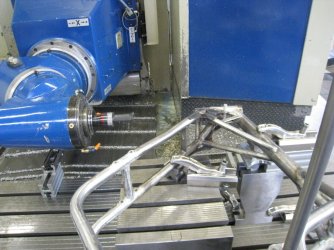
Reckon it took longer to set that up than the actual milling procedure. Both ends in the same set-up? Did you sleeve the frame or fit larger bearings?That´s the reason I milled the headstock of my race bike after welding.View attachment 100833
piet

piranha-bro2
Hero member
- Location
- Melbourne
On-road forces are going to be far greater on the lower bearing than the top - very clear when you see massive lower triple clamps combined with flimsy top ones - the function of the top clamp is mostly alignment. Also clear when you see how much a lower bearing will create pits (that cause self-centering steering/weaving) c/w top bearings.
andre g
Hero member
I did it with the guy who used to work with the big Anayak CNC mill on a Saturday morning.Reckon it took longer to set that up than the actual milling procedure. Both ends in the same set-up? Did you sleeve the frame or fit larger bearings?
piet
It took some time to bring the frame on the bench in the right position, especialy to put it normal to the swing axis pivot.
The headstock was elongated at the lower end as i.e Grant did it. We milled both ends of the headstock in the same position and with the original dia dimensions. The Anayak head turned around the frame to remill the upper end and the machinist knew that he had to compensate some toleraces in that case.
Interesting experience….
But meanwhile I sold the bike because I became to clumsy.
