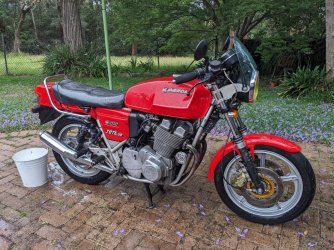
What did you do to or for or with your Laverda today?

I'm a big fan of the gel pad, incorporated into the seat foam. It allows for 500 mile + days, even for a septuagenarian.
I have them in both seats.

View attachment 109178View attachment 109179
What do the pads look like, Hamish? Are they inserts fitted within the seat foam or is it a separate layer? I was considering a combo with inserts or a different layer under or on top to get the most out of the meagre depth of my pad - unlike Mr Beast's generous wad!.
 
Here it comes again; my old story did the same on my Pantah. Parked the bike at a Western Sydney bike show in full sun on a 40 °C day. Headed home, and 5 minutes later I had to stop as my Arse was on fire. It was like sitting on a frying pan. The gel must have absorbed all that heat of the day. I had to get a chilled bottle of water on it, and I think some panflets from the bike show. It took hours to cool down. So maybe it needs some heat barrier to insulate it from radiant heat. Just my experience. Some modern bikes have gel seats, so they must have a way past this. Try an experiment: maybe apply a hair dryer to the gel for a while; don't melt it, but see what effect that has on getting hot and staying hot. Maybe try some Alfol, or that stuff I got to stick on plastic dirt bike sides to stop exhaust from melting them; that gel works great. It's easily the best way to stop numb bum and not require thick padding. Or maybe avoid parking in full Sun; it was unavoidable that day for me, and I had no clue what would happen. BTW, that was thin, shaped foam on the fibreglass and the gel pad, approx. 200 mm x 200 mm x 20 or 30mm on top of that, and then the vinyl cover. Seems that order would be the most effective. I think modern Ducati Gel seats might use Swade covers so maybe thts there insulation, who knows.
 
Just had a look on eBay, and every ad for seat gel has big letters: COOL Gel. I dont know what to make of that; it's absolutely not my experience at all. Maybe they changed the formula for this gel.
 
More google
    • Extreme Temperatures: Riders frequently describe sun-baked gel inserts as feeling like "molten lava," making it painful or nearly impossible to sit down immediately after parking outside. [1, 2]
    • Weather and Color Factors: Dark or black vinyl covers compound the problem by drinking in heat, which then transfers deep into the gel layer underneath. [1, 2]

How to Keep a Gel Seat Cool
    • Park in the Shade: Always look for a covered or shaded parking spot.
    • Use a Cover or Towel: Throw a light-colored towel, a dedicated reflective seat cover, or a sunshade over the seat when you have to park in the open.
    • Removable Pads: If you use a removable gel seat pad, take it off the bike and bring it inside or stow it out of the sun. [1, 2, 3, 4]

Would you like recommendations for heat-reflecting seat covers or alternative breathable seat pads that
 
This will give you an idea of the process, Quentin.

I got one like this and cut it into the foam on the Triple's dual seat.
The humpback seat was recovered by Viking Seats using one of their purpose made gel inserts, under one of Tony O'Connor's Eldorado seat covers.
Very innaresting, Hamish. Have you experienced Vince's 'lava magic' seat heat treatment with the gel insert?

I had hoped to use high density latex - it's amazingly compliant, completely different from any poly type foams, which is why it's so popular in expensive mattresses. I got a 50mm offcut gratis from a mattress place, but it's just too spongy - and by the time I cut to down to 25-30m it wasn't going to be firm enough. I'm tossing around to idea of a thin layer of latex over a thin layer of my new high-density reconstituted remnant. I'll try anything. In the meantime I'll see how the new seat goes.
 
Fettling misfire/splutter on SF1. My bike developed a splutter this year, only came on under load, and was only present for a few seconds. I was convinced it was fuel related, so went through the carbs - DelO 36’s, new jets, check floats etc. No appreciable improvement. Last ride of summer it suddenly we came worse, much worse. Had to nurse it for 10 miles and then it suddenly cleared and was normal for the last 20 miles home. I left it alone with the intent of emptying the tank and checking internals for crap and checking the taps. Before removing tank this week, bike wouldn’t start, fuel there so lets’s chase electrics.

Weak spark, worse on one side. Bike has Lucas Rita and a 1980’s KP02 coil. A nice feature of this setup is that with ignition on, closing the kill switch causes a spark. That showed a stronger spark than when spinning the engine. So maybe the battery is past its best, the Rita needs a decent voltage. On removing the HT leads I can see the caps are quite old, and there’s some verdigris on the spike for the HT lead in the coil tunnel. Thing is, the weaker spark is on the coil terminal without the verdigris, which is not what I’d expect. Today I’ll swap the leads over at the coil, see what difference that makes. Then I’ll clean the coil tunnels, fit new HT leads and plug caps (NGK resistor caps, B8ES plugs, copper cored leads). If that doesn’t give a decent spark then I’ll swap the battery out.

From the web, these coils have a dual output wasted spark -
When the magnetic field collapses, the high-voltage surge leaves Lead A, jumps the gap of Plug A into the metal engine block (earth), travels through the cylinder head to Plug B, jumps Plug B's gap in reverse (from ground electrode to centre electrode), and returns up Lead B to the other end of the secondary winding.
 
Not sure why you want a single dual pole coil - the original Bosch coils worked a treat. And if your battery spins a 0.95hp starter motor I think it will have no problems producing sparks. Might pay to run your voltmeter over the power at the coils during cranking - you'll probably find a significant voltage drop. And also when running (ie not using the startera motor).

A good mod is to run power direct to your coils via a relay, bypassing the ignition switch, the kill switch and several terminals and connectors. Even if you just run a temp lead directly from your battery to the coils and run the motor (on the road) it'll give you an idea if voltage loss is the cause of your troubles. I hate to say it, but you would probably be better off with the original dual points system than an old Rita. The advance mech worked really well if kept in good nick. (Paul Marx would be ROFL-ing! :eek: :ROFLMAO: )

It could still be your carbs - did you thoroughly clean all the passages in the stripped carbs? I've found that the inlets to the emulsion tubes and the pilot jet system on the intake side can be blocked and cause rough running under load.
 
Agree that if it starts fine and the misfire happens while riding it is unlikely to be your battery. No harm in checking charge rate regardless. Better still is as suggested check volts at the coil itself, and run it with a dedicated wire directly from the battery to the coil (with an easy to access disconnect plug). Vibration under load can show up any less than perfect electrical contact so triple check everything from the pick-up plate and at the electronic unit. I had a similar problem once and it turned out to be voltage drop at the original fuse box. Many electronic ignitions (as does my Ignitech) have a twin plug coil, nothing wrong with that.
 
From the web, these coils have a dual output wasted spark -
When the magnetic field collapses, the high-voltage surge leaves Lead A, jumps the gap of Plug A into the metal engine block (earth), travels through the cylinder head to Plug B, jumps Plug B's gap in reverse (from ground electrode to centre electrode), and returns up Lead B to the other end of the secondary winding.
Hard to believe... would mean the bike wouldn't fire at all if the "out going" plug isn't connected.

My experience with double coils shows sparks flying from the HT leads to ground at both terminals.

But has to be correct if the internet says so... :rolleyes:

piet
 
Hard to believe... would mean the bike wouldn't fire at all if the "out going" plug isn't connected.

My experience with double coils shows sparks flying from the HT leads to ground at both terminals.

But has to be correct if the internet says so... :rolleyes:

piet
We learnt exactly this at college- they also explained that one plug would wear the earth tang and the other plug would wear the centre electrode and that it would be good practice to swap the plugs to even the wear…of course no one does.
 
Hard to believe... would mean the bike wouldn't fire at all if the "out going" plug isn't connected.

My experience with double coils shows sparks flying from the HT leads to ground at both terminals.

But has to be correct if the internet says so... :rolleyes:

piet

I had a good read about them as it was new knowledge for me and seems solid info. How would you determine which direction the spark was travelling?
 
The bike came to me with the Lucas and KP02 coil fitted - was fitted by Steve Winterton for previous owner two back. It’s very neat and tidy setup, and worked without a glitch for about the 3000 miles I’ve put on bike. You can also get replacement circuit boards and pickups using modern parts for the Rita relatively at inexpensive price. Rex’s speed shop.

The carbs had been serviced by Ducati Paddy not long before I bought the bike, so I had faith in them. They’d not sat with old fuel so any hassle would most likely be crap in the fuel. None found in the float bowels though.

The battery turns the motor okay at first, but does run out of steam before it should. I charged the spare and the bike battery, and after two days the spare still shows 12.8V where the bike one won’t go above 12.4 even if left on optimate for a few days. The bike has always started on first touch of button.

The sparks are weak though, that’s a cert. My GTL which is not in running state has OE coils and points and gives a fat blue spark on spinning motor. The SF1 gives a weak yellowish spark, weaker on one side. Weaker on button than just flicking kill switch, which should be a clue I think.

I’ll be spending a few hours on it shortly, doing the tests of swapping sides and bypassing ignition switch and measuring resistivity etc.
I wouldn’t be remotely surprised by a CB points ignition giving a fatter spark at cranking speed- I recently fitted a racing ignition to a motocross 2 stroke that seemed not to have a visible spark when testing plug against the head. I had a conversation with the importer of the ignition and he told me if you can hear it “clicking” it’s fine- I was very dubious but gave it a go and the bike runs fine. Certainly a new one on me.
 
Back
Top