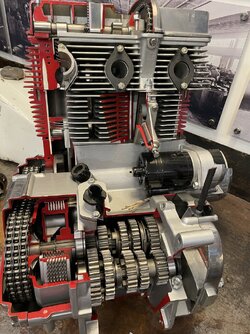
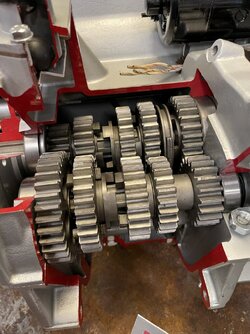
I am curious about the working principles of the gearbox of the triple 180 Laverda 1000.
The pinion that transfers the motion through the transmission chain to the rear wheel is in axis with the main shaft (gear shaft).
How can the layshaft create a mechanical advantage?
1st gear should be the bigger gear on the main shaft engaged with the smaller gear on the layshaft.
My question is: the main shaft is a solid piece or somewhere is disconnected taking the mechanical advantage from the layshaft?
Or better, how the layshaft ensures the mechanical advantage?
Attached a couple of pictures taken from the sample engine exposed at the Laverda museum in Breganze.
Thank you all to help me to solve my curiosity
The pinion that transfers the motion through the transmission chain to the rear wheel is in axis with the main shaft (gear shaft).
How can the layshaft create a mechanical advantage?
1st gear should be the bigger gear on the main shaft engaged with the smaller gear on the layshaft.
My question is: the main shaft is a solid piece or somewhere is disconnected taking the mechanical advantage from the layshaft?
Or better, how the layshaft ensures the mechanical advantage?
Attached a couple of pictures taken from the sample engine exposed at the Laverda museum in Breganze.
Thank you all to help me to solve my curiosity