1978 Jota Wiring (with DMC2 ignition)

Jap44

New member
Location
Bristol
Afternoon! I've had a frustrating morning trying to find out why my Jota won't now produce a spark. It's a new bike to me and I just started it up when I looked at it and when I got it home. To cut a long (and fairly expensive story short) I had to rebuild the carbs as there were bits missing and sort out the brakes. Anyway I put it all back together and it fired up with the tank on. Choke on and she fired up more or less straight away and certainly sounded better than she did. So I thought, balance the carbs! Took the tank off and connected up the vacuum hoses and dummy tank. Pressed the starter button and she spun over but not a spark insight - from any plug or even coil (I took the HT Caps off JIC).
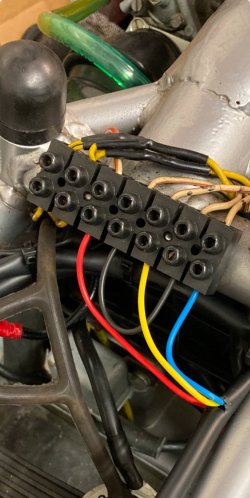
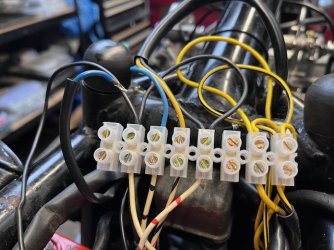
I have downloaded a brilliant wiring diagram from the ILOC for a Series 1 with DMC/2 ignition and set out checking everything wiring wise. I noticed that the terminals on the black connector block that sits to the rear of the tank looked very corroded - so I swopped the original for a nice new shiny connector block - checked against the wiring diagram and all looks well APART from 1 rogue blue wire that was just hanging about ( the blue wire to the WittDMC is there and wired correctly).
I set the DMC2 unit to position '0' and with the ignition on turned the engine over clockwise - turned all my lights off in the garage in case of stray spark but nothing at the plugs. I've read that the original pickups are prone to wiring issues after 40years (aren't we all?).
I have checked the wiring diagram and the only other blue wire appears to be the high beam repeater up in the clocks. My mystery wire is sleeved, has a soldred end and disappears into the loom just below the block connector.
The DMC was installed professionally - (I've seen the bill)and the DMC wiring harness looks fine.
Any ideas?
 

Attachments

  • JOta Blue Wire.jpg
    JOta Blue Wire.jpg
    99.7 KB · Views: 26
Can’t speak to the DMC, but with the Factory system on mine, spinning the engine without having the spark plugs earthed can blow the ignition unit.
 
Have you got the DMC installation instructions?.....in English?.....might help with trouble shooting also good to check which performance curve suits you 10/11 seem a reliably good choice.
 
Yes I have - the ignition unit was set on 10. I’ve printed off your photo and am going to have another look tomorrow. Some times you need to just walk away :coffee:
 
I wish I could give you detailed help, but I'm a series 2 owner. However if your carbs (fairly solid)needed rebuilding and the brakes (very solid) needed work then I'd be very surprised if your wiring was any good! How were those terminal blocks ever a good idea? I'd have a long look at all of the electrics especially near the engine (pick ups, alternator) and unless its been redone those wires are probably on their last legs. You may well find replacing the lot is better than constantly trying to solve different electrical problems. You can also make improvements while your at it, it's not an over complicated wiring system.
 
If the bike ran before you tinkered with it then it should run again in some way or form unless of course you have dislodged,disconnected,wrongly adjusted or reconnected incorrectly something along the way,could even be something as simple as the kill switch being activated,I've had that before with a new owner to a bike that i had sold him!

But don't be too disheartened with your new purchase,get to know her and it will be well worth it I can assure you.:)
 
I did speak to Mr Nairn as he has my RGS having just rebuilt the engine - he sells the Redax Sachse ignition systems I believe are the best now available. I will take another look at the wiring in the cold light of day. Yes checked kill switch, power to coils and earthed the plugs when turning engine over.
 
I did speak to Mr Nairn as he has my RGS having just rebuilt the engine - he sells the Redax Sachse ignition systems I believe are the best now available. I will take another look at the wiring in the cold light of day. Yes checked kill switch, power to coils and earthed the plugs when turning engine over.
My ignitions are Redax/Ignitech, they have nothing to do with Sachse systems at all
 
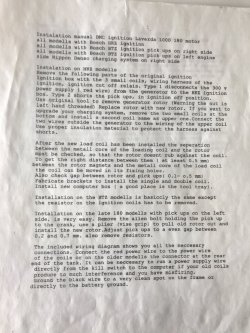
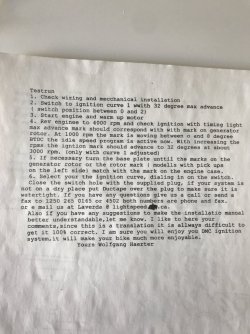
These are the instructions I received from Wolfgang when I purchased my DMC 2 system many years ago. It is basically set and forget unless you are pedantic about the ultimate ignition curve then you have to flip a switch or two on the DMC unit, simple. My bike Jota is a November 1978 production with the HKZ system. HTHs, let me know if you need photos of the wiring on the bike, good luck, Cheers Dave
 

Attachments

  • IMG_E5220.JPG
    IMG_E5220.JPG
    185.1 KB · Views: 17
  • IMG_5221.JPG
    IMG_5221.JPG
    163.1 KB · Views: 18
  • IMG_5222.JPG
    IMG_5222.JPG
    118.7 KB · Views: 18
  • IMG_5223.JPG
    IMG_5223.JPG
    164.9 KB · Views: 19
  • IMG_5224.JPG
    IMG_5224.JPG
    129.1 KB · Views: 17
From the general tone of your original post, I'm guessing you only have a very basic knowledge of electrickery and might need a bit of help to diagnose problems. The following is a step-by-step guide, so forgive me if I'm insulting your intelligence with the idiot-simple instructions. I'm assuming pretty much zero knowledge as a starting point. If you're proficient in auto electrics, then don't bother reading any further.

Before doing anything else, check that all the bike's fuses are intact. Sometimes we forget the simple things.

The wires that go through that connector block are related to the charging and ignition systems. Other stuff like lights, indicators, horn, etc. don't go anywhere near that connector.

The soldered end of that blue wire is nice and clean, and looks like it's been clamped by a screw in the connector block at some stage, so perhaps it was loosely connected before, and you inadvertently jiggled it out of the connector when removing the tank.

There were a couple of blue wires in the original Laverda wiring system but neither of them went through that connector block, so I doubt it's an original wire. It was most likely fitted by someone after the bike left the factory, maybe whoever fitted the ignition.

There is a blue wire in the DMC's wiring harness that's related to the pickups. It goes between the connector block and the DMC box. If it's disconnected then it will disable the ignition, at least partly. One of the ignition coils won't fire. If it's the double coil then the two outer cylinders will be disabled. That would make it pretty difficult to start the bike, although you may hear it trying to start on the centre cylinder.

If the blue wire isn't related to the ignition pickups, you need to do a little more investigation. As it's an aftermarket fitting, the colour is of little help as to its identification. So you need to figure out what it's for. It still may have something to do with the ignition and be the source of your current (pun intended) problem.

If you don't have a multimeter, go and buy one. A cheapo one is good enough for basic diagnostic purposes. They're pretty simple to use and you can't do any harm poking around with one. Some meters have an audible beeper on the lowest resistance scale to aid continuity checking. I find that feature very useful as you don't need to keep looking at the meter when tracing wires. It's worth a couple of extra bucks to buy a meter that beeps.

First, use the lowest resistance scale to check whether that wire has a connection to earth (or ground, frame or battery negative if you prefer - some people are fussy about semantics). You're looking for something close to zero Ohms on the display (or a beep from the meter) between that wire and the frame of the bike. If it does go to earth, then it's apparently an earth wire for something. It may be the negative connection to the DMC unit. You'll need to follow the DMC's wiring to figure that out. If it is the DMC's earth, you've found your problem.

If the mysterious blue wire doesn't go to earth, then it has some other function. Probably a power connection for something. Put the meter on a DC Volts scale sufficient to handle 12V (usually a 20V scale on a cheap meter) and attach the red lead on the multimeter to the blue wire. Attach the black meter lead to an earth somewhere on the bike. If it reads 12V or thereabouts before you've switched the ignition on, then I'd be pretty surprised because it's a direct connection to the battery for something. Possibly something to do with the battery charging system, although the charging connection to the battery doesn't normally go via that connector block.

If there's no voltage reading when you connect the meter, then switch the ignition on. If it then reads 12V you know it's a switched power feed for something, possibly the ignition system. Again, follow the DMC's wiring harness to find out if it's missing its power feed. If nothing happens when you switch the ignition on, it could still be a power feed wire for something, but the power goes into that wire rather than coming out of it (I'm trying to keep it simple). In that case, your best bet is to follow where it goes. The continuity function on your meter can help you find the other end of the wire. If it goes to the DMC unit, there's your answer. The 12V supply wire in the DMC's harness is normally red, but who knows how it was connected up? The blue wire could go to the coils before connecting to the red wire in the DMC's harness. With modified wiring systems, you can't rely on wire colours to tell you what its function is.

If it is the 12V supply to the DMC, use your meter to identify the pole in the connector block that has 12V when you switch the ignition on, and re-connect the blue wire.

If you can't identify any function for the blue wire, and it doesn't connect to earth, then it may just be a redundant wire.

Good luck
Cam
 
Thanks all ! I have the write installation instructions and Cam's pointers so into the garage tomorrow. And JIC my alternator puller just arrived from a nice man in Belfast for £37.50 inc postage ! (y)
 
Back
Top