1981 1200 in Spain

I balanced the carbs, and all 3 were fine. 2-3 months ago. No dirt or water in the tank, plus there are filters on the fuel lines.

One more thing I forgot to mention, and that might be of interest. The engine (and yes, it?s a 180 1200) will start from cold really well with minimum choke applied... however; when hot, it won?t start at all unless I apply the choke again.

As Laverdalothar said in his original post, with all the needed tasks, choke plungers need to be reviewed; just to check them out.

I went down and unscrewed the suspect mixture bolt. Bolt came out, and spring and o-ring stayed inside. Came out with compressed air. Seem to be in good condition. Does the O-ring go "around" the bolt, or does it just sit loose at the end of the "tube"?

I did in the past, but I need to swap the external ignition leads, to see if the problem stays.

Thanks a lot to everybody helping here!


carlitox33 said:
I went down and unscrewed the suspect mixture bolt. Bolt came out, and spring and o-ring stayed inside. Came out with compressed air. Seem to be in good condition. Does the O-ring go "around" the bolt, or does it just sit loose at the end of the "tube"?
O-ring should "fit" on the non-threaded part of the mixture screw. BTW, there should be a little washer placed between the o-ring and the spring.
 
Gravelroad said:
O-ring should "fit" on the non-threaded part of the mixture screw. BTW, there should be a little washer placed between the o-ring and the spring.

Thank you! No washer in my case. Just spring and o-ring.

The Oring was jumping around, not attached to the screw. I?ll try with a generic washer, and see how it goes.
 
The washer is to stop the spring wearing out the o ring. It is not very thick so unlikely to stop the o ring moving around as you say.
 
carlitox33 said:
The engine (and yes, it?s a 180 1200) will start from cold really well with minimum choke applied... however; when hot, it won?t start at all unless I apply the choke again.

It's normal on Laverda if it needs choke when started hot. But when the engine starts it's better to turn the choke off quickly. It has relatively big intake channels and the Dell'Ortos won't give mixture unless there is enough flow on the channels. This is also discussed many times earlier on this forum and I think all of us can agree. Still all individual bikes doesn't need it, depends on idle mixture settings etc.

Funniest Dell'Ortos I have are SHAs (small two stroke carburetors), other on a 50cc and other on a water pump. The 50cc can be kicked forever or pushed for a mile and the water pump starter cord pulled forever, both engines just won't start. And when I push my finger to the air filter inlet hole, both engines start immediately. The carburettors have no needles and the choke is just a restriction plate, they just don't give enough mixture other way.
 
Ok. So I had  a bit of time to check the mixture screw. I will fit a washer, but I had just put the o-ring in its "right" position. Report is in:

1.- Idle is a lot stabler now
2.- Temps are equal on all 3 cyls (success!)
3.- Running is greatly improved. Much more responsive, a lot less noise in general.

I?m really happy, as the bike is running a lot better. However, as I was a bit worried by what I hear as "knocking" under load; so I recorded a 3 minute video of the bike running. Could you guys, whose ears are "ran into" Laverda noises tell me if what you hear is "normal"? The bits where I can hear the knocking sound (although a lot less than before) are:

- Second 20 to 24
- Minute 2,05
- Minute 2,35 to 2,40

Here?s the video: https://youtu.be/qEB2UIxSDAg

Please help me out! Take a look at the video.

Thanks a lot! I?m planning some heavy running already!
 
Carlitox:
Didn't heard well on the video, also cameras have automatic sound level adjustment that fluctuates the sound level.

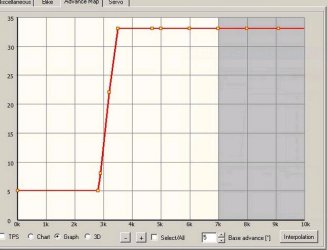
Do you have two channel Bosch BTZ ignition?
The advance curve of it can be seen below.
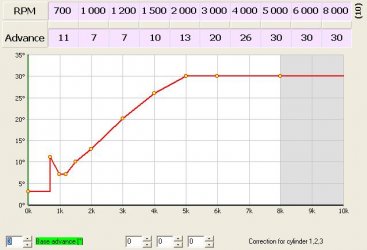
There is also my current advance curve, but it is for 120 degree engine and therefore
quite different to what 180 engines need.
My 120 degree engine did knocked and even pinged when rided slowly on engine speeds around 3000 RPM (speeds around 30 km/h) before I changed Ignitech ignition unit. BTZ gives too much advance on those conditions.

Sounded also a little bit if valve clearances are not adjusted.
 

Attachments

  • BTZ original curve.JPG
    BTZ original curve.JPG
    36.1 KB · Views: 21
  • Ignitech 2017 curve.JPG
    Ignitech 2017 curve.JPG
    35.3 KB · Views: 23
Thanks Motojouni. I do have the original Bosch ignition. Do you mean that I should avoid driving under 3.000 rpm, as the ignition gives too little advance, and is prone to knocking and pinking?

Just trying to understand.

The bike stops knocking at higher RPMs for sure, I have to check where.
 
Carlitox:
I mean too much advance somewhere between 3000 and 4000.

I think it is not actually pinging (like I said) even it made mechanical sound like "ping", but stopped when opened more throttle or rided even a littlebit faster. If it would be actually pinging it should get worser when opening more throttle. It's just knocking. I think it just made riding slow a little bit less comfortable, no other harm on the case I'm describing.
 
Dellortoman said:
Hi MotoJouni. Your ignitech advance curve is interesting. What's the reason for the 11? peak at 700 rpm followed by a dip down to 7? at idle speed?
I have also had previously some issues with idle circuits and therefore the engine used to stall. If idle speed drops under 1000 it increases the speed back to 1000. It actually works quite well. Now the engine idles well between 1000 and 1100 RPM even if temperature changes quite much.
 
Cartilox the Bosch ignitions have the full advance coming in too early I think it may be around the 3000 RPM mark and this may be contributing to your knocking the only way to resolve this is to change to a programable ignition module.
 
It still helps a lot if everything is well adjusted including valve clearances, primary chain, ignition timing and pickup air gaps. On BTZ system the pickup air gaps (between pickup and rotor) have an effect to ignition curve. If the air gaps are different, center cylinder has different advance curve than left and right cylinders.

Personally I mostly like to adjust everything as accurate as measuring instuments can read if possible. Some people have said it's quite sick :)
 
take the primary cover off and check that the crankshaft nut is tight, the correct torque for this is just a tad before the thread strips and cannot be achieved if you do not have a method of locking the crank with a special tool, bits of wood or rag in the chain are of no use, as is, in gear and locking the rear wheel.

Remove the nut, then if the splines on the crank and the nut are not worn..... clean the male and female portions of the thread with a solvent (eg brake cleaner), use a new lock tab, apply locktite to the thread, the tighten using a one metre long spanner, deform the locktab and your done.

If the splines are wormn then report back here for further advice, which does not always mean replace crank , how many years is yours holding now Nicko?

CLEM
 
Laverdalothar said:
yeah - sounds like carburator issues to me, too. Float settings need to be absolutely accurate to get the next steps right, else you simply mask symptoms rather than fixing issues... Follow these simple steps:

-set the float hights to between 17,5 and 18,5mm (cut out credit card is a smart tool!). You can even check this while the carbs are on the bike...: Close the pet-cocks, put a glas or something similar to catch the petrol under the left float bowl, open the center screw and unmount the float bowl. Check the fuel for water (water bubbles remain at the bottom of the glas...). now use the credit-card-alike tool to hold the float up and gently open one pet-cock. no fuel should come out of the carb. If it does, the float-level is set to high and you need to adjust it. Gently lower the credit card and watch if fuel comes out. if not, float level is to low. Repeat that with all 3 carbs

-while you are at it, check the starter and main jet size of all 3 carbs and take a note. you can unscrew them while carbs are installed.

-there is a smal but looong jet installed in the carb body that reaches into a hole in the float bowl. at the lower end, there is an O-Ring. Check this is still in place and not broken.

-turn the mixture screws completely in and then 1,5 turns out (or 3 half-turns). Check what they were set to while you screw them in. if they were different, this might mask another setting issue...

-now adjust the sliders mechanically. remove the rubbers from carb/airbox and pull throttle wide open until the first of the 3 sliders hides in the body. adjust the others accordingly. now check with a 8mm drill how they look like when almost closed. if that is different, the links between the carbs have been bent and you need to straighten them first, else the sliders always run differently. Also open the little cover at the top of the carbs and make sure the little screw fixing the lever on the small axle is tight. if not, take it out, put a drop of loctide on it (not the "glue", but the lighter version...) and fasten it again.

-next adjust the choke sliders. standing on the right side of the bike, you can look into the inlets and will see the brass sliders on the left side of the carb. make sure the move all equally and completely close (!!) when you turn choke off...

-put the rubbers back on and now check how the bike starts and performs. you should be able to lower the idle a fair bit now and have a fairly good running engine...

Oh - and if you have the synchronization connectors (left front side of the carbs, should be connected with a rubber hose between each other), check the hose is air-tight!

95% of the carb issues should be fixed with this, if nothing is worn...

Finally managed to get some time to pull the carbs tonight. Unfortunately, I stopped at the float level part; as I did the credit card thing for 18mm, and found all 3 floats way out of that "measure". The "offending" carb at 24, the rest at 20 and 21. The difference is so large that for a moment I though that perhaps I had a different set of carbs on my bike, but no, I have PHF32 and the correct height is as Laverdalothar mentioned.

I am measuring height with carbs resting on the intake side, over a horizontally leveled ruler.

Will bend the little tang to get within tolerance and then proceed to check all other points. One additional question... how do you take off the float "pins" that hold the floats in place? Mine are stuck in there and there?s no way they?ll come out.

Cheers.

Carlos
 
I measure the float heights with the inlet side down and then tilted a little further over so the floats are just on the fall towards closed float valves. As for the pins: just pull harder...
 
Well... Apart from the float level, I?ve started to dissasemble the carbs completely, so I can give them another thorough clean. I?ve also decided to replace those elements I believe are/look warn, or just as a measure of not having to do them again. Those are:

1.- Gaskets, in general (https://www.stein-dinse.biz/Dellorto/miscellaneous/seal-kits/Carburetor-gasket-set-PHF-D::952.html#prettyPhoto)
2.- Needle valves (https://www.stein-dinse.biz/Moto-Guzzi/Carburator-Airfilter/needle-valves/Carb-Needle-valve-250-PHF-PHM-PHBH-PHBE-PHSB::1464.html)
3.- Mixer adjustment screws (https://www.stein-dinse.biz/Dellorto/PHF-B/D/M/G/P/R/mixture-adjustment-screws:::15_2178_2226.html)

I?ve looked at the pumper?s diapraghms, and they look OK, not hardened or broken.

I need some help here, as I?m lost as to which part fits my 1981 Laverda 1200. :'(

1.- Are these the right parts? (For example, no idea which adjustment screw should I choose)
2.- Are there any other parts I should be replacing "while I?m at it"?

Many thanks again!

PD: BTW... AndyW... it was just a question of pulling harder.. thanks! :D
 
Needles and needle jets, or atomizers, should also be replaced, even if the "look" good.  They aren't...  :D 1000 spec K1 needles work a whole lot better than the stock K14 of the 1200s.  Check the linkage shafts for play in the carb tops, usually the bushes are well knackered.  Well worthwhile to reduce the pumper volume from 10cc to 5cc/20 carb strokes.  Will bump fuel efficiency without peformance loss.  If you haven't already done so, junk all the air box innards, bar the filter.  Main reason the airbox has all that paraphernalia is induction noise reduction, doesn't seem to matter to most owners these days...

You need the adjuster screws with the shorter tip.  I have all neccessary stuff, except slides, in stock.

piet
 
Back
Top