1981 1200 in Spain

Well... I finally got all the carb rebuild kits here, and I?m trying to find some time to get them assembled. Good thing is I had plenty of time to clean the carb bodies and they are spotless.

For reference, this is almost the same as the gasket kit I got (there is only 1 mid-size oring  in mine:
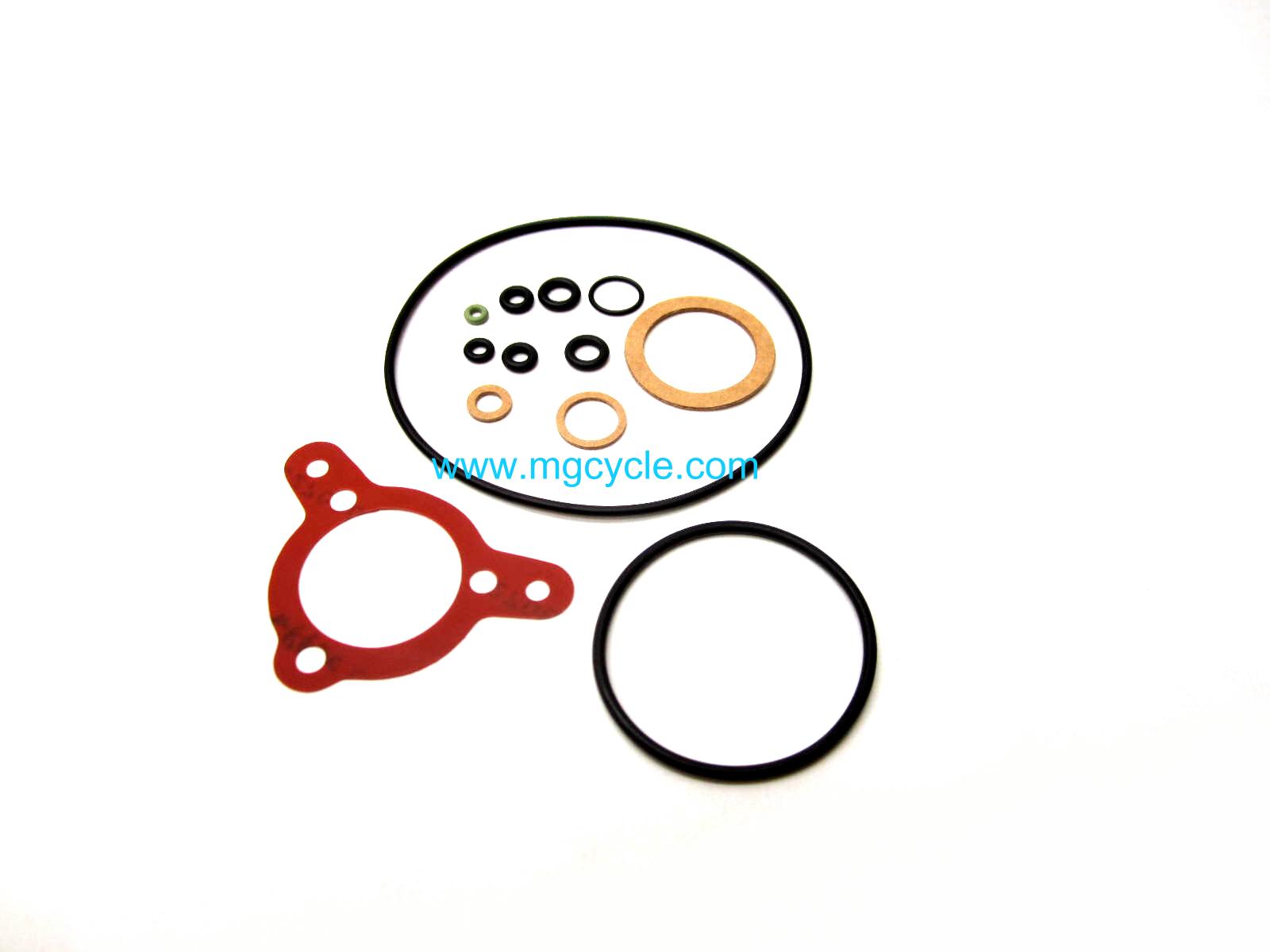
28939911.jpg


I have a few questions, and I?ll probably have a few more. Here we go:

1.- I got K1 needles. In which position should it be?

2.- The new kit includes some pump diaphragm gaskets. My diaphragm?s gaskets seem to be a one-piece. Does the gasket just go on top?

3.- Where does the little green oring in the picture go? I didn?t find any green stuff in my carbs! (well, yes, but it wasn?t rubber orings)

Cheers
 
carlitox33 said:
I have a few questions, and I?ll probably have a few more. Here we go:

1.- I got K1 needles. In which position should it be?

2.- The new kit includes some pump diaphragm gaskets. My diaphragm?s gaskets seem to be a one-piece. Does the gasket just go on top?

3.- Where does the little green oring in the picture go? I didn?t find any green stuff in my carbs! (well, yes, but it wasn?t rubber orings)

Cheers

Needles, middle notch.
Just place the diaphragm gasket on top of the diaphragm, I haven't noticed any difference if it is placed under or over the diaphragm.
The little green o-ring is for the accelerator pump adjusting screw.  Means the accelerator pump should be correctly adjusted afterwards.  Stock setting is 10cc/20 strokes for the 1200, using the 1000 setting of 5cc/20strokes will aid consumption with no loss of performance.

The gasket sets cover more than one variant of the PHF/PHB carb, you will have a couple of bits left over.

piet
 
sfcpiet said:
The little green o-ring is for the accelerator pump adjusting screw. 
[...]
piet

You learn something new every day, thanks Piet. (bigthumb)

I have worked on several PHFs, but never got those adjusting screws entirely out to notice that there is a seal around them, which indeed makes perfectly sense. They seem to be quite long lasting, I never saw one leaking there.

Regards,
Stefan
 
Reading this thread reminds me of (frustrating) times of old.  I think I'll go pull the cover off the Mirage and kiss the Mikuni RS carburetors!  :LOL:
 
lawrence said:
Reading this thread reminds me of (frustrating) times of old.  I think I'll go pull the cover off the Mirage and kiss the Mikuni RS carburetors!  :LOL:

They too will require some TLC in due course, won't be kissing them then! :D

NOTHING lasts forever...

piet
 
It's interesting that rubber parts like gaskets seem to be very problematic in vehicles because those have best before dates. And almost whole vehicles need to be disassembled to change some them.

And many historical vehicles had paper, fabric or some kind of felt cloth gaskets. I think the felt gaskets on shafts did mechanically weared quite fast.
 
Blimey, I'd forgotten about felt seals. They were little better than cave-man technology. I used to have an old Vauxhall car that had a felt seal in the timing cover behind the fan belt pulley. It leaked so I replaced it. The new one actually leaked more than the old one  ::)
 
Dellorto triple carbs have a felt seal for the linkage shafts, they do appreciate a drop of oil every now and then... as do the bushes that hide behind them. :D

piet
 
Felt seals are actually still widely used on some new products. At least it is a common component on new electrical hand tools. Of course these modern rubbers seals are far more suitable to crankshafts or transmission shafts on vehicles.

When felts are lubricated both motor oil and grease can be used (at the same time), or at least that is a standard method here used. On most cases I think better to be lubed before assembling. Any kind of radial force should not be used when it is assembled or it will have permanent deformation and will leak (ring type). It's actually better to littlebit force it against the shaft if possible (stripe type). Assembling depends quite much if it is a stripe or ring type and does it have an outer shell.
 
Well... everything (almost, see end of post) is ready. It?s taken a while, but it is extremely satisfactory.

I cannot imagine how did the carbs do anything before. Most o?rings were broken, flattened or missing. It?s probably a miracle. All cleaned up, new jets, all gaskets and o?rings and new needles (k1) and float needles. Floats are all at the correct height... I?m really looking forward to starting the old lady.

Just something that I can?t get hold of. I?ve been trying to set the carbs pumps to factory spec. There is a great thread on how to do it (http://www.laverdaforum.com/forum/index.php/topic,85883.15.html)

However, after plugging a fuel supply to the carbs, whenever I open throttle, I get zero fuel out from the carbs. Nothing, zilch, nada. :-\

I?m tempted of just making them inoperable, and get out of trouble, but general opinions seem to be to keep them.

Any advice I can use?

Cheers.

Carlos
 
Carlos, I usually advise to replace the 2 one-way valves incorporated in the pump circuit... forgot this time, sorry.

I've spent far too many hours fucking around with inoperable valves, replacement saves time and nerves.  Fit new ones, and I'd wager the pumps start working after only 2-3 stokes.

You could try priming the pumps by injecting some fuel where the top valve sits, in the diaphragm housing.  On rare occasions, I've been able to tempt the pumps to take up work with this measure.

piet
 
Best to follow Piets advice, but if priming still does not help to get them to work, it's usually the diaphragms had become hard with age, with the result that only the spring loaded part of their actuator piston will move when the throttle is opened, but not the diaphragm itself > result is zero fuel is pumped. In that case replace the diaphragms.

Regards,
Stefan

 
sfcpiet said:
Carlos, I usually advise to replace the 2 one-way valves incorporated in the pump circuit... forgot this time, sorry.

I've spent far too many hours fucking around with inoperable valves, replacement saves time and nerves.  Fit new ones, and I'd wager the pumps start working after only 2-3 stokes.

You could try priming the pumps by injecting some fuel where the top valve sits, in the diaphragm housing.  On rare occasions, I've been able to tempt the pumps to take up work with this measure.

piet

Piet, do you mean the #54 part in the diagram Tom sent us? I?ll do as Tom proposes. And see what happens.
 
#54 and #68, both are one-way valves and prevent fuel from leaking back after being drawn into the system.  One keeps the pump feed primed, the other keeps the delivery side of the circuit primed.  If one of them leaks, you will never get the pumps working satisfactorily.

Even if they are internally clean, they have been subjected to decades of vibration and corrosion.  The valve seats are tiny, and the smallest leakage renders them useless.  I did assume your diaphragms to be supple to the touch, they do get stiff when dried out for any length of time.

When overhauling carbs, I throw out and replace all these components, I just don't trust the old stuff.  Besides, saving a few pennies here and there is quickly gobbled up by the extra labour time required for getting nowhere...  The result is a set of carbs that usually work as intended the moment they are replaced on the bike.  Normally just a touch of adjusting the balance and the idle mixture, adjust idle speed and all is well.

piet
 
Good morning everyone. I finally put together the carbs las the night, and connected them to a fuel source to try the pumpers.

Even priming them, I have no flow from the side carbs and a river of fuel from the middle one.

For the moment, I?ve Just taken off the diaphragms until new parts arrive.

I have one issue, which is fuel overflowing from center carb, from the center hole of the engine carb side (three holes in the bottom of the carb opening). I thought I?d wrongly set up float height, but it seems to be fine.

Any idea why fuel would just flow from there?

Regards
 
Float is sticking open.
Are you going to replace the 2 x one way valves for each carb relating to the accelerator pumps too, as well as new diaphragms?
 
Grant said:
Float is sticking open.
Are you going to replace the 2 x one way valves for each carb relating to the accelerator pumps too, as well as new diaphragms?

Thank you Grant. I?ll see what may be going on with the float. I am planning on replacing all 6 valves, but diaphragms seem to be quite soft and flexible, so will keep. They are bloody expensive as well!

Regards.
 
Back
Top