3c starter relay

Jo

Hero member
My 3c had been having trouble starting for a while.

When I pressed the starter button, different things happened. Sometimes the starter motor pulled, sometimes it only turned for a fraction of a second. In any case, it was an inconsistent picture. However, with patience and several attempts, it always started.

After I had checked the starter motor with friend Jürgen in May and installed an additional earth cable directly from the battery to the starter motor before the trip to Breganze, which didn't change the behavior described above, it refused to start for the first time on Sunday before the trip home from Laverda-Meeting in Heftrich/Bauschheim. A mate helped out with a power bank, with which I got it running.

But now it was clear to me that this problem couldn't be put off any longer.

Today I removed the starter relay and the two fat positive cables. All connections had been found tight and uncorroded. Took the whole caboodle and drove to Jürgen again. We opened the relay, it looked very good overall, except for the contacts, which were slightly burnt:
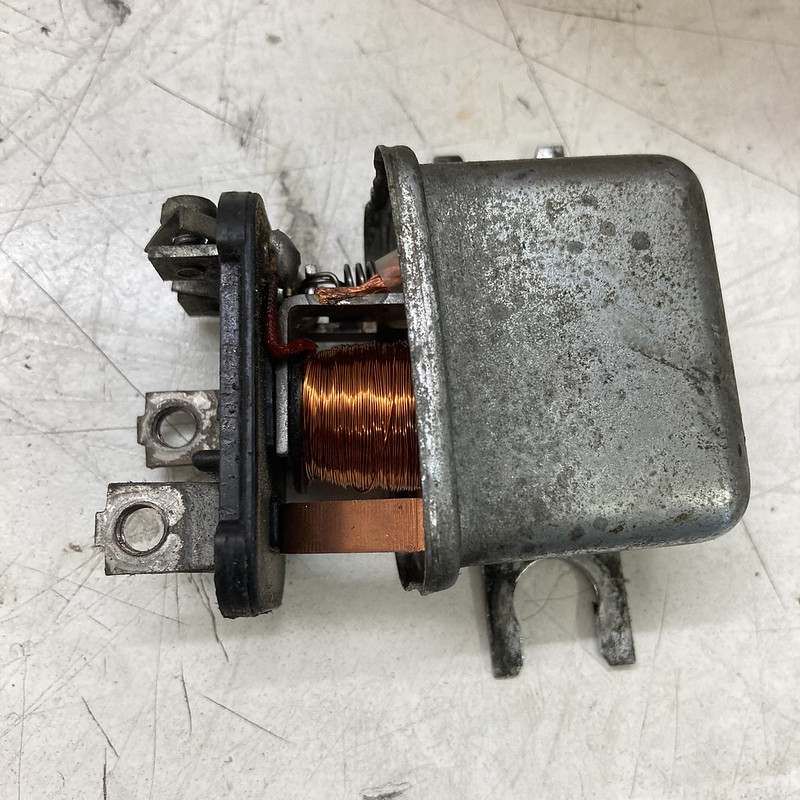

53920524471_9df3dcfa39_c.jpg


53920524396_087bbcba67_c.jpg


We smoothed the contacts with emery cloth and reassembled the relay. Jürgen then made me two new thick positive cables - thank you very much for that! I've just put everything back together and the starting behavior is like new.

If the relay starts acting up again in 50 years, I'll complain to Bosch!

Cheers,
Jo
 
Last edited:
You have to watch those relays Jo, I have had plenty of trouble with them over the years. When the contacts stick on it's worse.
 
Can replace with an Aprilia Mille one if it fails again - mine welded the points together and run the starter continually until i disconnected the battery ;)
You have to watch those relays Jo, I have had plenty of trouble with them over the years. When the contacts stick on it's worse.

Had this happen on my Miller - no fun - luckily there was a skilled mechanic nearby who was very quick-witted and unbolted my seat and the battery within a few seconds (I was prepared to start with 1st engaged and hold the Aprilia in place while shouting him to take a 4mm allen for the seat cushion and so on).
 
I've travelled that same road Jo. Once the starter relay had been apart and contacts cleaned it never performed reliably. Well worth replacing the relay with one that has a higher current rating to avoid the nightmare of welded contacts, as Sir Sid suggests.
My theory is that old starter motors in need of overhaul and deteriorated cables see more current being drawn than the relay contacts can safely handle.
 
I've travelled that same road Jo. Once the starter relay had been apart and contacts cleaned it never performed reliably. Well worth replacing the relay with one that has a higher current rating to avoid the nightmare of welded contacts, as Sir Sid suggests.
My theory is that old starter motors in need of overhaul and deteriorated cables see more current being drawn than the relay contacts can safely handle.
Exactly this. I also had the relay stick closed, while loaded with luggage... took a while to get to the battery! Never again, I now have a generic car solenoid, and bigger, shorter cables connected much more directly.
 
Same same except for the sticking-on bit. It first started, a little pun on a 1200k trip to Melbourne in pretty bad wet weather when halfway there the starter stopped working. Bumpstarting with luggage got old real quick. So I got home and the local old-school Auto Electrician rebuilt the starter, that was the first time I saw it being used as a wood router to check if it could take load after being rewound. So I am thinking all good and then a week later it wouldn't turn over again. That was the original starter relay, the sparky filed it. That worked for a month and it failed again. By then I was dealing with Mr Wilson and his Green Smoke Magic. That included converting the original EI coil to another charging coil and a regulator controlling the charging and I think a Suzuki starter coil. The bike went and started much better for a good decade after that.
 
Well, I was touched in a way that the old stuff was so transparent and easy to repair.

Of course I also see the other side of the coin and thanks to you for the relevant advices. The relay that snapped on my Miller was not the original, but an aftermarket part of (as I now know) inadequate quality.

Then I'll drop my romantic approach and start looking for a suitable replacement ...
(y) :)
 
Last edited:
.... put the original starter relay on the antique shelf with other "served their time" parts that did work..sort of... nothing wrong with nostalgia, just not on a road riding Laverda, especially safety first.

Starter relays are basically unquenched electrical contacts, quenching can be done though the snubber components would be very robust and bulky.

The contacts actually weld shut on the release of the starter button, high back emf and ensuing arc, over time heating reduces the spring tension on the contact support arms, ie why dressing up the contacts post welding will not address the lack of spring tension in the support arms.... and consequent lack of rapid contact opening velocity to snap the arc process.

Yes Vince, owner/riders have the bike problems, the remedies were readily available in the day.... pleasure all round when the problem(s) are removed... very satisfying. The many chats post repairs, also a side benefit. j

Any barrel style module starter relay from the wreckers will work, japanese quality and low cost, easy to fit and have an on board fuse to feed the down stream 12V electrics. Kwaka GPZ ZZR 250cc et al are more than capable for the 0,6kw bosch or SICE ( spelling? ) motors. j.
 
Posted before ... I'm using a unit from a big Jap twin - no dramas and don't expect any - has fuse plus output for an external non-switched circuit (maybe for a battery tender. Nice kit.
 
Starter relays are basically unquenched electrical contacts, quenching can be done though the snubber components would be very robust and bulky.
I'd never thought about arc quenching in a starter motor relay. Having the contacts weld themselves is not something that's ever happened to me so I'd not really given it much thought. But having a starter relay stick on would an alarming situation. Perhaps more so with a car than a bike. It makes a battery isolator switch seem like a good idea.

When I was building substations, arc quenching was done chemically with the contacts in a capsule full of SF6 (sulphur hexafluoride), or with the contacts in a vacuum (arcs are made of ionised gas so can't form in a vacuum, and SF6 doesn't easily ionise). I very much doubt you can buy small SF6 relays but you can buy vacuum relays if you're really keen. They're not even particularly costly.
Here's a 100A vacuum relay that would do the job:
Come to think of it, the condenser on a set of ignition points is a simple snubber circuit. I'd guess the capacitor would have to be a whole lot bigger on a starter motor circuit.
 
When i was at the Electricity Commission, interrupting 330,000V feed lines was done with compressed air and an "arc shute" and air cylinder of some 1,5-2m in length and maybe 1m in diameter drove a vane arm to swing the contact arm and the residual burst of compressed air ( high psi ) blew out the arc as it formed on the travelling rotating arm. Favourite was to send in new comms tech like me into the switch yard and then blow the breakers from the control room outside the yard, hard to say if it cured or worsened a nervous disposition, the bang and hissing rush of the arc was memorable.

Yes Cam lots of big toys for big boys and gals in engineering, disk sealed very high frequency valves ( tubes in USA ) with ceramic "chimney" with high velocity blower feeding from under the chassis, 4CX250 ( have a bunch in the stores here..somewhere...) used a vacuum variable capacitor, work of art. These disk seal valves where a military valve ostensibly, we used to make transmitters to bounce signals off the moon, why... dunno why... we just did... another exotic was bouncing signals off meteor tails/trails... think i may have stood in front of the transmitters once too often... where these rambling messages come from.... i blame the moon and meteors.... or the Russian TV i use to watch during Sporadic E propagation October and maybe Feb March... on a 3 beam 6m ( wave length for 52-54Mhz ) Yagi, all home made of course.... nothing wrong with me a channel change wont overcome... rotary selector if you please...j
 
( all ) Too kind, indulging the errant child that resides here, also the many of you... naughty boys on powerful Italian motorcycles.... hard to deny, a smile. j.
 
I might jump on this thread and ask a question.
My bike is not starting via the starter motor, after I washed it and parked it in the garage. I hit the go button and all I get is a tick from the starter relay. I cleaned up the contacts on the relay, along with a new battery and nothing. Is the ticking from the relay telling me anything? I don’t know what to check now. Any help is greatly welcome.
 
Clicking implies that the current from the starter button is getting to the low amp circuit of the relay but not necessarily making successful contact between the battery and the starter motor itself. Have you got a really good earth from the motor to the neg battery? And are both the pos battery strap to relay and from relay to starter motor heftyand are the contacts at each end of those sold (at battery +, relay in, relay out and starter motor)?

Try running jumper leads directly from a fully charged battery, pos to the starter motor and neg to a really good earth point on the motor (bolting onto battery and bolting to motor the safest way).
 
The (original) relay can be taken apart; if you sandpaper the contacts, it normally is good for another 20 or so years. That would be my first thing to do...
 
Back
Top