4 row primary Drive & Power outputs, Crank balancing, Con Rods, Alloy casting.

Phil. I balanced it static on a par of parallel narrow edges. I made it neutral with equal weight hanging from each rod then set the balance up for one side while the other side was neutral. This should be the same as each as a single and was the advice at the time. Dynamic balancing would have requiring dismantling several times and I don't like pressing things apart unnecessarily; also I'd have had to trust the piece of unobtainium to someone else's hands. As others have found there wasn't much metal available near the crankpin where it needed to come off. I also got good at hand-sharpening cobalt drillbits; as you know the inner flywheels are the same hardness as the crankpin, being one piece on the SFC crank and no joke to drill. I'm very confident it is at the factor I did it to. However you never know how good it can be. Being a pretty big and invasive job I won't alter it before I have some proven data. We've always felt that the rocking couple due to the distance apart between the cylinder centres as Piet has mentioned is our limiting factor.
What is the general opinion regarding service life of the conrods?
Almost every wrecked bigend I've seen on a twin was caused by overflowed oil slingers.
 
Hi Tippie - Can't really say what the life of a rod may be, but.,For racing ,we used to encourage customers to have carillos on their twins, many couldn't afford it, so I used to have the beams polished then whole rod shot peened to try to extend its life. Amazing how many people had no qualms about going racing with rods that were 20+ years old - preferred to spend cash on head jobs etc!
Rob - I've put shorter rods on a twin, but never longer rods on a triple - regards - Phil
 
Phil you have to remember with age comes quality. The best F1 engine ver was the BMW turbo where the blocks were from a standard engine that had been stood outside getting "weathered" for years. :D :D :D :D :D

Andy
 
andychain said:
Phil you have to remember with age comes quality. The best F1 engine ver was the BMW turbo where the blocks were from a standard engine that had been stood outside getting "weathered" for years. :D :D :D :D :D

Andy

The old NASCAR guys did the same thing. They would get the newly machined and cast iron blocks from Detroit and leave them out in the weather, for a few years.

Every new racing engine was built with an old rusty block from the woods around back of the shop.

Sounds good, but i have no idea why it would make any difference.
 
I thought BMW used blocks off cars that had done 10s of thousands of kilometres as the heat/cool cycles de-stressed the blocks and made them less prone to failures or more dimensionally stable or something.
 
It seasons the casting, lets it move around and releive internal stresses, idealy they are then rough machined and left again before finishing. One of my jobs at a place I worked at years ago was to machine Monel metal components for big thermionic valves, they took weeks, everything was machined  0.030" up then the parts were left to stabalise then machined 0.010" up, left again then finish machined.

   Keith.
 
BMW did use road engines with loads of miles on but in the days of turbos they went through a great many engines and blocks so seeing a shortage on the horizon they chucked new ones out in the yard. I still sell to a couple of BMW engine builders and the new parts they use tend to be gaskets, valve train and of course chains. As with the Porshes they use duplex but although I have tried to get them to fit simple they wont, so its just the Jags, TVRs and Porsche that run singles.

I would think the same priciples would work on Laverdas with the weathering thingy.

Andy 
 
Forced induction was mentioned earlier in this thread - did any of the handful of turbo Laverdas ( Malcolm Cox etc., ) ever end up on a proper dyno ?

Ally
 
The BMW F1 crew scoured scrapyards for used 2l 4 cylinder blocks to build thier 1.5l turbos....sure, they blew up loads, but I'm quite sure they knew what they were doing!

Tippie, we have also come to the conclusion that the 270 twin needs to be regarded as 2 singles.  We have acess to a balancing jig and will balance each crank web individually which allows us to machine further if needed.  Loads of calculations necessary, though.

Rods last almost indefinitely with proper maintenance.  Filled slingers is usually a sign of prolonged oil change intervals, or just using poor quality oils.  Lots of magnetic solids in there meaning a lot of abrasion going on inside.  Once that crap is forced through the big ends, there goners.  Unfortunately, big ends can wear/distort slightly oval, with as much as 0.03mm difference in diameter top/bottom, front/rear.  Some can be reclaimed by honing, some are just too far gone.

The big end cages wear the conrod a bit, looks dramatic but doesn't really cause any harm as the rollers still have clean races to roll upon.

piet
 
Piet. Do you mean that we need to press it apart and do each side separately instead of neutralising one and balancing with the other as we have done?
And do you individually balance each separate flywheel web after you have calculated exactly how much weight to have it neutral? That is really a massive job and not something to experiment with over and over. You'd have to be sure that the factor you balanced it to would be right on the money.
With the rods my concern is fatigue. Racing bikes do very few miles. We're get just over an hour of track time at a race weekend. We get practice, qualifying and race on day one, then warmup and race on day two.  About 15 min each session. Even at a training day we get 3x20min sessions. From memory average speeds are only about 115kmh despite it feeling like you are in the upper gears most of the time. At the most I've done 4 meetings a year and maybe 2 training days. There aren't many km run up.
Bearing surfaces we can measure but fatigue failure comes out of the blue. Phil, did you see many SFC or SF racers with snapped rods or is ovality the main problem? Are the Carillos so much better than SFC rods or SF ones like Piet has modified?
I've seen a factory supplied SFC crank with all the big-end rollers cracked apart across their diameter after not so many road and a few track miles. Analysis by bearing technicians gave the cause as that the rollers had squared ends. In their application they need radiused ends and that is what came in the SFC crank I have now. That crank with the broken rollers and its rods measured perfectly within spec, no damage to the bearing surfaces despite the as you say Piet the ugly marks from the cage. Bloody good quality to withstand that.
True that poor attention to oil changes fills the slingers. I've had the muck from the slingers analysed and as you say it is mostly iron probably mainly from the cylinder likers as they wear. I have also seen that something like a melted piston can top the slingers up pretty fast. In my own oil drain plates I have fitted a round (donut) magnet from a speaker under the strainer. It grabs all the iron out of the oil on the way to the pump. I can post a picture if anyone is interested.


Tippie said:
In my own oil drain plates I have fitted a round (donut) magnet from a speaker under the strainer. It grabs all the iron out of the oil on the way to the pump. I can post a picture if anyone is interested.

I'd like to see it Tippie, I have a magnetic drain plug but thats a long way from the Liners and an extra one there would be neat !

Rob
 
Tippie,

The crank needs to be dismantled for new bearings and lightening work anyway, so each web can be balanced individually.  Calls for a lot of calculating, got a college teacher mate who's a wizard in maths.

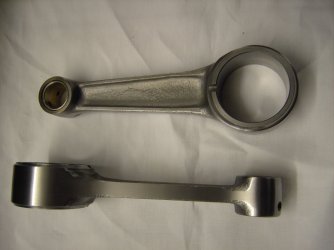
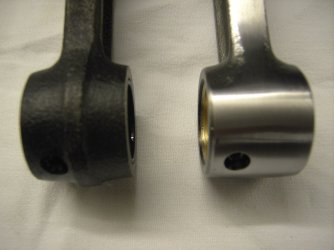
Here's a pic of a pair of conrods I re-worked recently.  Weight saving is only around 45 gr., but they are now equally balanced top and bottom.  Stock rods usually show huge differences.

The Carillo rods certainly will not snap where the stock ones do, but there have been several issues with the big end bearing liner coming loose.  Strangely enough only in engines that others have assembled, never in engines I or OCT have done.  We're assuming the bearing clearance was too tight on assembly.  Have experienced quite a few Carillos that were a bit tight, needed slight honing for proper clearance.

Have never found out why the stock rods let go, more triples than twins, too.  Unfortunately, the battered bits don't give much of a hint why the bloody things fail, haven't come across a rod that showed signs of giving up.  What's puzzling is that they usually let go in mid-range, very seldom at high revs or heavy loads.

The crap accumulating in the slingers often tells a sorry tale, of engine blow-ups, worn bronze bushes, shattered pistons..... the different materials gather as rings in the slingers and can be clearly seen if the slingers are removed.

piet
 

Attachments

  • Neu_PICT1232.jpg
    Neu_PICT1232.jpg
    136.8 KB · Views: 28
  • Neu_PICT1235.jpg
    Neu_PICT1235.jpg
    141 KB · Views: 27
  • Neu_PICT1247.jpg
    Neu_PICT1247.jpg
    156.1 KB · Views: 79
Keith,

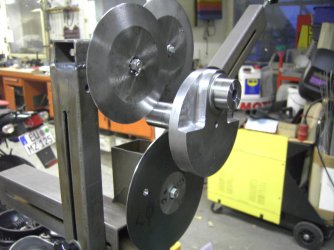
It's a re-worked web from the centre of a 180? triple, the one carrying the cam drive sprocket.  The pin is removed and replaced with a smaller pin to which washers are added to simulate a master weight.  Not balanced in the pic, was just setting up when I took it.

piet
 
No, just a lightening/balancing exercise on a triple.

The crank web and the rods are from different cranks...... sorry for the misconception

piet
 
A bad day at the races, conrod 'let go' with devastating results. Punched out the gearbox, starter, and both upper and lower cases fucked along with extensive internal damage.
 

Attachments

  • 20100928085150.jpg
    20100928085150.jpg
    38.8 KB · Views: 59
  • 20100928085215.jpg
    20100928085215.jpg
    158.9 KB · Views: 61
Most likely, if it is like mine when it broke the centre conrod, the head will be trashed. Piston continues North, taking out the valve, guide and anything else it can fond. The only things salvageable from my motor were the gearbox, starter motor and engine casings.
 
Grant said:
Most likely, if it is like mine when it broke the centre conrod, the head will be trashed. Piston continues North, taking out the valve, guide and anything else it can fond. The only things salvageable from my motor were the gearbox, starter motor and engine casings.

Sorry to see that Graham ?

Grant, mine didn't damage the head or valves and even the piston damage was minor, it did take out the liner skirt. The rest was very similar to the mans bike below.
Rob
 
Back
Top