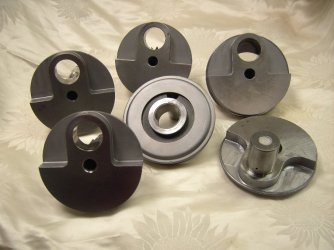
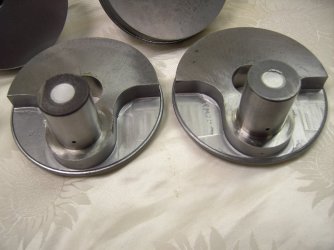
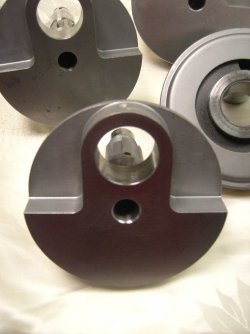
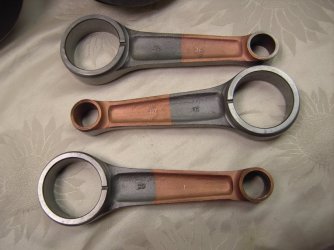
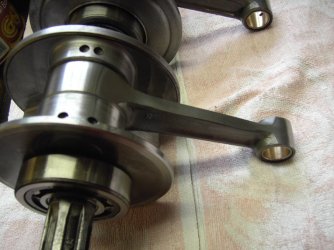
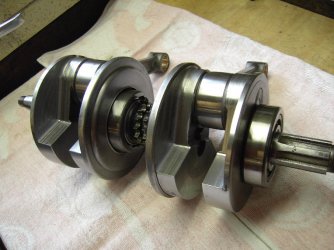
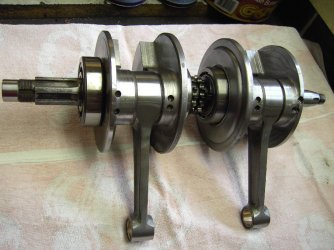
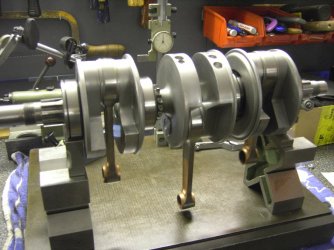
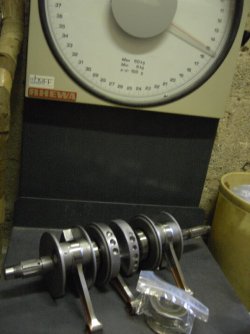
Crank work has progressed a bit.... finished the tedious milling of the triples' crank webs. Rolled the slingers back on this evening.
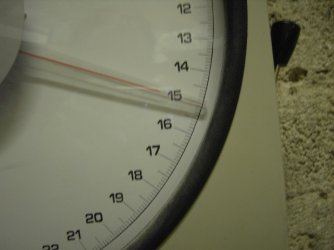
Next step is weighing and determining master weights. Once that's done, the individual webs can be balanced and the whole caboodle stuck back together.
Interesting thread. I always enjoy seeing what people are working on in the Laverda world.
Couple of things....
Many many years back the original motor from my '81 Jota had a rod come loose while cruising at a steady speed in the 55-65mph range. In my case I believe it was an oiling problem though as the piston seized in the bore and the rod small end ripped out of the pin boss. I was however rather lucky as the flailing rod only broke off the cylinder liner. No case damage. The piston however was stuck near TDC so the valves...well they were modified a bit
The other thing, a slightly off topic question. Looking at the Mkv Motodd spec sheet Scrumpy posted earlier I see a claimed weight of 362lbs. Is this correct? That seems seriously light for a triple. My Spondon framed bike carries almost no steel outside of the motor (even the misc bolts are aluminum) and bodywork made of a single layer of carbon, magnesium wheels, all aluminum frame, etc. and it weighs in at a bit over 400lbs with a half tank of fuel. Where the heck did someone find more than 38lbs? If I tried I could probably pare off some ounces here and there but 40lbs?
I always wonder what the vibes would be like if you fired one of those triples with the outers firing together and the centre at 270 degrees, Sort of like a funny 270/450 twin! in theory it would stop rocking couple completely and help secondary balance "sort of" and sound real funny!
Wouldn't recommend someone else trying it unless they had a mixed up mind like mine, but will do it one day just to stop me wondering "what if?"
Bloody beautiful work Piet.
Julian, in the early ?70s we talked ourselves hoarse about experimenting with firing orders just like you are now; it stemmed from the differences between flat-plane and stepped crank V8 engines. Nothing ever came of it. Beside for Phil Irvings twins I don?t think anyone else did either. The first I heard was a Jap 4 sidecar racer in NZ in the ?80s who tested but I don?t think raced it; nobody had heard an engine sound like that before. Then came the GP500s and then Yam with their twins and now fours. Do it!!!
I think the motor in NZ you refer to was a GS1000 speedway sidecar - word on the grapevine here is that the pressed up crank twisted with the revised firing order, hence doubled torque peaks....
Big - banging a 180 triple is certainly possible but will it take it ?
Yes, Rob, the RH web is very f****** hard, as are the 2 inner webs with the integral pins. Cost me 2 solid carbide end mills, both so dull they won't even cut cheddar decently! I bead-blasted the webs to cover up the unsightly cutting marks....
A friend is doing the maths for me (will take me too long to get into it to fully understand the balancing magic), hopefully I'll be able to present the finished item within the next 2 weeks.
Julian, have also thought of a "twisted" triple, ie, the centre set at 90? to the outers and the outers firing simultaneously. Might even work from a balancing point of view, bearing loads work out within the range they are as stock, but nobody knows for sure if it will last and how it might behave. I'll let you have the first shot at it!!
A little update in my crank lightening adventures....
Starting point was a SF2 crank in good condition. Goal was to lose as much weight as possible without sacrificing rider comfort or reliability. Crank is to be used in a racer of some sort.
Total weight now is 12.6 kg including outer mains. Stock weight is around 15.4kg, so that's almost 3kg lost.
The small drillings around the crank pin bosses are remnants of the original ex-factory drillings. We calculated the size and shape of the bobweights to get them as equal as possible and also needing as little drilling as possible for final adjustment. Getting all webs equal in weight and weight distribution helps reduce the rocking couple within each web pair and reduces bearing loads as well as flexing within the crank itself.
The first one we did on maths alone worked out fantastic. A stock 750, just optimised, as in conrods and pistons matched, and balanced accordingly. Never rode a SF3 before with clear images in the mirrors at 6500......
Cannot state an exact amount Tippie, but it's not cheap.....
As it stands at the moment, about 20 machine hours of work in the crank and rods, then another 3 for the final balancing plus the normal disassembly/cleaning/measuring/assembly/truing which on average works out to 6-8 hours. Don't know how to get the time taken for the calculations into the equation, but I think you get the idea....
If we find a reliable company willing to take on the CNC milling of the webs we can surely cut costs dramatically.
Reviewed the balancing with my mate the maths genius and pared off another 400 gr.
Balanced each web individually and stuffed it all together again. Total weight is a shade over 15kg, makes a saving of 2.9kg, using Robs' crank on his bathroom scales as a benchmark. Cannot really state the weight before modification, the thing is built from odds and sods I had laying around! Inertia has been reduced by almost 34%, so I'm hoping it will spin like a stroker.....
Will be tearing down the motor next week and hopefully get it all back together before the end of the month.
This site uses cookies to help personalise content, tailor your experience and to keep you logged in if you register.
By continuing to use this site, you are consenting to our use of cookies.