
You are using an out of date browser. It may not display this or other websites correctly.
You should upgrade or use an alternative browser.
You should upgrade or use an alternative browser.
4 valve balance shaft engines
- Thread starter Vince
- Start date

chrisk
Hero member
- Location
- Brisbane, Australia
Never had experience with the balance factor guff.I have read a few times about removing these shafts on road race bikes to increase power and reliability. Will that produce the vibes contained by their action? What's the story regarding this mod?
But remember my Jawa speedway bike had been converted to a total loss battery (like a Tesla) ignition when I got it. The magneto was still complete, because the points ran off the end of the magneto shaft.
I pulled the magneto apart and turned down the magnets etc, until it was just a shaft,
The power increase could be felt immediately.
I should think removing and unneeded spinning mass would have the same effect.
But vibes????
Reducing vibrations is the whole point of these gadgets, Chris. One of the Honda XR 250s a mate owned had a chain driver balancer; the chain was stuffed, that chain was loose as a goose and had allowed its weight to move from its correctly timed position. The vibrations became insane plus distructive. I guess there are restrictive loads generated by driving these shafts, so I expect that when not driven, engine power would increase. But in the case of these engines, people would have direct experience of what happens with them connected and not connected to both power and vibrations. There is zero chance of me doing this to my Atlas, but I would like to understand the effects.

piranha-bro2
Hero member
- Location
- Melbourne
Removing the balance mech is just removing rotating mass and surely no different from reducing the rotating mass of the crank - every crank produces SOME flywheel effect. There's s limit to how much weight you can remove before the thing will be no good. Endlessly removing weight isn't going to continue to produce more power. So to my mind, I'd remove weight from a crank before I'd toss a counterbalance system.
And then there's the torque factor - VW added weight to the crank in their rally cars and they immediately produced a higher top speed.
And then there's the torque factor - VW added weight to the crank in their rally cars and they immediately produced a higher top speed.
chrisk
Hero member
- Location
- Brisbane, Australia
VW added weight to the crank in their rally cars and they immediately produced a higher top speed.
That reminds me, check out the Caddy parked outside the VW dealership in Coffs Harbour


Vince,
The later 500s had only a single gear-driven bobweight located under the clutch cover. Pretty straightforward and nothing much special. The 180° twin is actually well-balanced from the start, just the rocking couple to deal with. The bobweight was meant to counter this. I don't see a terrible amount of "power" to be unleashed if it is omitted. Probably not much to be lost either, the earlier 500s did well without it, I haven't heard of any crankshaft differences between the 2.
A proper balance shaft was introduced with the OR600. Again, gear-driven and located forward of the crank. The shaft carried 2 bobweights, one at each end of the shaft, countering the imbalance of both individual cylinders. Never came across one that had shit itself other than finding a 1/8" bearing ball imbedded in one of the drive gears, heaven alone knows how it got there... The OR runs a great deal smoother than either of the 500s.
The Zane models use much the same set-up as the OR. Over time, the shaft itself was thickened/reinforced, but I have never found a broken one. What I have found though, was incorrect seating/fixing of the drive gear of the shaft, one more of the many design/manufacturing flaws that plagued the Zane bikes. The gear could come loose from the shaft, shearing the 3 fixing screws. Provided nothing was badly damaged, this was an easy fix by skimming a few 0.1mm from the RH bobweight and providing a more secure fixing by the central nut holding it all together.
Don't over-think it Vince, your Atlas will do just fine.
piet
The later 500s had only a single gear-driven bobweight located under the clutch cover. Pretty straightforward and nothing much special. The 180° twin is actually well-balanced from the start, just the rocking couple to deal with. The bobweight was meant to counter this. I don't see a terrible amount of "power" to be unleashed if it is omitted. Probably not much to be lost either, the earlier 500s did well without it, I haven't heard of any crankshaft differences between the 2.
A proper balance shaft was introduced with the OR600. Again, gear-driven and located forward of the crank. The shaft carried 2 bobweights, one at each end of the shaft, countering the imbalance of both individual cylinders. Never came across one that had shit itself other than finding a 1/8" bearing ball imbedded in one of the drive gears, heaven alone knows how it got there... The OR runs a great deal smoother than either of the 500s.
The Zane models use much the same set-up as the OR. Over time, the shaft itself was thickened/reinforced, but I have never found a broken one. What I have found though, was incorrect seating/fixing of the drive gear of the shaft, one more of the many design/manufacturing flaws that plagued the Zane bikes. The gear could come loose from the shaft, shearing the 3 fixing screws. Provided nothing was badly damaged, this was an easy fix by skimming a few 0.1mm from the RH bobweight and providing a more secure fixing by the central nut holding it all together.
Don't over-think it Vince, your Atlas will do just fine.
piet
Thanks, Piet, just interested in learning as much as possible. What's not to like with from my reconing the most advanced engine, barring big daddy V6, Laverda ever made? Detuned from the road race models, slightly lower compression, I guess, 4 valves per cylinder, alloy barrels with ceramic coating, not sure on that one, 6 speed gearbox, and better balance shaft design, the now impossible to find alloy CNC inlet manifold and a brand new version 3 Cox exhaust. Now if only you could find cam chains for them, and hopefully soon new clutch plates, thanks for supplying my new bits mate, that allows finding neutral, all will be tickty boo.


Last year I had a discussion with Richard Bulkley why it is hard to find the neutral at our Zane 650.What makes you think I don't ride it? It did a few hundred kilometres of dirt a while back on a solo trip I did through The Wadigans and out past St Arbans. It's just painful in traffic, not being able to select neutral.
We find out that the selector drum has a raised ball on it which presses against the contact off the neutral switch.
When the switch is to deep it needs too much pressure to push the switch.It push back out of neutral.
Put an extra ring under the switch so it’s less deep.
I did at my 650 and it works! Much easier to find neutral!
500 and 600 Atlas are the same.
Attachments
chrisk
Hero member
- Location
- Brisbane, Australia
Last year I had a discussion with Richard Bulkley why it is hard to find the neutral at our Zane 650.
We find out that the selector drum has a raised ball on it which presses against the contact off the neutral switch.
When the switch is to deep it needs too much pressure to push the switch.It push back out of neutral.
Put an extra ring under the switch so it’s less deep.
I did at my 650 and it works! Much easier to find neutral!
500 and 600 Atlas are the same.


 Couple of washers and problem solved Vince!
Tippie
Hero member
- Location
- Dr?bak, Norway
Try it with a short bolt to plug it instead of the switch. Do you really need a light to know you are in neutral.
I like my light, I have heard here about shimming the switch on triples if the light doesn't work, or the switch completely blocking gear changes if shimming isn't correct, but poor shimming causing it to be so stiff it blows right past neutral is a new one. Gees, I hope it fixes my issue, even after buying a $400 replacement set of plates. They might come in handy sometime if adding one 00000.1c washer fixes this. Fingers bloody crossed
piranha-bro2
Hero member
- Location
- Melbourne
Same as the fix for all Laverda SF/Cs, GT/Ls and triples Vince.
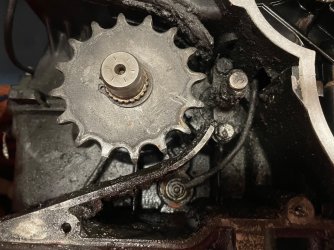
Hi Vince, it is at the sprocket site. Because yours is hard to get in neutral I would start to put in two or three extra copper washers. When your neutral light doesn’t work, take one washer out. Then you have done the maximum. Check oil leaking afterwards.Mate, I hope so. Otto, where is this located on the engine, and is it hard to get assess too it? When you say ring, is that a copper washer like on the neutral switch on Briganze Triples?
Picture is a 650, don’t know if an 600 Atlas looks like a 500 or 650. System is the same.
Attachments
It’s pretty simple Vince, calculate your annual mileage on both bikes and then add on a few more years before your no longer able to ride and you’ll see that you probably won’t be needing cam chains or engine rebuilds going forward. Not targeting you but this applies to so many on the forum . Age is going to get us all  including me. Like our bikes we are getting old.
Tom
including me. Like our bikes we are getting old.Tom