66HP at rear wheel

markQLD said:
Factory standard Jota Series 2.
After riding it south of the border 1,000 km down to the race festival at Eastern Creek, Sydney.
MissJ-20110402-98.jpg

I told the bloke only to take it to 8,000 RPM and he suggested I get on and run it.
DynoRun-BSFOS_01.JPG

Miss J spun up the roller with 85 HP  (bigthumb) A good girl  :-*
And the next day, rode her back home again, and collected another speeding ticket.  8)
Ya Gotta Luv Ya Lav!

Thanks for posting this Mark. I agree with Grant the most noticeable difference, and one that is noticeable in the 'seat of your pants' dyno is that the Jota just starts to get going at 6000 whereas the graph of it on the dyno has it leveling off, even when it had the old filters on. Let?s see how it runs to 8k with the unfettered velocity stacks.
 
dja982 said:
I wouldn't leave it outside in the rain, as the right hand carb and tank, line up perfectly.

Well mine did. >:(

Fortunately we don't get much rain here in Western Australia. Will have a plan B for when it does!
 
many people use bathtube drain plugs like the below one, which you can connect with the chain to two others so you can pull them easily all 3 at once:

ae235


check for the right size, there are different types...
 
Obviously i know nothing but what I have read..but dont engines like still air ..plenum chamber? Hence large airboxes on modern bikes?
 
redax5 said:
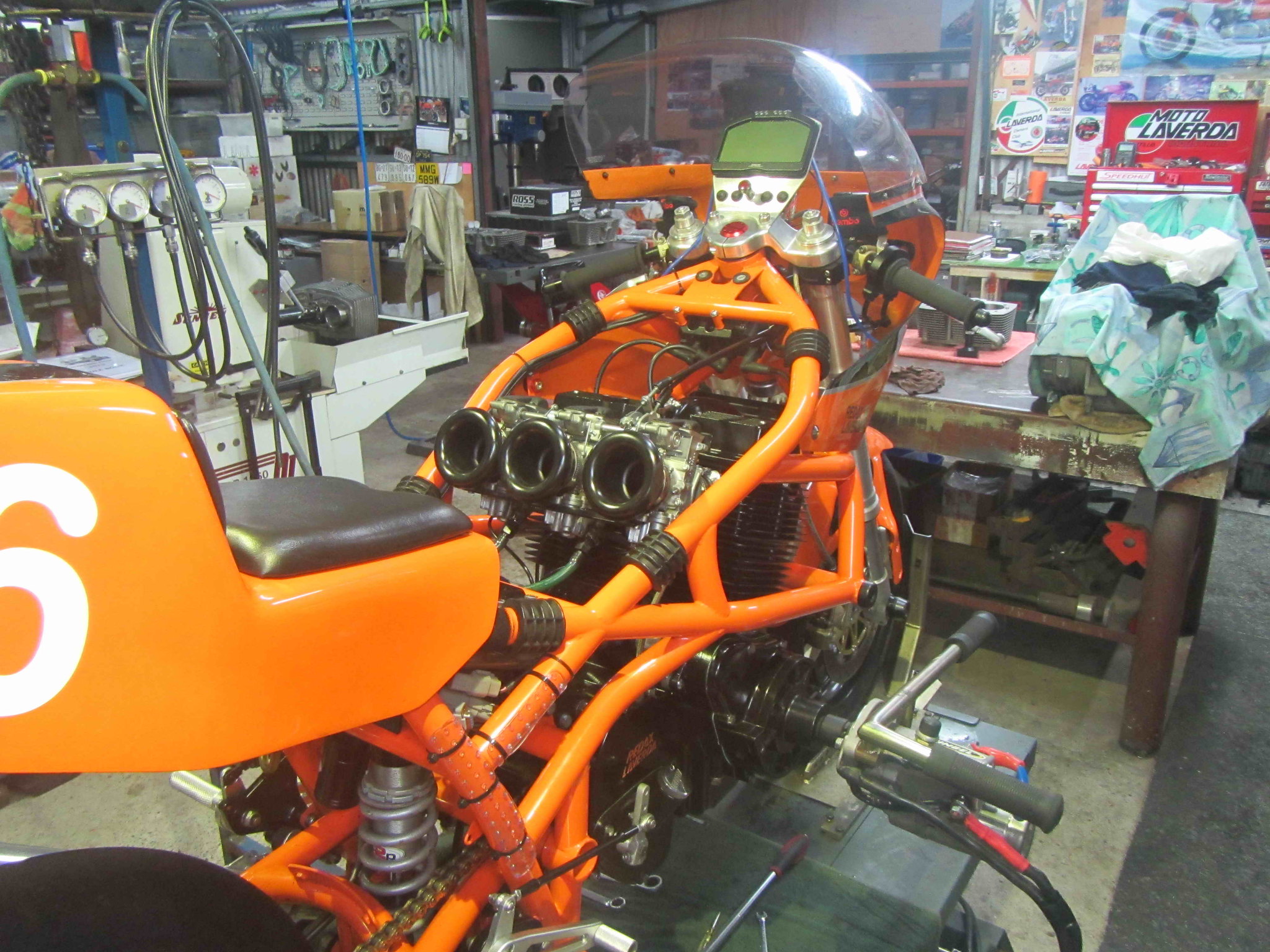
these are velocity stacks Carlo, designed on my mates Flowbench

One of the first things I learned in fluid dynamics was that a large radius rounded edge on an air inlet reduces friction loss and allows greater flow. Red's bellmouths are textbook examples of that.
You only have to look at the inlet on an aircraft jet engine. No sharp edges to be seen.
 
Laverdalothar said:
many people use bathtube drain plugs like the below one, which you can connect with the chain to two others so you can pull them easily all 3 at once:

ae235


check for the right size, there are different types...

I used bath plugs on my track bike. Forgot to take them out when I went for a test ride one day. The bike evidently spat two of them out when I hit the starter, so it actually started, but sucked the 3rd plug tighter into the bellmouth. I took off down the road and it was immediately obvious that the bike was running on 2 cylinders, but I didn't know why. I looked around and it was blowing a bit of smoke. I pulled over and had a look. Soon found the problem. The remaining plug was jammed in pretty tight.

It must have been causing high vacuum in the cylinder that sucked oil in, either past the rings or valve guides - hence the smoke. Once the plug was removed it fired up normally on all 3 and  there was no hint of exhaust smoke.
 
Short Velocity Open Bell Mouth Stacks or open carbs ='s + YES from my experience. No Breathers with either Dellorto or Mikuni Carbs ;o)

Gotta love the smell of the fuel stand off vapour - Makes your Ass Hot with a battery ready to explode, providing your using a battery - LOL.

A battery is only require to start a Street Bike.

Ran my Breganzie like that for 40 years never hurt the rings or cylinder bores providing you changed the oil frequently.

How about 480 Hp at the rear wheels with a 70 Z28 MKIV.

 
nick7 said:
Better with an air box though, however pretty?
Agreed.
Engine breathing from a still-air box is always best. Getting the volume big enough to be of use on a Laverda triple is difficult but something that would be perfect to do on a spaceframe bike that has that advantage of no frame above the carbs.
I've found the 60mm velocity stacks give better midrange for the shorter tracks. don't be fooled by pretty pics and hype, I always run with Uni Filter socks over them, take them off for the photos :)
I run them dry but many like to oil them. They have a spring that hold the shape and fits the velocity stacks

If you have plenty of cash to rebuild the engine every meeting then run without filters if you like.

But do just one lap and look at the rubber granules and grit from the track sitting around the starter motor area that blows in past the barrels and know that this is what your engine is breathing, or better still pull the motor down and have a look at the piston, bore and valve-seat damage.
Pure clean air is what you are aiming for, dust has volume that takes up the space of Oxygen too and simply sandblasts your combustion chamber and valve seats.

https://damclassicracing.com.au/62500044-1-trumpet-alloy-for-phf-48-61/
https://damclassicracing.com.au/62500044-2-uni-filter-u-603/ They come in all colours, I keep green in stock. Ask for other colours no problem.... uhm orange is a problem unless you would like to run these on your Mikunis.https://damclassicracing.com.au/62500054-1-air-filter-pod-dna-ovi-5400-l-o/
 
Greg Parish said:
If you have plenty of cash to rebuild the engine every meeting then run without filters if you like.

interesting comment, is different to what we have found

we have been racing Paul's #63 for 4 seasons and my #86 for 2 seasons with the custom open velocity stacks
we strip both engines at Xmas to prepare them for the next season and with #63 that runs the same set up with the open Velocity stacks as shown in the "pretty picture" all we have changed in the top end in 4 seasons has been two valve shims, she has run 4 seasons on the same pistons, rings, valves and valve seats and still tests at zero leak down

#86 had issues bore wise in the first season as we were playing with different piston/conrod combinations but last season no issue and we did not change pistons/rings/valves or valve seats over Xmas


I?ve also run open for umpteen seasons with no ill effects from it. The bloody SF frame has no spare room with my long inlets. I think the main problem can be ending up in the kitty litter. Seen lots of sand through carbs from that.
 
Seat of the pants feel from a decent run today is that the bike spins up quicker once it gets into its stride, although there's a slight flat spot just before it takes off which will no doubt get eliminated at the next tune. I set the rev limiter on the ignitech at 8k to stop any exuberance on my part. Can't wait to get it on the dyno again.
 
redax5 said:
interesting comment, is different to what we have found

we have been racing Paul's #63 for 4 seasons and my #86 for 2 seasons with the custom open velocity stacks
we strip both engines at Xmas to prepare them for the next season and with #63 that runs the same set up with the open Velocity stacks as shown in the "pretty picture" all we have changed in the top end in 4 seasons has been two valve shims, she has run 4 seasons on the same pistons, rings, valves and valve seats and still tests at zero leak down

#86 had issues bore wise in the first season as we were playing with different piston/conrod combinations but last season no issue and we did not change pistons/rings/valves or valve seats over Xmas

You have made a decision to run with open carbs, it was not the only choice you could have made. Nor is it the only choice available to other racers.

MotoGP know what they are doing by putting air filters on the fastest road racing bikes in the world.
Here's a quote from Repsol abvout the air filters fitted to their Hondas: "Air filter, injection systems, bearings, and spark plugs: All of these parts are checked after every session and replaced when necessary, either because of visible wear or because the electronics have detected a drop in performance."

Have a closer examination of the engine internals of #63 after 4 years of being run flat-out and perhaps reappraise your claim of Zero leak-down after 4 years.  I doubt anyone on the planet has ever seen a race engine from any engine builder with zero leak-down after even just one season. Even after just 20 minutes without an airfilter on our dusty Australian racetracks the engines are nowhere near optimium performance.
We all enjoy a bit of hype, but truly .... absolutely zero leak-down after 4 years of revving above 9,000rpm without any air filtration?
To say close inspection of the engine #63 shows no signs of appreciable engine wear and zero leak-down after four years of that service schedule is an absolutely staggering claim.

From my point of view, and previous comments, DAM Classic Racing aims to be supportive of every level of racing participation taking into consideration each individual's financial and riding capacity.  To advocate the unnecesary premature wearing of anyone's engine is irresponsible when a simple and inexpensive air filter could save them a lot of money, extend the life of their engine and keep them on the track for more seasons. They also have the choice to do as you have done and accept the inevitable premature wear that does occur.

I stand by my comments on the use of air filters for race engines.
 
redax5 said:
>interesting comment, is different to what we have found

>we have been racing Paul's #63 for 4 seasons and my #86 for 2 seasons with the custom open velocity stacks
>all we have changed in the top end in 4 seasons has been two valve shims, she has run 4 seasons on the same pistons, rings, valves and valve seats and still tests at zero leak down

While I've been waiting for the revelationary secret of turning water into wine, and other opinions based on experience from the various engine builders on the forum, I further pondered the direction modern WSBK were taking with their air intakes.

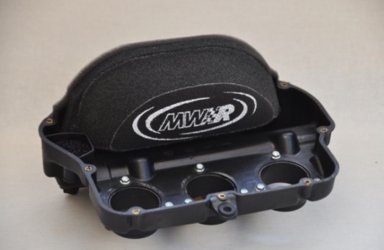
Something similar to this WSBK airbox would certainly improve the season's wear figures of any race engine.
Quote from MWR: "All World Supersport teams tested this WSBK F3 filter , with all the same results : this WSBK filter is a step forward with the performance. All WSS teams have this filter in use . We decided to bring it in production and is now available for everybody".

I'm sure that Redax, being at the forefront of bringing Laverda into the 21st century and having the wherewithal for development, would agree it's hard to justify not commisioning something like this for the Scorch spaceframe, a frame that simply cries out to nurture its Laverda engine with superior still-airbox filtration that results in the reduction to zero of the 200+kmh turbulence around the velocity stacks at race speed, more consistant and cleaner breathing, and a better spread of power. (perhaps even resulting in immortality for #63)


Attachments

  • MWS Triple air filter box.jpg
    MWS Triple air filter box.jpg
    91.7 KB · Views: 66
Back
Top