750 crank balance factors

Silvo,

No disrespect intended, and see your angle now.  It would be fun for sure, and yes a learning curve which is what my racing project is all about anyway.  

I think the other added benefit in my bike's case is that Drmsby regularly spins the rear under power out of corners with the 360 format, and the uneven firing sequence would probably help with traction.  As I said before, from an engineering perspective it's a no-brainer but in my heart I still want it to sound like a (very very angry) SFC.   :)

I'm 6-12 months from starting on the new engine anyhow, as I'm still in the midst of building the new workshop which is keeping me time and money poor.  Red will be way ahead of me, so I'll let him work out all the pitfalls and start from there.   >:D

Actually, maybe the trick will be to go 45deg and make it sound like a Harley.  Confuse the almighty fuck out of everyone.   >:D

Cheers
Steve

EDIT:  PS Julian, you're right of course, but on stock dimensions 76deg is basically correct.
 
well if Steve B has done the maths and confirmed it to be 76 degrees then that is great as I have already started to machine the crank jig insert
a lightened 76 degree crank will be coming here soon

still trying to work out if No 1 piston is at TDC where is No 2 piston, - 76 degrees or + 76 degrees, to me it makes more sense to be at - 76
that is how I am making the fixture anyway


The twisted twins that I know all have undergone major tuning work, which makes it hard to tell why the engine performs as it does.

Sure would be interesting to compare a bog standard 360 with an equally standard 90ish degree twisted twin.

Marnix
 
Can't remember if a stock rod is 145 or 146, but it makes feck all difference (<0.1deg). 
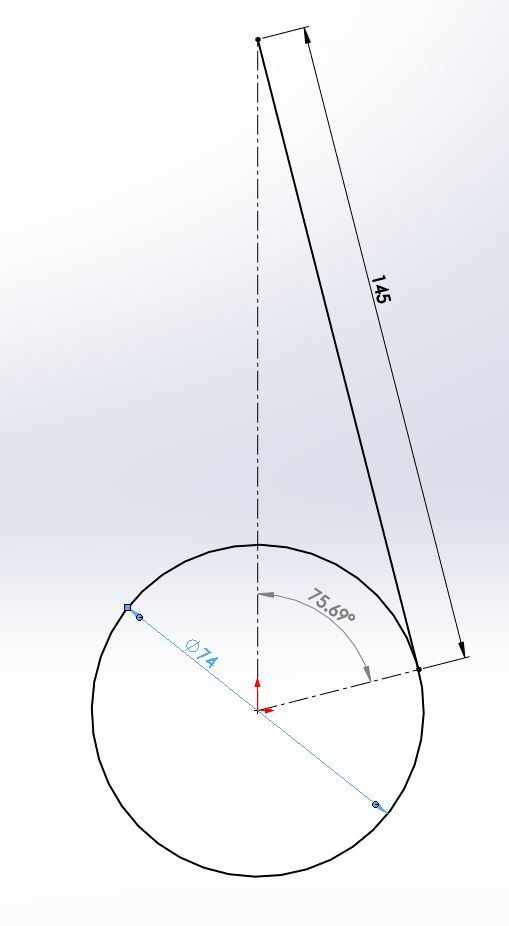
This is how I understood max piston speed to be - crankpin and conrod are perpendicular.
76deg.jpg


Red, don't know what your + / - means, but if left cylinder is at TDC right cylinder should be 76deg ATDC, so firing intervals are 0-284-436.  With right cylinder 76BTDC you'll get 0-76-644, which in the Harley parlance would be a "twingle".  They fired both cylinders on the same revolution in some of their dirt trackers to get more traction (0-45-675).

Cheers
SteveB
 
Hi Steve,

Yes this is correct but add the measurement to show that the position of the vertical dotted line intersecting with the 145mm "rod" line is at exactly half piston stroke.  I know this is what you mean but it may not be obvious to all.

Agree Marnix, it would be a much better comparison. Like for Like! 

Will be interesting to find out how my 1000 behaves as the crank will be quite light but with more "Flywheel" due to the Triple alternator/flywheel,  Maybe now it's been asked, I will start as a 360 and change the phasing later to 90 just for a back to back comparison!  Just Maybe  ;)

Julian
 
Hi,
Maybe we should think again the max speed of the piston.
The speed of the crankpin may be described as a vector tangential to rotating circle of the crankpin.
The speed vector of the crankpin can be divided to y-component and x-component. The speed of the piston is equal to y-component of the crankpin speed all the time. When x-component is 0 the y-component is at the maximum.

Teuvo
 
breganzane said:
Red, don't know what your + / - means, but if left cylinder is at TDC right cylinder should be 76deg ATDC, so firing intervals are 0-284-436.  With right cylinder 76BTDC you'll get 0-76-644, which in the Harley parlance would be a "twingle".  They fired both cylinders on the same revolution in some of their dirt trackers to get more traction (0-45-675).

Cheers
SteveB

should have written No 2 piston at either 284 degrees or 76 degrees but you have given me the answer anyway so 76 it is
off to pick up the crank in a couple of hours when the shop opens, rest of the day will be spent machining the insert
no bikes booked in today that I know off except for the Blue RGA which came back last night to get its new exhaust fitted
should be a good day

I'll ask Ollie if he has ever set up a "twingle"  :D
 
 
I picked up Reds sleep disorder last night over this thread, had to do a piss stop at 1.30am and tripped over the Mrs shoe and slammed my head into the door-jam... so the blood clean up had to happen....

OK this is what I'm concerned about and losing sleep over (and banging my head against a wall): What about the exhaust gases? Is the pulse effect, if using a 2 into 1, going to be comprimised? As standard, each fire helps draw the gases from the previous fire, this new sincapated firing order is going to alter that effect, isn;'t it??? All I can invisage through a 2 into 1 is a mess of backpressure gasses, trying to bust out!

Red, you've got an email.
 
G'day

Well, I did some geometry and a bit of algebra, and came to the conclusion that you're all wrong.

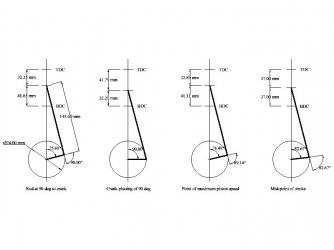
The point at which the rod forms a 90o angle with the crank is not half-stroke. Nor is that the point of maximum piston velocity. It's close, but not quite spot on.

90o crank phasing isn't half-stroke or maximum piston speed either.

Using the 145mm rod length and 74mm stroke:
Maximum piston speed speed occurs at 76.49o from TDC, whereas the 90o rod/crank angle occurs at 75.69o - 0.8 degree difference.
The mid-stroke point occurs at 82.67o from TDC, at which point the rod-crank angle is the same.

Anyway, if you're looking for the maximum piston speed phase angle, 76o is near enough.

Cheers,
Cam

PS: Calculation of piston speed involves a bit of trigonometry and calculus (maximum piston speed is the point at which the second derivative of displacement = 0).
Julian, I saw on your website that you're looking for a mechanical engineer. Can I have the job?  :D
 

Attachments

  • twisted twin.jpg
    twisted twin.jpg
    47 KB · Views: 82
Cam, does an offset Gudgeon Pin alter the figures ?

crank is back in our shed, just had a 30 minute talk to our crank master
he tells me that by phasing to 76 degrees the balance factor will change from what it is now which makes sense so need to do another dummy crank run
aiming to drop modified crank off to him on Monday

 
Fascinating stuff Cam and Red, but I can't see how that if the crank is at 90 degrees to the stroke why it isn't at half-stroke.
Or maybe I should shut up and learn. :-[
 
Jeez Red, trust you to come up with a difficult question!

The short answer is yes, an offset gudgeon pin will alter the geometry. The long answer is ...  Er, I'll need re-calculate to figure out exactly what effect it'll have.
How much of an offset were you considering? Further calculation will have to wait until tomorrow - got something else to do now.

BTW, there's little to be gained with an offset gudgeon. It doesn't achieve much other than reduce piston slap, which may be useful in an engine with large piston/bore clearance such as an air-cooled two stroke. It may actually increase friction losses in the bore because the cylinder pressure tends to tilt the piston against the walls of the cylinder. The real advantages only come when the entire cylinder is offest (google "desaxe").

Cheers,
Cam
 
Hey Cam,

Was wondering when you'd chime in!  I knew it wasn't at half stroke but after further reading on the subject last night it was also clear that it's not 'quite' when crank and rod are 90deg as I had thought.  Very bloody close though, it will be interesting to find out the different vibration modes of the various angles.  Julian/Red - please do field tests under identical conditions at 90, 83 and 67 deg and get back to us asap. :-)

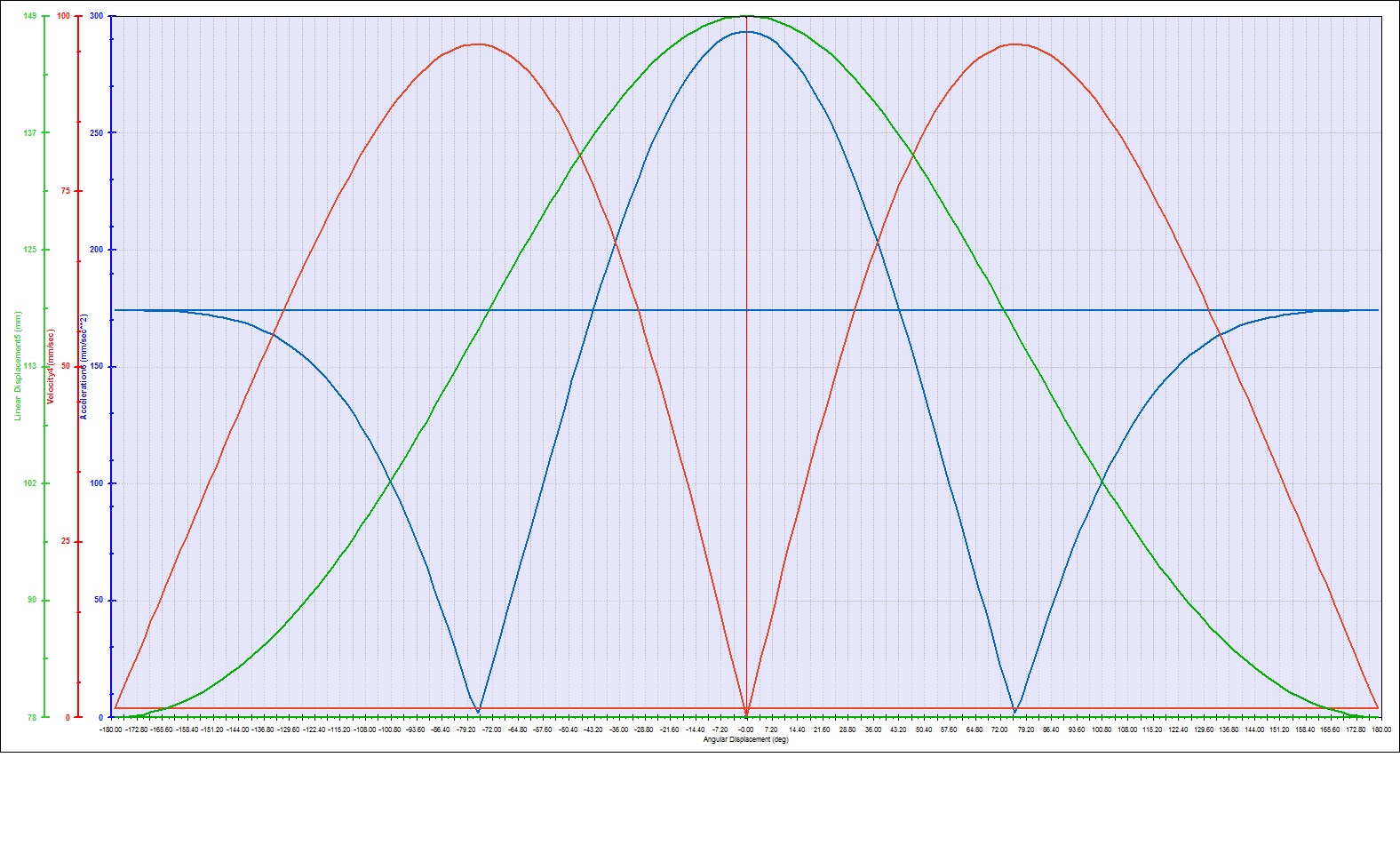
BTW I did a Solidworks motion simulation and came up with the following:
pistonmotion.jpg

Not 100% confident of it though, as it shows piston displacement of 71mm, not 74mm.  No idea what's going on there, I don't use the simulation stuff much so was just bumbling around, but it did show max velocity/ zero acceleration very close to 76deg.  Good example why they don't build aircraft based purely on computer simulation. The GIGO rule always applies to anything like this (including "virtual dynos" - garbage in, garbage out.
Red, the pin offset shifts things forward a smidge, so your maxima and minima (ie TDC) are no longer at zero crank degrees, but a 2mm offset gives less than 0.5deg difference, so again, it's background noise for practical purposes.

Cheers
SteveB
 
Dellortoman said:
Going to school isn't enough on its own Chris. It helps to be a boring and pedantic nerd with acne and no girlfriend during your school years :D

Well I was rooted then  8)

Oh, and Chris, less Shiraz before bedtime will mean less Claret on the walls.
 
Davo said:
Dellortoman said:
Going to school isn't enough on its own Chris. It helps to be a boring and pedantic nerd with acne and no girlfriend during your school years :D

Well I was rooted then  8)

Oh, and Chris, less Shiraz before bedtime will mean less Claret on the walls.

Steve, Red has suggested my motor be one of the crash test dummies....... I'm leaning toward 90 degrees, until I'm convinced otherwise. I can't read the graph titles, how come the red camel has two humps?

Davo, well, someone must have spilt the beans! A mate dropped two bottles of French red over, we managed to get through two bottles, because it took the first bottle to get the tastebuds numb..... now I know why those blokes have a funny accent, it's because of the shit wine.... although, when I was there I had some great reds.

Maybe they are like Fosters, and send the shit wine overseas.

Anyway, love the topic, because it's right where I'm at, at the moment. Thanks.
 
breganzane said:
Julian/Red - please do field tests under identical conditions at 90, 83 and 67 deg and get back to us asap. :-)

67 deg? Now you're just being silly  :D

Incidentally, Harleys have a 45 deg phase angle or thereabouts. Might be 47 or 50, I can't remember. Anyway, it's a stupid angle. It has all the disadvantages of a parallel twin and none of the advantages of a 90 deg V-twin. Bloody impossible to balance. It's almost like the designers were trying to maximise vibration.

Cheers,
Cam
 
Back
Top