750 crank balance factors

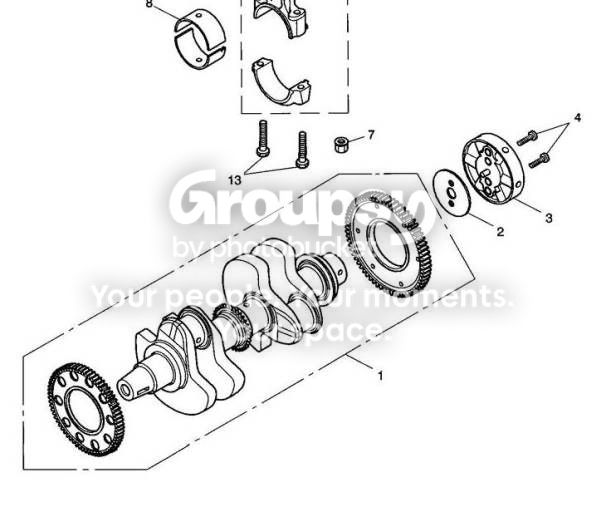
Hinckley Triumph have done a 270? crank
http://www.worldoftriumph.com/triumph_motorcycle_parts_locator.php?block_01=&block_02=300765&block_03=2991
hinkleytriumphcrank-270.jpg

 
But didn't the Triumph self twist to 270 :D
Being more serious -
My 580cc Monty crank was balanced to 50%.Fairly rough below 5-5500,but very smooth above.No balance shaft currently fitted.

Andy
 
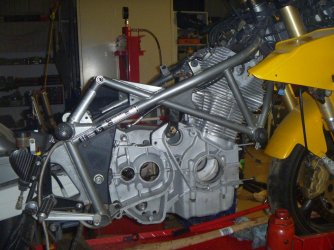
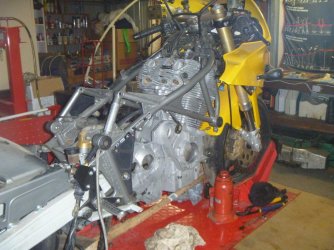
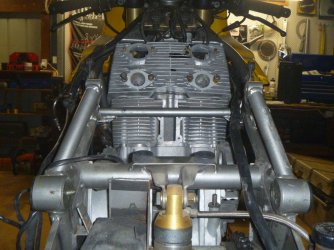
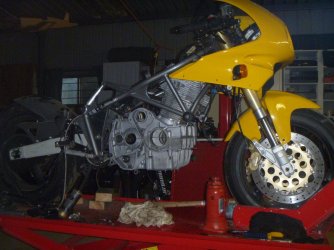
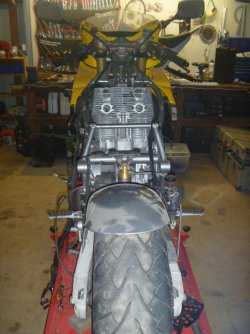
Here are a couple of preliminary photos taken a while back.
The work has not progressed any further as Red is just too busy to get to my SF motor yet.
And I am not busy enough to pay for the significant costs. >:( >:( >:(
I do not want to cut up the frame until I have a completed motor ready to rock and roll.

It all looks like it will fit but the Headers will be tight clearance to the front wheel.

Measurements would indicate the motor will not fit in the Zane Beam frame (Nikko Baker)

I call it the SFZ.
Cheers


Attachments

  • P1000631.jpg
    P1000631.jpg
    193.4 KB · Views: 69
  • P1000632.jpg
    P1000632.jpg
    131.8 KB · Views: 67
Red, Phil, Piet, and the rest of you engine engineers why are most motorcycle engines not equipped with harmonic balancers. We use them in large displacement aircraft engines, but these engine also are not as high revving as the ones used with our motorcycle engines. Is it the revs along with the frequency that changes the need for them? Also, from reading Tony Foale's article on balance and balance factors, http://www.tonyfoale.com/Articles/EngineBalance/EngineBalance.pdf, why was the 120 engine not the way to start out in the beginning, or is it the 180 was the best way to produce more horsepower?????

And on the subject of cranks, who is still lightening the 750 cranks, and what's a ball park figure to have it done.

Clay
 
'71 SF said:
Red, Phil, Piet, and the rest of you engine engineers why are most motorcycle engines not equipped with harmonic balancers. We use them in large displacement aircraft engines, but these engine also are not as high revving as the ones used with our motorcycle engines. Is it the revs along with the frequency that changes the need for them? Also, from reading Tony Foale's article on balance and balance factors, http://www.tonyfoale.com/Articles/EngineBalance/EngineBalance.pdf, why was the 120 engine not the way to start out in the beginning, or is it the 180 was the best way to produce more horsepower?????

And on the subject of cranks, who is still lightening the 750 cranks, and what's a ball park figure to have it done.

Clay

Mainly weight saving, as well as saving a lot of complicated "unnecessary" engineering on behalf of the manufacturer.

The biking public of the 70's and before was so used to buying bikes that shook themselves apart, the factories couldn't care less.  Only when specific power rose during the 90's to levels that were before un-heard of, did they deem it necessary to eliminate vibrations as best they could.  Very many production twin and triple bike engines are thus equipped these days, as well as a lot of car engines.

I can lighten 750 cranks, but am not taking further orders till at least the end of the year...

piet
 
The other factor was that with time, engine design moved away from vibey, with many more big-bore bikes cradling a four cyl unit. This meant that the buyer became more discerning, and smoothness considered a prerequisite in any new moto. BMW had always used it as a strong point in marketing and selling.
 
True harmonic balancers are only required on cranks of sufficient length to have a critical period of torsional excitement.
In practise this means six cylinders in line or certain V arrangements. Bike cranks generally are too short to require a harmonic balancer.
On the other hand, contra rotating balance shafts are now quite common.

I have however struck a couple of 180 deg parallel twins that could have used a harmonic balancer - the Kawasaki 500 twin would break cranks in race use unless the resonant frequency of the crank was raised - by taking off the alternator...
 
Piranha Brother 2 said:
I generally avoid the Benny Hill stuff ... but really, this one is too good to be true!!  :LOL: :P :-*

Yeah. OK - how would you have put it in plain english ?

If you've ever owned a tweaked 202 Holden you'd know about the excitement arising from crank torsional stress - and it is stress on the owner....mine was like having a drummer in the car with you at about 1800rpm.
 
'71 SF said:
from reading Tony Foale's article on balance and balance factors, http://www.tonyfoale.com/Articles/EngineBalance/EngineBalance.pdf, why was the 120 engine not the way to start out in the beginning, or is it the 180 was the best way to produce more horsepower

I tend to treat any technical article by Tony Foale as potentially unreliable because I've seen a couple of real howlers in his articles. But credit where credit is due, in this case he's actually done a pretty good job of explaining engine balancing in layman's terms.

Cam
 
Yeah, it does cover most of the ground. And he does point out the indiosyncrasies of every engine and frame within the equation. Showing my ignorance in the greater depths of physics, but when he talks about the sum of the secondary forces totalling in a 4-cyl engine producing high-rpm vibes, is that because there is what could be described as a rocking couple acting in a lateral plane between opposing cylinders? Is that the twisting harmonics you mention, Greg? Because in terms of balance, if the the counterweights of each opposing cylinder were acting fore-aft on the same plane (impossible - except maybe in a square four???) they would balance each other out perfectly, wouldn't they?

All this is relevant to the pursuit of an effective setup in a Laverda SF/C crank offset to (say) 270 deg - the width of the crank with double centre mains and a joining pin with cam chain drive must be producing all sorts of secondaries from the counterweights, on top of the rocking couple from produced by the pistons. This is why I have a haribrained scheme to reduce the balance factor (to minimise secondaries) and attempt to achieve as much counterwieghting as close to the centre of the crank's length as poss, effectively blancing the outer webs to 100% - no idea what that might do to bearing loads or crank twist!

When a British twin with a huge central flywheel and only two outer mains is converted to 270 deg, these problems don't really occur (but then you DO have all the other associated probs of a poorly unsupported crank assembly.

I was pretty blown out by the Supermono and Beemer 800 twin counterbalance offerings.
Quentin
 
  tend to treat any technical article by Tony Foale as potentially unreliable because I've seen a couple of real howlers in his articles. 

We bought our Heenan rolling road dyno from Tony Foale - He'd made a small dyno by converting a car's automatic gearbox - a really clever conversion and must have taken a fair bit of brainpower. Conversely - when we ran the dyno - set up as he'd had it - it wouldn't read reliably over about 80mph. I looked at the drawings and saw the massive leather belt connecting the rollers to the water brake wasn't fully tight - it needed to be so tight you could play it like a drum - dyno worked fine after that. was pleased we'd got dyno so cheap with so little work to fix it!! - Regards - Phil
 
The only twin i have experience of with a very long crank is the Benelli 650. They're more than a little odd - very short stroke and the two sets of webs are separated by a central flywheel. At least the central wheel makes it easier to change the balance factor as the crankwebs are tiny. I'm pretty sure they're the same forgings as used in the singles which have the usual horizontal single factor of around 30% - so to get the factor right for an upright motor, all the extra counterweighting is on the center wheel. Oh, and the camshaft is about as long as a 4 cylinder car one....
The one I played with had a factor of 83%....and shook like a bastard. Changed it to 75% and very usable.

Cranks which are long in proportion to their diameter (stop giggling Quentin) tend to have a natural frequency of excitation. If this coincides with a frequently used rev range, you can see some strange results. The Holden six i referred to in some versions is very bad and like mine can feel the car is coming apart at certain revs...a different harmonic damper cured it.

Tony Foale...I have an aermacchi customer in Adelaide who knew Foale when he started racing there. He has nothing good to say about him at all....I've read some of his articles and theres usually something to think about in them. His first book - with Vic Willoughby - was a waste of paper but once he got past needing to air his pet theories, he got better.
 
phil37 said:
We bought our Heenan rolling road dyno from Tony Foale - He'd made a small dyno by converting a car's automatic gearbox - a really clever conversion and must have taken a fair bit of brainpower. Conversely - when we ran the dyno - set up as he'd had it - it wouldn't read reliably over about 80mph.

In the mid-late 70s I worked for a guy called Bruce Hartley who had the only bike dyno in Western Australia (was also the WA laverda concessionaire). We used to run that thing flat chat, full-blown Moriwaki and Yoshimura Kwaka conversions. I had a hot one on there one day, rear wheel under full load at 130mph and the exhaust burnt through the tie-down strap! Front wheel was lodged in a buffer, but still scared the living shite outa me ... always checked exhaust flow after that!
 
GregT said:
The one I played with had a factor of 83%....and shook like a bastard. Changed it to 75% and very usable.

Read elsewhere (in this thread?) about the Benelli (Tornado?) vibes - totally bizarre figures, those. Be interesting to see how a 270 conversion would run - the central flywheel would fit with my 'design', and I'm guessing the piston-width would be about on a par with the Lav twin?

Ignorance again ... is Tony Foale an Australian? geez, I'd loved to have spent an arvo with Phil Irving back in the day - discuss balance factors for my beats and the like ... he was a good friend of a good friend of my mother's (6 degrees ;-).
 
Piranha Brother 2 said:
Read elsewhere (in this thread?) about the Benelli (Tornado?) vibes - totally bizarre figures, those. Be interesting to see how a 270 conversion would run - the central flywheel would fit with my 'design', and I'm guessing the piston-width would be about on a par with the Lav twin?

Ignorance again ... is Tony Foale an Australian? geez, I'd loved to have spent an arvo with Phil Irving back in the day - discuss balance factors for my beats and the like ... he was a good friend of a good friend of my mother's (6 degrees ;-).

Yeah, Foale seems to keep his origins quiet. My contact basically says the whole Adelaide bike community was pleased to see him go overseas....Met Irving when he came to NZ in the 80's - stories.....lots of stories - and answer any question too.

The Benelli twin isn't something a reasonable person would waste time on. i know others on here have a different opinion but frankly there's just so much to be modified to make them work IMO.
 
I don't know much about Tony Foale. I've never met him, only read some of his articles. He appears (through his writing) to be a reasonably intelligent bloke who has a good understanding of how stuff works and a talent for writing about it. Most of what he writes is OK on a basic level and he does a pretty good job of explaining things. But some of his technical writings don't stand up to engineering scrutiny.

I could give specific details, but as far as I know he is no longer messing with peoples' bikes so there's little to be gained now by taking him to task on such issues. It's all water under the bridge. Besides, I don't want to expose this forum to any legal challenges if TF reads this and takes offence.

Cam
 
Back
Top