750SF2 head case

mikeb

New member
Location
new zealand
A couple of questions re head repairs.

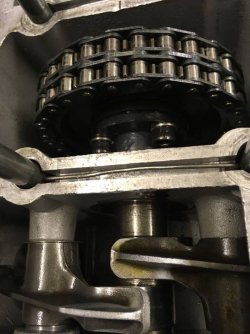
1. The camshaft tunnels are a bit scored and one or two bearings have spun a bit (see pics). I’m thinking Loctite 609 on the cam/bearings and 641 (weaker) on the scoured tunnel…. Yes? Better ideas? all bearings are being replaced - there was a slight rough patch on 1 or 2 of them

2. I’ve read about cutting the cam key in half to aid reassembly. Sounds good, as I imagine a key in place in each half will greatly assist pressing the flanges back on accurately. As the bolts do the work, is there any downside to cutting the key in half?

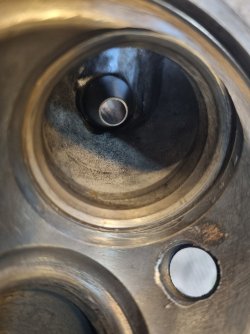
3. The valve seats are slightly pitted but I think look ok (see pics). Am I right that they look like a PO has replaced them? ie, they look like inserts, not 'skulls' (not that i know what a skull looks like). The valves are 7mm and look farily new to my untrained eye, and the contact / wear ring less than 2mm (tho hard to measure accurately).

Thanks!
 

Attachments

  • 20260524_144323.jpg
    20260524_144323.jpg
    198.3 KB · Views: 26
  • 20260524_152542.jpg
    20260524_152542.jpg
    111.3 KB · Views: 25
  • 20260601_140453.jpg
    20260601_140453.jpg
    150.8 KB · Views: 23
  • 20260601_140308.jpg
    20260601_140308.jpg
    123.6 KB · Views: 26
7mm? Looks like you've got a nice pair of SFC valves there. Std SF are 8mm stems, and that penny on a stick exhaust looks def to be SFC. Check your cam for a number - you might find it's been replaced with maybe a 5/C - std SF2 will be stamped 7/1. Owners generally wouldn't fit 7mm stem valves to an otherwise stock motor.

Check that the old bearings were C3 (larger clearance) - it's be marked. If not, buy new ones in C3. Generally I wouldn't be too bothered about them spinning a tad (you'll probably find your crank bearings have all been doing a bit of dosey do!), but a std clearance bearing might have more tendency than a C3. I've never Loctited them - you definitely wont' need to Loctite the bearing onto the cam - it's a decent press fit (hence the need for C3s).

They do look like inserts - I can see both cast skull and the insert. Not a bad thing. Give the valves a light lap with paste and those pits should disappear.

It's not tricky getting the two halves in with the full key, but not a prob to cut it. Personally I wouldn't, unless I intended to check and dial in the cam timing. If you know how, it can be very worthwhile - and left to right may not be the same either. To make them adjustable you'll need to slot the three holes in each flange. If you're not trying to get every last HP out of it it may not be worth the trouble - and cutting the key will potentially introduce discrepancies between L and R that may not have otherwise been there.
 
Last edited:
A couple of questions re head repairs.

1. The camshaft tunnels are a bit scored and one or two bearings have spun a bit (see pics). I’m thinking Loctite 609 on the cam/bearings and 641 (weaker) on the scoured tunnel…. Yes? Better ideas? all bearings are being replaced - there was a slight rough patch on 1 or 2 of them

2. I’ve read about cutting the cam key in half to aid reassembly. Sounds good, as I imagine a key in place in each half will greatly assist pressing the flanges back on accurately. As the bolts do the work, is there any downside to cutting the key in half?

3. The valve seats are slightly pitted but I think look ok (see pics). Am I right that they look like a PO has replaced them? ie, they look like inserts, not 'skulls' (not that i know what a skull looks like). The valves are 7mm and look farily new to my untrained eye, and the contact / wear ring less than 2mm (tho hard to measure accurately).

Thanks!
7mm valve stems?
What cam is in there?
Where did you read about cutting the cam key in half to align the flanges on reassembly?
Paul
 
The cam bearings are actually quite free to move around a bit. Even the slightest warming of the head allows the bearings to slide in easily, when at operating temperature, the bearings will be even looser. Loctite is not recommended. The camshaft assembly is located by the cam end caps, axial movement is limited.

No problem at all cutting the key, been doing that for years to aid assembly. I actually use 2 short keys, looks neater. ;) Far more important is the interferance fit of the flanges on the camshaft! This should be at least 0.01-0.02mm, otherwise the key/s won't last very long. Also make sure the flange and sprocket mating surfaces are dead flat to ensure adequate clamping pressure.

The seats indeed look like inserts and as thus, are probably of far better quality and hardness than the originals cut into the cast iron of the skull. Seems also the head has been converted to accept SFC 7mm stem valves, or is an original '74 SFC head (only MY of skull and 7mm stems). From what I see in the pics is the exhaust valve head seems to be quite deeply recessed in the combustion chamber, but as long as the geometry at the rocker/valve tip wosrks out OK all should be well. Intake valve seat looks good. See how the seats clean up with some lapping compound and go from there. A seat width of less than 2mm usually ensures a nice, gas-tight seal.

piet
 
IIRC a '74 SFC head will have a 36mm port, not the double venturi 36-34.5-36mm of big valve SF heads (ie from 36mm at the intake flange carb side down to 34.5mm at the engine side - and mating 34.5 at the port entrance.

And what Piet said about tight flanges - VERY important.
 
thanks for the replies:
  • Yes the bearings (old and new) are C3
  • There is no marking on the cam(s). The head has ‘74’ stamped into it, which I assume is a date (being SF2). I haven’t measured the valves/ports re diameters tho will have a look.
  • The flanges were very tight to press off. You say to tap them on? I thought they would press back on, with some heat… no?
  • I also thought the valves looked quite recessed. But its not a race bike and all I know about the geometry is the tappet adjusters are not near their ends. I’ll definitely lap them in (just a little).
  • Re the cam bearings being loose in the tunnel - I get the point about movement with heat. That must mean most/all of these bikes have scored tunnels and scraped cams. I guess in means they align well. So I’ll refrain from Loctite. Tho 2 of the old bearings were not a tight fit on (off) the cam.
  • I’ll cut or make 2 new half length keys. I did wonder about reversing the cam sprocket for ‘new’ teeth, as the bolts ‘look’ symmetrical around the key way, and easy to transfer the alignment dot. Yes…. No…. maybe…?

Thanks
 
The flanges are the interference fit Piet mentions, not just tap on, should need a press. The cam halves can generally tap into the centre sprocket before tightening.
I polish my cams and rocker arm mating surfaces any time they are out to remove any impurities. I had a big problem with the studs blocking the oil channel across the head, with several destroyed cams and rockers as a result, so I always put a bit of L shaped wire down the start of the stud hole to prevent that, cheap peace of mind. Check that the oil holes through the rocker arms are open, they can catch tiny plastic chips from the tensioner wheels.
 
Copper plate the outside of the bearings with a home plating kit. You will need to mask of the inside etc with wax but it works great for worn housings.
J
 
thanks for the replies:
  • Yes the bearings (old and new) are C3
  • There is no marking on the cam(s). The head has ‘74’ stamped into it, which I assume is a date (being SF2). I haven’t measured the valves/ports re diameters tho will have a look.
  • The flanges were very tight to press off. You say to tap them on? I thought they would press back on, with some heat… no?
  • I also thought the valves looked quite recessed. But its not a race bike and all I know about the geometry is the tappet adjusters are not near their ends. I’ll definitely lap them in (just a little).
  • Re the cam bearings being loose in the tunnel - I get the point about movement with heat. That must mean most/all of these bikes have scored tunnels and scraped cams. I guess in means they align well. So I’ll refrain from Loctite. Tho 2 of the old bearings were not a tight fit on (off) the cam.
  • I’ll cut or make 2 new half length keys. I did wonder about reversing the cam sprocket for ‘new’ teeth, as the bolts ‘look’ symmetrical around the key way, and easy to transfer the alignment dot. Yes…. No…. maybe…?

Thanks
As Quentin has stated, the bearings should be a firm sliding fit on the cams. Use copper-plating as suggested by Julian or simple Loctite to prevent them from spinning there. The bearing housings in your head look just like all others. You can "check" alignment once the cams are installed, they should spin without the slightest resistance anywhere.

A bit of heat helps when re-fitting the flanges. An old mechanics trick is to coat the surfaces to be pressed with stag tallow to prevent galling/siezing without influencing the interferance fit itself, as can be the case with mineral oils or greases.

Don't turn the sprocket around, you'll be missing the timing mark. Besides, wear is neglible, as on the crank sprocket.

piet
 
Back
Top