750SF2 - rocker axial play when spindle end sits low

mikeb

New member
Location
new zealand
Hi
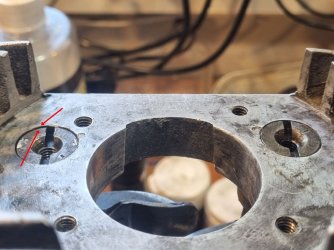
For reassembly, I thought I’d test fit the rocker spindles prior to deciding about shims to minimize axial play to the 0.2mm figure I’ve read about. Before dissembling, the left exhaust had 0.63mm play and the left inlet close to 0. But when I test assembled these and drove them both fully home (inboard) the exhaust spindle is now recessed below where the cam end cap would hold it in, and as shown (in the pic) is close to 0 (while moving freely).

If the cam end cap stops the spindles moving outboard, then do I have to assemble with the end cap, drift it out then measure for shim thickness? Or maybe it should not be recessed, even tho it is? Or cut a shim disk to sit outboard of the spindle to hold it in, under the cam end cap? Or maybe I’m overthinking this?

Any guidance gratefully received.

thanks!
 

Attachments

  • 20260712_161406s.jpg
    20260712_161406s.jpg
    145.6 KB · Views: 24
I drive them in with the head warmed up but able to handle with bare hands, as it nears home I stop it with just a bit of end float and check that the rocker lines up ok on the cam lobe ( with variation I have seen some that hang over one side, which I try to avoid). If it drives home and there is excessive float I remove the pin and shim either side of the arm to have it centred on the cam lobe. Rarely does the pin sit proud of the head surface from my experience.
Check that the holes in the rocker arms are not blocked in any way, they feed oil to the cam lobes.
 
The cam end cover gasket will compress into any minor recess after you've driven the spindles home. I generally just check for excessive side play - never thought to look at the position of the rocker face relative to the cam lobe.

You can also try different spindles in each rocker to see if you get a good matching combo with minimal side play for each pairing. My technique is to grind the stop face of the spindle very carefully to allow it to recess further before it bottoms out (thus reducing side play), but again, this doesn't factor in the alignment mentioned above by Tippie. I prefer this than fitting fiddly shims.

I mount the spindle in a chuck and use an angle grinder with a cutting blade mounted solidly on a pedestal drill or lathe saddle ... you don't want to take too much off!
 
thanks for the comments. Pirhana – interesting thought the gasket will essentially squish in to any recessed space between the cam end covers and a slightly recessed spindle end, and so hold against outward movement. Tho this doesn’t sound like great engineering.

I assume it best to have spindles and rockers in their previous locations tho I note some old marks on them that imply they’ve been mixed up by a PO. So yes, I’ll try and swap them about and find which is best where.

Lastly, I’m having trouble finding suitable shims. I assume they need to be carbon steel DIN988, ID of 12mm or 14mm. Does anyone know an easy source of these?

thanks
 
thanks for the comments. Pirhana – interesting thought the gasket will essentially squish in to any recessed space between the cam end covers and a slightly recessed spindle end, and so hold against outward movement. Tho this doesn’t sound like great engineering.

I assume it best to have spindles and rockers in their previous locations tho I note some old marks on them that imply they’ve been mixed up by a PO. So yes, I’ll try and swap them about and find which is best where.

Lastly, I’m having trouble finding suitable shims. I assume they need to be carbon steel DIN988, ID of 12mm or 14mm. Does anyone know an easy source of these?

thanks
Swap spindles, not rockers - they should stay with their partner cam lobe ... swapping spindles to find the best compromise on side play will make no diff. It might even be that every spindle is identical - dunno, never measured them! The shim enigma is one of the reasons I preferred to grind the stops on the spindle/s. As for gaskets compressing, there's virtually nil side thrust on a spindle, so only minimal pressure is required to keep them snug. Once set up, they are set up for good.
 
Back
Top