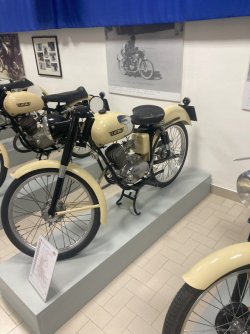
75cc singles, period, engine numbers, "series"?

arancia

Senior member
Location
Arizona, USA
OK all you fans of the tiddlers (75cc singles) out there, some basic questions to get me started on the next project(s).

Some years ago I bought a 75 (I think a Sport) as a restoration project but didn't get started yet - too many other projects, but it's getting close to the top of the list.

Recently I had to save/adopt a 75 (claimed to be a Tipo Sport) that was begging for a new home and so it came to my shelter for orphan Laverdas.

This drives motivation now to get the older project under way so: How do we interpret engine numbers and "Series" names?

My project bike has motor 54xxxxS with matching frame number - does that imply a 1954 build year and Sport cams, head, valves etc?

The latest acquisition has motor 55xxxx but the prior owner/restorer powder coated the frame so I can detect but not read its number, without the S on the motor, would this be other than a Sport specification? Does 55 mean it's a 1955 build?

Then there's the "Series" thing, it looks like the external visible major change in the motor (separate from the entirely different chassis, sheet versus tube etc) was in more finning and so a change in the valve top cover so that the gasket for that cover changed shape. Were there other significant engine changes along the life of the regular production 75cc motors - clearly Sport head, cams, valves versus Touring equivalents, but other changes; base, "Series 1". "Series 2"?

I love the ILOC magazine series and then the booklet on the 100 single restoration (Thank you Andy, Dean, and others involved) and see that there have been several in this community doing 75cc restorations, who are the "go to" guys on the 75cc production singles?
 
Yes, the first 2 digits of the engine no. denote year of manufacture, suffix "S" denotes Sport model.

Best to get parts books for the models to find out all the subtle changes that were introduced. If you don't already have it, "Storia di una Passione" can be very helpful, lots of tiddler data and trivia to be found there.

What is actually inside these engines can only be found out by disassembling them, the same applies as to the larger Breganze models, generations of mechanic wannabes have tried their luck on them... with varying sucess. Only true external give-away would be the 4-speed gearbox in the 100s.

piet
 
"My project bike has motor 54xxxxS with matching frame number - does that imply a 1954 build year and Sport cams, head, valves etc?"
confirming as correct what Piet says and that the sport had 4 speed box and the normal had three speed box.

Moto Laverda stopped the year prefix very quickly, as a gues, because a bike in a showroom for two years (or more) with the year clearly visibly could never be a good selling point, but as I said I am guessing.
CLEM
 
Not correct Clem.

Storia di una Passione states the 75cc bikes all had 3-speed boxes, even the Tarantino models, only the 100cc Sport models were blessed with 4 speeds.

Year prefix was used up to the end of production.

piet
 
Best to get parts books for the models to find out all the subtle changes that were introduced. If you don't already have it, "Storia di una Passione" can be very helpful, lots of tiddler data and trivia to be found there.

Thanks Piet, I believe I have every book ever published about Laverdas - lots of them now, a far cry from when I bought my first SF2 before the Parker Green Book was published and tried to do maintenance based only on the information in Italian in the owner's manual for a different model.

I have a parts book copy for the "Motoleggera 75cc" that seems to be correct as it's for the tube frame models - I'd have to guess that this is what is described as Series II or second series but would appreciate confirmation based on year or number what the Series designation means as wondering why, for example, Athena lists three different gasket sets for the 75cc models.
 
Thanks Piet, I believe I have every book ever published about Laverdas - lots of them now, a far cry from when I bought my first SF2 before the Parker Green Book was published and tried to do maintenance based only on the information in Italian in the owner's manual for a different model.

I have a parts book copy for the "Motoleggera 75cc" that seems to be correct as it's for the tube frame models - I'd have to guess that this is what is described as Series II or second series but would appreciate confirmation based on year or number what the Series designation means as wondering why, for example, Athena lists three different gasket sets for the 75cc models.
Hi Arancia, amongst the first production Laverdas were 75cc models with pressed steel frames in 1951 to 1952 - often referred to as Tarantina models nowadays after the early successes in the Milano-Taranto races. But can be called Priest bikes - as the local priest was given a prototype to test ride! The photo is of the 16th made - believed to be the oldest in existence. There were minor bodywork and suspension changes but all were three speed with a rocker cover with a "functional" shape. This I believe is what the gasket manufacturers refer to as Series 1.

In 1953, the 75cc models with a tubular frame and an altered rocker cover were introduced to great acclaim (a few pressed steel frame models were sold on to clear stocks). These are the Series 2 bikes your gasket chaps refer to. In 1954, the model continued with only minor alterations (that a sad old anorak like me would spot). Sport and Normale models were offered in both years, and all had only 3 speed boxes with a complicated external gearchange mechanism.
HOWEVER, the Corsa model - only produced in very limited numbers for racing - had a four speed box. The 1954 75cc racers had a number of other features that the 100cc production bikes later adopted, such as an improved gearchange mechanism, rear upper engine mounting plate and finned front brake drum. Just to add confusion, the Corsas are sometimes referred to as the Mi-Ta model, and race classes for standard bikes (small carbs, standard brakes and 3 speed) and more tuned bikes (big carbs, altered rockers, etc etc improved brakes and 4 speeds) were run in the same races in later years and termed Formula 2 and Formula 3 - I can never remember which is which for the life of me. All were recognisably derived from showroom Laverda tiddlers, but when you look at the fine details the development and craftmanship is quite breathtaking.

In 1955 the 100cc model was introduced to the showrooms and the 75cc bike was dropped from the line up. The 100 was produced in 3 speed (Turismo) and 4 speed (Sport) versions from the off, Laverda having presumably debugged the four speed box via the racers. Only 100cc bikes were offered for general sale in 1955, 56, 57 etc until the end of the line. HOWEVER, rumour has it that 75cc Corsa models were offered for some years after the 1955 cut off to special order, and it is proven that the works racing team ran 75cc and 100cc bikes each year with the first 100cc racers seeing competition in late 1954, before the production models were launched.

I'm confident in saying an engine/chassis number that begins with 52, 53 or 54 is 75cc and one that begins with 55, 56, 57, 58 (or even 59) is 100cc. You can see the long chrome cylinder barrel/head studs running through the fins on a 75, but they were enclosed on the 100 which is another way of telling them apart.

Only the engine numbers have an S suffix to denote a Sport. The frame numbers never carry the additional S. This might be due to the way/time they were stamped at the factory. Clem very kindly explained this to me once but I'm afraid I have lost it in the midsts of time...

75cc Sport models have a skimmed head for higher compression which was stamped S. I have an aftermarket "Sport" piston with a VERY slightly raised head but I'm not convinced factory Sports originally had it. On all the 75cc engines I have stripped, the valve sizes are the same size on Turismo/Normale engines as they are on the Sport version. 75cc Sports all had hotter cams and a 1mm larger carb than the Normale version, were painted in Ivory rather than grey and had chrome sides on the petrol tank. A dual seat, a speedo and alloy rims were an option. All 75cc rims were 20" diameter, not 19" like the 100cc bikes.

I hope this is of help. I would highly recommend joining the Laverda 50-75-100 F*book group, as you'll get real experts on there, not just sad anoraks like me.
Chris.
 

Attachments

  • 75cc.jpg
    75cc.jpg
    92.7 KB · Views: 21
  • 52 Tarantina.jpg
    52 Tarantina.jpg
    155.8 KB · Views: 19
  • 75 1954 Sport.jpg
    75 1954 Sport.jpg
    132.2 KB · Views: 19
Last edited:
Hi Arancia, amongst the first production Laverdas were 75cc models with pressed steel frames in 1951 to 1952 - often referred to as Tarantina models nowadays after the early successes in the Milano-Taranto races. But can be called Priest bikes - as the local priest was given a prototype to test ride! The photo is of the 16th made - believed to be the oldest in existence. There were minor bodywork and suspension changes but all were three speed with a rocker cover with a "functional" shape. This I believe is what the gasket manufacturers refer to as Series 1.

In 1953, the 75cc models with a tubular frame and an altered rocker cover were introduced to great acclaim (a few pressed steel frame models were sold on to clear stocks). These are the Series 2 bikes your gasket chaps refer to. In 1954, the model continued with only minor alterations (that a sad old anorak like me would spot). Sport and Normale models were offered in both years, and all had only 3 speed boxes with a complicated external gearchange mechanism.
HOWEVER, the Corsa model - only produced in very limited numbers for racing - had a four speed box. The 1954 75cc racers had a number of other features that the 100cc production bikes later adopted, such as an improved gearchange mechanism, rear upper engine mounting plate and finned front brake drum. Just to add confusion, the Corsas are sometimes referred to as the Mi-Ta model, and race classes for standard bikes (small carbs, standard brakes and 3 speed) and more tuned bikes (big carbs, altered rockers, etc etc improved brakes and 4 speeds) were run in the same races in later years and termed Formula 2 and Formula 3 - I can never remember which is which for the life of me. All were recognisably derived from showroom Laverda tiddlers, but when you look at the fine details the development and craftmanship is quite breathtaking.

In 1955 the 100cc model was introduced to the showrooms and the 75cc bike was dropped from the line up. The 100 was produced in 3 speed (Turismo) and 4 speed (Sport) versions from the off, Laverda having presumably debugged the four speed box via the racers. Only 100cc bikes were offered for general sale in 1955, 56, 57 etc until the end of the line. HOWEVER, rumour has it that 75cc Corsa models were offered for some years after the 1955 cut off to special order, and it is proven that the works racing team ran 75cc and 100cc bikes each year with the first 100cc racers seeing competition in late 1954, before the production models were launched.

I'm confident in saying an engine/chassis number that begins with 52, 53 or 54 is 75cc and one that begins with 55, 56, 57, 58 (or even 59) is 100cc. You can see the long chrome cylinder barrel/head studs running through the fins on a 75, but they were enclosed on the 100 which is another way of telling them apart.

Only the engine numbers have an S suffix to denote a Sport. The frame numbers never carry the additional S. This might be due to the way/time they were stamped at the factory. Clem very kindly explained this to me once but I'm afraid I have lost it in the midst's of time...

75cc Sport models have a skimmed head for higher compression which was stamped S. I have a "Sport" piston with a VERY slightly raised head but I'm not convinced Sports originally had it. On all the 75cc engines I have stripped, the valve sizes are the same size on Turismo/Normale engines as they are on the Sport version. 75cc Sports all had hotter cams and a 1mm larger carb than the Normale version, were painted in Ivory rather than grey and had chrome sides on the petrol tank. A dual seat, a speedo and alloy rims were an option. All 75cc rims were 20" diameter, not 19" like the 100cc bikes.

I hope this is of help. I would highly recommend joining the Laverda 50-75-100 F*book group, as you'll get real experts on there, not just sad anoraks like me.
Chris.
Well I'm all ears, you sad anorak, keep it coming. I can only claim to owning the zip-on hood at present, and look forward to being seen in the jacket when its appropriate. 🙂
 
Milan Tarantino, I have a Moto Guzzi Zigolo in the Italbrit Classic Motorcycles workshop at the moment total engine , suspension and brake rebuild.
Customer wisely wants to keep all the patina left from 1958.
It's been a long term project due to part's availability. But almost their now.
Repeat customer after doing two of his Laverda for him.
 
Back
Top