A question for specialists regarding injection systems

I have currently checked a 750 Formula that did not start after three years of idle time.
During the check, I discovered that the right injection nozzle no longer sprayed but only produced large droplets.
Of course, you can clean this single-hole nozzle and reinstall it.

However, it would be smarter to replace both green single-hole injection nozzle IW 724 with a more modern 4-hole injection nozzle.
With other engines (K75, VW, ...) this results in a noticeably higher performance (e.g. +8 HP) and a smoother engine run with lower fuel consumption
guided.
Does anyone have a tip here in the forum, which modern injection nozzle fit here could? Do you then have to recreate the mapping?

The task is to find a 4- or 6-hole injection nozzle that delivers the same amount of gasoline.
If the shape is a little different, you can build an adapter if necessary.

Thank you in advance for the feedback from Thomas von LAU
 
Have you checked your fuel pressure? Its common for fuel pumps and efi hoses to require replacement after sitting for a while. Although i would assume pressure is ok as there is no critique of the left hand nozzle.

Probably best to just leave it with the oem injector until you get it going properly, or just sell the bike to me.....
 
I have currently checked a 750 Formula that did not start after three years of idle time.
During the check, I discovered that the right injection nozzle no longer sprayed but only produced large droplets.
Of course, you can clean this single-hole nozzle and reinstall it.

However, it would be smarter to replace both green single-hole injection nozzle IW 724 with a more modern 4-hole injection nozzle.
With other engines (K75, VW, ...) this results in a noticeably higher performance (e.g. +8 HP) and a smoother engine run with lower fuel consumption
guided.
Does anyone have a tip here in the forum, which modern injection nozzle fit here could? Do you then have to recreate the mapping?

The task is to find a 4- or 6-hole injection nozzle that delivers the same amount of gasoline.
If the shape is a little different, you can build an adapter if necessary.

Thank you in advance for the feedback from Thomas von LAU
I'm basing my feedback on my hours of conversation with my neighbour who supplies, installs and tunes fuel injection systems for american muscle cars replacing carburetors to gain best power and drivability and where I ask about best options for development of my Zane' bikes. In general the answer I get is just to keep the injectors clean and make sure the fuel pressure is correct as there's little to be gained by simply replacing those injectors that are rated for higher specific power and flow rates than needed for these bikes. Cleaning and checking the calibration is valuable, they should both flow the same throughout the range, a test bench that will measure the flow at various % open times is essential.
I would be very interested to know of any scientific comparisons of the performance of our MM/Weber injectors with these alternatives. Which manufacturer is still doing that development of compatible nozzles for port injection which is now largely obsolete in this era of GDI?
As Greg has shown in his experiments reported here and other forums/Facebook etc, it's not the injectors but the mapping set in the ECU which gives far greater opportunity to improve drivability given that the factory had to comply with various noise and emissions regulations rather than achieving maximum power or fuel economy. If you change to an injector with a different flow rating then you will have to redo all the mapping and I'm told that the stock injectors are capable of delivering a flow rate per injector much higher than is needed for the power of the Zane' 750s.
When somebody tells us they got a great improvement after installing a different injector I question whether that might be because the old ones were tired and dirty or was it really due to improved atomization from a change of nozzle or number of holes?
In this game, the injectors themselves are a much smaller part of the story than the ECU mappings and its ability to adjust fuel amount and ignition timing based on the many sensors especially since it is not a feedback controlled system, lacking any exhaust temperature or oxygen sensor, and so just has to assume that what it tells the injectors to do is really happening, hence the importance that the injectors work exactly as expected, are clean and with the right fuel pressure.
 
Thomas, try to find someone close by that does ASNU service for injectors (normally Bosch dealers, but also tuning shops or some other car services). They can professionally clean and service these injectors. Have done that for my Porsche 944 S2 - feels like a brand new car now!
 
Thank you arancia and Lothar for your information.

I will clean the nozzles and coordinate them. However, I will continue to pursue the topic of multi-hole nozzles with a specialist Tills.

With large oil heating systems, I have been able to achieve very good results through finer atomization.
I will inform you when there is news.

Thomas aus LAU
 
Hi Thomas,

let me know if you get progress there, the company is roughl 50km away from me. If you should visit them, you know where to have a beer or two, some food and a bed to stay over night if you like ;-)
 
As stated above +

It is the opening-time of the injector which determines the amount of fuel injected. Fuel pressure always stays the same.

The opening-time is specified in the ECU mapping (X milliseconds @ Y revs and @ Z load)

Changing the TYPE of injector means the need of fine tuning the mapping
 
It's going to be difficult to fully determine the difference, I think.

Although I can't speak to differences in atomisation, I've done a fair amount of research on the Marelli FI systems (and similar), and as a lockdown project, built an ECU (based on an Arduino microcontroller) for fun to run my Bimota.

If you're considering swapping out the injectors for ones with a different spray pattern, then it's inevitable that the flow rate of the injectors is going to change as well, and to compensate for that you'll either need to add a power commander, or have the map in the ECU updated - either way, it's a trip to the dyno.

Because you'll likely end up remapping the ecu, it's going to be difficult to say that the new injectors are significantly better than old, as you're changing two things at the same time (the injectors, and the map, I mean), and there is nothing to determine whether simply mapping, without the additional work of changing the injectors wouldn't have resulted in the same difference.

Still - it would be an interesting exercise, particularly to determine whether the throttle bodies could be adjusted to take more modern injectors.
 
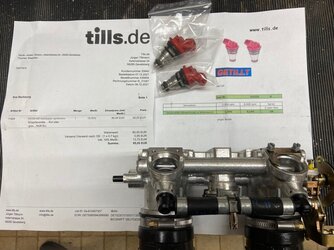
In order to test the competence of the company Tills, we had the nozzles of the 750 Formula cleaned and adjusted there.
The result, including the test report, looks very good at a fair price.

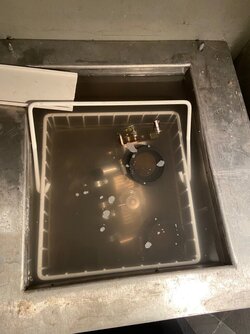
In order to remove the dirt (white coating) from the injection system, it was given an ultrasonic bath. It's amazing how much dirt loosens, also from the pores of the rubber. After New Year's Eve we put the parts back in and test how the formula works.

Thomas aus LAU

ultrasonic.jpg injection.jpg
 
Hi Thomas,

the cleaning is an important step, the more important one is the renewing of the seals and filters etc.

I had my classic car's injectors re-worked by a local shop with the ASNU System: They test the spray pattern, amount etc. of each injector before and after the cleaning. The car is 32 years old shortly and so there was a lot of dirt and not a clean spray pattern anymore. The result was a decently improved, clean running at idel and way more torque in midrange. Well invested 120€ for all 4 injectors (special price though, normally they charge 150€).
 
Starting with the tank: the pump is like new, the tank is clean, the lines in the tank are perfect, the external lines have been replaced, all the seals on the nozzles are new, the metal filters on the nozzles have been cleaned.

After the ultrasonic bath, I neutralize the cleaning agent and then put the parts in distilled water for a while. Then it is dried with compressed air.

In addition, I am converting the throttle lever to the shorter throttle path.

Thomas aus LAU
 
Back
Top