A shock absorber question. What's this for?

Ventodue

Hero member
Location
France
Hi all,

I've got a question about the operation of twin-tube shock absorbers/dampers which I'd be very grateful if someone can enlighten me about.

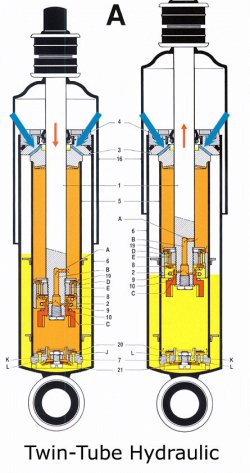
It's about the small, slanted drilling(s) that you find in the piston rod guide.  On the attached diagram, I've coloured this drilling(s) up in blue (the diagram is from Koni, who say nothing about it.  But I also find it in the Paioli unit that I'm looking at).

Even so, it may not be very clear.  So hopefully it will suffice to say that the drilling makes a connection between the air/gas reservoir and a small well formed on the top of the rod guide, around the piston rod.

So, basic question(s):

What's it for?  And how does it work?  :D

TIA

Craig


Attachments

  • Koni twin tube v2a.jpg
    Koni twin tube v2a.jpg
    104.8 KB · Views: 34
As far as I can see the drillings prevent any air/gas lock as the rod extends and retracts and fluid redistributes itself.

If they didn't then I would imagine the seals would blow out.
I could be way out of course.
 
As the damper extends, a certain amount of oil will find its way past the top guide, the holes allow the oil to drain back instead of pressurising the seal. 

piet
 
Ah, yes!  That I can see, Piet  :): there being no oil seal in the guide itself, a small amount of oil is always going to come up with the rising rod, only to get wiped off by the seal in the top nut.  And that oil can't stay there - or pop goes the seal!

Got it.  You know, nowhere else have I seen it discussed, let alone explained!  Thanks to you both. 

A follow-up question, if I may.  This may be peculiar to this Paioli shock ...  ???

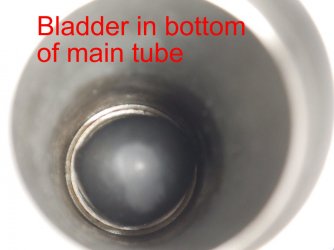
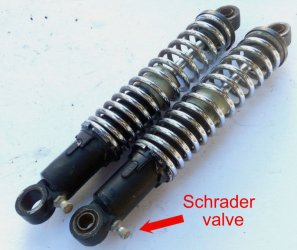
At the bottom of the main tube there is a small rubber bladder.  Connected to it is a Schrader valve.  See the attached photos.  I can't see how the bladder is fixed in the tube, nor if there is also a foot valve hidden beneath the bladder. 

So what were Paioli trying to do here?  If I close the shock up and then pump a little air into the bladder, the rod moves up gently of its own accord.  That I understand.  However, push the rod back down, release it, and up springs the rod again.

So where's my rebound damping gone  :o?

All ideas welcome!
 

Attachments

  • Bladder 1.jpg
    Bladder 1.jpg
    61.8 KB · Views: 2
  • Schrader.jpg
    Schrader.jpg
    91.5 KB · Views: 3
I got this from the local shock bloke, might or might not be applicable. Rubber bladders are used in high end shocks to separate the gas from the oil so the oil does not cavitate, have tiny bubbles dissolve into it stuffing its damping ability. These bladers over time become porous and allow this mixing. That's why you need annual maintenance on high end suspension. I think these bladders also allow control over tiny shock movements that help with traction.
No idea if this applies to these shocks,I found it interesting when I heard.
 
There are a few reasons why Nitrogen is used in bladders - less leakage, more stable pressure with temperature.

Even local tyre fitting places can pump up tyres with Nitrogen now.
 
Air contains 78% Nitrogen.
Seems a lot of faff for a few percent more for anything other than 10/10ths racing.
 
Back
Top