Abnormal noise?

Anakin

New member
Location
france
Hello everyone.

Revision of 3 cl

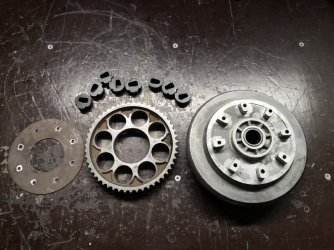
I opened and removed the primary transmission because it chatters too much for my liking at idle.
This clicking noise diminishes slightly when disengaging the clutch, but it remains very loud it seems to me.

After opening:
The triplex chain did new ras.
The tensioner same thing.
The bell has little or no rotational play.
No crankshaft sprocket play.
No play anywhere actually.........
IMG_20241109_165937.jpg
Once the clutch nut was removed, I found a circular scratch on the back, certainly caused by the axis of the selection forks, an axis that I moved by pressing on it with my finger.
If I read the RMT correctly, this axle is radially pinned to the housing of the left primary gearbox shaft bearing.
It's not normal for him to move, right?
IMG_20241109_181328.jpg

I remain with my question about this snap......what could possibly snap like that?
I add that with the engine slightly accelerated it disappears.
I also add that while the motorcycle was running, there was no indication of any abnormal noise.

I passed an aluminum circle before dismantling to listen to the engine running, on the imaginary crankshaft/clutch axis.
Listening to the crankshaft, nothing, well not much.
Nothing on the channel.
When reaching the periphery of the bell, the clicking noise becomes much louder, say towards the rivets.
On the primary gearbox axis it becomes smaller.
It starts again harder on the other side of the bell, back towards the rivets.
This difference is very clear.

So? Original bell and its hardened silent blocks?
Fork axis?
Other?

Your opinions are welcome.

Have a nice weekend everyone.
 
Last edited:
unusual this one, there should not be any scraping marks at all on the part that is in your first picture, (I just looked at one that I have on a shelf) it is shown around the circle of the holes. I dont like the look of the shaft end in your later picture that show the bearings and the screw to prevent movement, its the smaller one at the bottom of the picture, this is the shaft which supports and locates the gear selector forks inside the gearbox, it is retained by a pin that you can see, that pin is prevented from coming out by the bearing which closes the driling that it sits in, it would apear that the pin is not central accross the shaft where it should be, and so may not be installed and locating correctly, I have seen one engine (1026) where this pin was left out, and the shaft was then free to move, it did a lot of damage INSIDE the cases, it wouldnt seem to me (in your bike) that the pin has not moved enough to do damage, and the peened/chiselled on the end of the shaft might have been a very bad attempt to stop the shaft moving. All a bit strange and a much closer look is needed.
CLEM
 
Thank you for your contributions.:cool:

The fork axle has a lateral play of 12/10 mm.
It cannot be flush with the crankcase to the point of touching the clutch nut.
Unbelievable but true.
I think, on reflection, that this scratch is from a past time, another life for this piece.

Regarding the metal shavings, nothing at all.
Not in oil inspected when drained.
Nothing either during the last emptying, no more in the sieve.

On the other hand, the pin of the fork axle is damaged by the lateral play, I think.

On the part list I saw this pin but on the right side of the selection drum, but it is located on the left on the engine.
Are there two?
I really don't know enough about this engine to know that.

For now the gears were shifting well, but knowing this I think some disassembly is in order.
At least I'll be sure.
What do you think?
Nice day to you.;)
 
Ignoring the marks on the clutch drum, your original problem of a clattering primary drive is highly likely to be hardened clutch cush drive rubbers. Available and an easy fit.
 
@piranha-bro2
Thanks for answer.
I dismantled the bell yesterday, and ordered screws and taps, I have silent blocks in stock.
IMG_20241111_173527_resize_96.jpg
What do you think of the 12/10 lateral play of the fork axle?

It's annoying to take it apart just to check this.
But if it must be, i'll do.
I have no experience with this particular axis.
Thank you for your feedback.
 
The markings on the rear of the clutch hub are most certainly from a previous rebuild during which the fork axle locating pin was forgotten... happens far more often than would be expected! The SKF stamp on the layshaft bearing is evidence that the engine has been opened previously. Laverda used RIV brand bearings throughout. The shifter fork axle cannot touch the clutch hub if the pin is fitted, as in the photo. The axle is a simple part made from round stock, the axle ends do not have any machining marks other than from the saw blade that cut it off. The locating pin has a huge amount of play in its bore, quite irrelevant if it is central or not.

The clanging sound is either hardened clutch rubbers or the clutch hub being loose on the mainshaft. Bikes of this age also emit quite a racket at idle from the gearbox sprockets, it's surprising how much the noise level can be lowered with new sprocket bushes and bearings!

180° engines have the axle locating pin left, 120° engines on the right. No engines have 2 pins.

piet
 
Hello Piet
Thank you for this detailed answer.

The engine has indeed been opened at least once, as evidenced by the traces of blue gasket, and some one traces too.

When you say:
The locating pin has a huge amount of play in its bore, regardless of whether it is central or not.

This refers to the 12/10 lateral play of my machine, and would be prohibitive, so opening to correct?
Or is this more or less common? and in this case the machine is able to function properly?

Nice day to you.:cool:
 
It's perfectly normal to have a certain amount of lateral movement at the axle, it does not impair the function in any way. The sole purpose of the pin is to prevent the axle from wandering and subsequently rubbing the rear of the clutch hub. With 1.2mm play I'd suspect a thinner than the stock 4mm pin has been fitted. I've found all sorts of stuff in there, from the tip of a nail, broken drill bit to a to split pin. OTOH, the pin must not be tight, it would be impossible to remove!

Check the fit of the hub on the mainshaft, if you removed it by simply pulling it off without effort it can already be too loose. Heat expansion will cause the hub to become even looser when the engine runs. It should be a quite firm sliding fit requiring gentle mechanical persuasion to seat it properly. Check also the fit of the splined steel insert in the hub casting, these can work themselves loose. The loose hub can be countered by machining a groove in the rear around the centre to accept the o-ring (part# 55 130 032) that was used in the later 750s. It is only a temporary fix, lasts about as long as a set of cush drive rubbers. The clutch hub then usually needs to be pressed home the last few 0.10mm to install the securing circlip, but it no longer wobbles around on the shaft causing undue noises.

piet
 
Thanks Piet for the additional information.:cool:

The steel core is not loosened, nor does it move in the aluminum clutch nut.
When fitting the clutch nut, a slight tightening occurs at the circlip, removing any play.
It is not a rough spot or a metal burr.
This tightening is done on half the thickness of the circlip, it is really at the end of the fitting.
The play I'm talking about is tiny, almost undetectable by hand.

Regarding the silent blocks of the clutch bell, they will be replaced during reassembly.
I'll see if this persists or not.

Thank you all very much for your contributions and help.(and)

Have a nice day.🌞
 
Back
Top