Alpino 500 camshaft bearings hassle.

Wilson77

New member
Location
Spain
Dear gents,
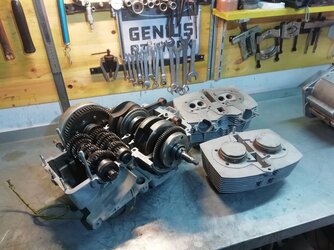
it’s a couple of years now since I asked for help here regarding an Alpino 500 engine from a friend of mine that we were planning to reassemble. The project has progressed pretty slowly but is now close to completion. That’s when we have hit a snug with the camshaft bearings which we’d like to seek advice about. But please, first allow us to share the job we have done this far. What came to our hands was a complete and fully disassembled engine plus an assortment of used parts from other engines. The crankshaft, gearchage and bearings looked good without any odd clearances, chipped teeth or the like. The cases, cylinder block and head had been previously sandblasted and the covers nicely polished.
IMG_20181101_125317.jpgIMG-20181027-WA0027.jpg

All eight female treads in the upper crankcase for the cylinder studs were shot, so we fixed them using extra-long (2,5xD) helicoil-type inserts.

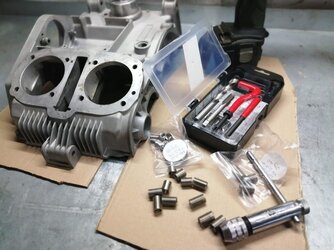
IMG_20200119_120419.jpgIMG_20191012_184808.jpg

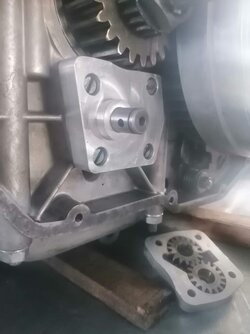
The oil pump was good but anyway we replaced it with a new billet uprated one.
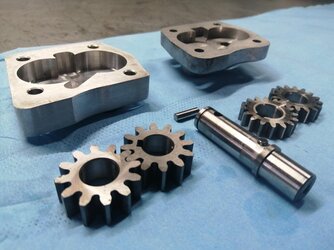
IMG_20210228_161946.jpgIMG_20210417_195821.jpg

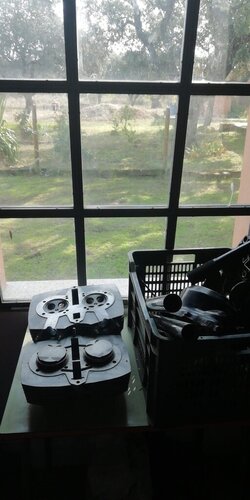
Bores, pistons and pins looked in good shape. Piston ring gaps were within spec so we just honed the cylinders and reused the whole set.
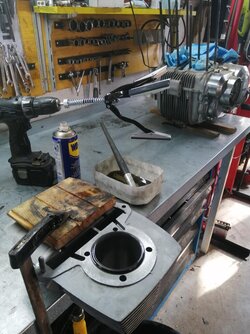
IMG_20210228_105358.jpgIMG_20210409_183450.jpg

The head came with new but unfinished valve seat inserts, so we had them and the valve faces recut by a machinist shop.

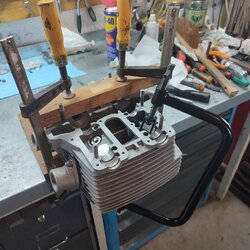
IMG_20210908_164738.jpgIMG-20210910-WA0018.jpg

Sorry, ten pics limit rached.
Continued...
Marcos.
 
Last edited:
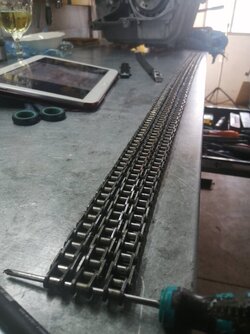
Sorry, here we go again.
Best from a handful of sliders and camchains were selected from the box.

IMG_20210228_125247.jpgIMG_20210409_183406.jpg

Cases loctited, of course all gaskets and oil seals renewed

IMG_20200327_102311.jpgIMG-20210911-WA0027.jpg

Carbs cleaned and rebuilt.

IMG_20210412_155339.jpgIMG_20210411_190917.jpgIMG_20210418_131847.jpg

All new parts sourced from Wolfgang Haerter in Canada as per advice taken from this forum.

IMG_20210217_101755.jpg

Thanks for reading. Continued...
Marcos.
 
Last edited:
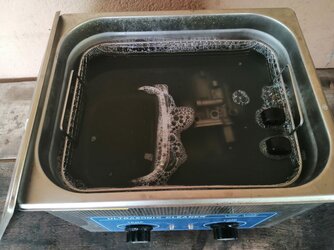
Now on with the camshafts, herein lies the rub.

Three pairs in the box came damaged beyond repair at the journals, at the cams or both.

Thankfully, another intake camshaft (see picture, right) was in very good shape, with factory alloy plain bushes at the sides and a factory needle roller at the middle.

006.jpg

Last, we have one only exhaust camshaft in seemingly reusable condition (picture, left) . The outer journals have been reground by a previous owner and matched to bespoke bronze bushes. Radial clearance at them seems fine to the finger pull (sorry, no other means to measure accuratelly), so I think we could make do with this, as is. A similar job has been done at the middle: the journal has been reground and a matching bronze bush made to fit, but a radial clearance of 0,2 mm has been left, which seems like too much. Once in place, it can be felt as a loud ticking noise felt just by gentle finger pulling. The same happens if the factory needle roller is used instead of the bronze bush.

We are considering four options, and this is where we would like to get some advice and opinions.
  1. Find another exhaust camshaft in good working order. Tough. No luck this far.
  2. Fit our used exhaust camshaft and bushes as they are (picture, left) and hope for the best. With a 0,1 mm gap between journal and bush, I’m afraid there won’t be any load carrying effect at the middle bush, but it rather will let the camshaft bend and vibrate when under load.
  3. Have another bush fabricated to size with a tighter tolerance. Easy. Cheap. But I wonder why Laverda never used a plain bush in this location unlike they did with the outer bearings. I believe that oil supply at this spot is not enough and that a needle roller must be used instead. I wonder if a modern sintered, porous, oil retaining bush could do.
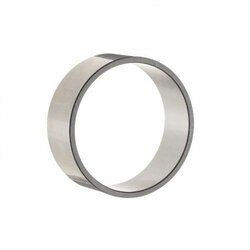
  4. Go for a needle roller. Factory one is 35x42x12 mm (IDxODxW). There exists in the market an inner ring 30x35x12.5 mm on that could be press fitted to the camshaft journal, so that the nominal OD is restored. However, it would need its ID machined to 32,3 mm in order to save the cams, then machine the journal to fit. Final wall thickness of the ring would be (35-32,3)/2= 1,35mm. This is my favourite option, but I wonder wether such a piece of hardened steel can be machined this way.

    Inner ring from Ebay.jpg
Thank you for reading, and very much in advance if anyone chimes in.
Marcos.
 
Last edited:
Personally I go with the third option. Make up a bush out of steel ,'sweat' it on and return the outer dia to original. Thus retaining the standard roller bearing.
OR Find another exhaust cam Andy Jessop might have one , still second hand but hopefully in better nick than yours - acrjessopp(at)manx.net
I'm at Cadwell with him this weekend I'll try and remember to mention to him. In the mean time drop him an email.

Andy
 
Last edited:
Option 5: Thermal spray, sometimes called 'metallisation'. It's a shaft repair technology where molten metal is sprayed onto the shaft to build up the surface, then it's ground back to the original journal diameter. The process can deposit hard facing metal, but you'd have to check whether it provides a suitable surface for roller bearings (I have no experience with the technology). It's a common enough technique so you should be able to find someone in Europe who can do it.
 
" in order to save the cams"...Do you mean in order to clear the camlobe by this ?
You can machine a hardened bearing race , modern carbide cutters can do it .
But it might be better to grind it in a cylindrical grinder.
 
Many thanks for your inputs,
Where did you find valve shims?
Miguel, well as said in the first message we have a bunch of parts from used engines, perhaps enough to build another one, and this includes a handful of shims. Once we solve the camshaft issue we'll see if we have enough to adjust our valve clearances or if we need some more...
Personally I go with the third option. Make up a bush out of steel ,'sweat' it on and return the outer dia to original. Thus retaining the standard roller bearing.
Find another exhaust cam Andy Jessop might have one , still second hand but hopefully in better nick than yours - acrjessopp(at)manx.net
I'm at Cadwell with him this weekend I'll try and remember to mention to him. In the mean time drop him an email.
Andy, I understand you mean the fourth option not third. A good camshaft would be great, anyway we think the one we have should be salvageable either for this or a second engine, so we still would want to find the best solution for it.

Option 5: Thermal spray, sometimes called 'metallisation'. It's a shaft repair technology where molten metal is sprayed onto the shaft to build up the surface, then it's ground back to the original journal diameter. The process can deposit hard facing metal, but you'd have to check whether it provides a suitable surface for roller bearings (I have no experience with the technology). It's a common enough technique so you should be able to find someone in Europe who can do it.
Dellortoman, yes I've read about that before. I don't thinks there's any shop close to our location doing it, but sure we could have it done somewhere. However, some of the sources I've consulted stated that metal sprayed surfaces can't withstand the kind of load and rubing action in of a needle bearing, more so in a camshaft. Maybe someone can shed more light here.
" in order to save the cams"...Do you mean in order to clear the camlobe by this ?
You can machine a hardened bearing race , modern carbide cutters can do it .
But it might be better to grind it in a cylindrical grinder.
Boetje, yes you're right, I mean to CLEAR the cam lobes when passing the ring to its position. Cam height from base circle to cam tip is 32,2 mm. The ring is sold with 30,0mm ID. An engineer I know who has experience in this field reckons that this is not a viable option but that we should go for a sintered bush instead. Again, I would like to have more opinions about this and hopefully based on experience.
Best regards to all,
Marcos.
 
Last edited:
The centre journal can be laser welded and re-ground to size. I have had this done on main bearing journals of classic MV Agusta cranks in order to install new rollers, works a treat.

piet
 
I tried that metal spray technic to attempt to recover a worn out 1st gear clutch hub from my 82 420 Husky Automic Dirt bike. It has 4 clutch drums that work with centrifugal brass brake shoe like gadgets that expand with engine revs and each, in turn, drive its 4 speeds at different revs
The 1st speed one is the biggest and cops the most use and wear. It didn't work for long as the brass friction areas of the shoes just picked up the metal spray material off the hub and made more wear. Because the drum was so worn it made the shoes move more than its design and it would break the return spring regularly. I ended up getting slightly longer springs made to composite from Chris Pritts spring maker mate. I ended up just buying the 2 shoes new, BTW they were the last available in Oz, maybe anywhere. That metal spray just was too soft for that application, I thought about getting the drum hard chromed but was worried that would reduce its friction level, it needed to have enough friction grip to drive but be hard enough not to wear out. Tricky thing for Husky to get right and me to fix.
 
Very interesting Piet .
They don't need any heat treatment afterwards anymore ?
No. The weld can be as hard as 76 Rockwell, that's harder than most bearing steels. I have it done to around 64 RC, a little easier on the grinding wheels. Also has the advantage of zero distortion.

Google DSI laser, closest to you are either Indonesia or Thailand. I'm lucky to have one "around the corner", although not a DSI franchise.

piet
 
Thank you very much for all your comments. First we will consult the machine shop about grinding the inner needle bearing race. If not possible, then we'll investigate the laser option even though it sounds a bit exotic around here, but may be abroad.
Metal spraying equally if not more exotic plus not suitable for this application.
Will keep you posted here about our progress.
Cheers,
Marcos.
 
Back
Top