You are using an out of date browser. It may not display this or other websites correctly.
You should upgrade or use an alternative browser.
You should upgrade or use an alternative browser.
Balance factor
- Thread starter KERMIT1200
- Start date

eyeguy
Junior member
fantastic stuff, guys, I've always wondered exactly what 'balance factor' is, I seem to have a better idea, now. FWIW I have an early Motobi(Benny) 650 twin, I wouldn't say it shakes any more than any other similar design of the same era, far less, in fact, than several I've owned!
KUTGWF!
ATG
Paul
KUTGWF!
ATG
Paul

Dellortoman
Hero member
- Location
- Tasmania, Australia
julian said:We have a force acting on our piston crown, we have a force acting on our Combustion chamber roof,
In think it's easy to get confused with forces. I'm confusing myself right now. Don't get me started on dynamic forces and reactions in motorcycle frames or my brain will go into meltdown. They're hellishly complex.
The following is just my idiot-simple interpretation, so feel free to shoot me down with a better argument.
Yes, there's a force on the combustion chamber roof, but the cylinder head is (hopefully) attached to the crankcase via the cylinder/head studs, so the upward force is transmitted to the crankcase. The downward force through the piston-rod-crankshaft is also transmitted to the cranckase through the crank bearings, which balances the upward force from the cylinder head. These forces don't necessarily all act along the same line, so the net result is a torque reaction at the crankshaft - which is basically what an engine does.
I think what I was trying to get at is the combustion process operates in a closed system, so there's no way the combustion forces can be transmitted to the outside of the engine other than through the torque at the crank.
The only way there can be a translational reaction measurable on the outside is if there's a change in veocity (ie an acceleration) somewhere inside. If you remember simple harmonic motion from school physics, there's always a radial acceleration going on with rotating machinery, even if it rotates at a constant speed, It's this radial acceleration that turns rotating masses into out of balance forces that then produce translational vibration at the engine mounts.
Combustion forces can introduce another dimension to the accelerating components by changing the shaft's rotational speed. But this is purely a rotational (or angular) acceleration component and has nothing to do with the crankshaft's mass balance.
Taking a spark plug lead off a running engine increases the variation in crank speed (or angular acceleration) through its 720o cycle so the engine will wobble around more, but only in the rotational mode about the crank axis.
Cheers,
Cam

jotacorsa
Hero member
- Location
- between Santa Fe and Taos
cam, that is why your wear a helmet at the computer
so when it all melts there is containment
there are velocity changes when the piston dwells at TDC and BDC
and the radial acceleration changes with the changes in angle of the crankshaft and rod during rotation
the rational for balancing pistons and rods to the same weight is to make all these forces the same
the next step on a plain bearing engine is to machine the rod journals that each is in the correct crank angle position
and to make certain throws are exactly the same (not so easy with a roller bearing crank)
rods are checked for identical center to center lengths
chambers are cc'd to the match one another and you then have
balanced pressures on each cylinder
smooths the power pulses, smooths vibration

I told you that I found arguments in everything I wrote! and it is some good points raised.
Here is my take.
Greg,
Yes,
But only in the exact context of my initial wording. "In General" and Harmonic frequency" not crank design etc, The design obviously has a much higher importance than the mass (within limits) but yes, you have a good example with the 750SF Frame!
With a lighter re designed crank (again in general) you lower the forces on your bearings etc and are changing far more than just the mass so it is hard to compare one to the other directly. Harmonic balancers, (big chunks of metal designed to "capture" unwanted harmonics)
Of course the heavier crank will generate larger loads, and depending on what the loads are being applied to etc you either will or will not notice!
I can though give you a very relevant example.
We specialise in Pre-war Lagondas and one of the engines is a 4.5 litre 6 in line.
This engine has a definite "period" at 2300 to 2600 where it is so noticeable on some engines that you dare not stay there!
It has a front balancer and if you remove this, the crank will surely break! and does regularly!
The standard forged crank is a fairly light affair but not badly designed for the period, We change this for a Heavier later crank but of similar design, Problem solved until you go racing and get other problems!
Then we change it again for a modern design crank that is actually still heavier due to correctly designed counterweights etc and you never see any problem again! Although this latter crank is not really relevant to the "mass" discussion as it is of far better design.
Another example is engines I used to build for F1 Ski racing, these were 8.2 litre twin turbo Big Block Chevy full race engines revving up to 8000 rpm! and some races were full throttle flat out for 1 hour. If we used the US made light weight cranks in the full power "Flat water" race engines we would regularly snap a crank during test simulations on the dyno! When changed to heavier cranks from the same manufacturer and of very similar design, we had no problems!
So my experience with this and many many other cranks etc has been one of mass helping disperse unwanted harmonics but as I say, strictly on an "all other things being equal" foot note!
Also read up on NASCAR engines, these too use lighter cranks for the "sprint" and small oval races and heavier cranks for the longer full power speedways! for exactly the same reasons.
Cam,
I know what you are saying and have the same smoke emitting from my head as you do.
However. to "Simplify" this equation, is to get it wrong!
We all know that theories that say one thing when the practice shows otherwise are Unarguably Wrong.
That means to say, "something is missing from the equation"
Now I have thought long and hard for many years on this and added this and that theory etc and have listened and read this person's and that person's work etc and tried to include what I thought was ans was not relevant and each time I have made my own arguments for and against my own theories.
Trouble is when we try to theorise that something that "IS" happening should not happen! and can not happen! We must be missing something, and unfortunately "I" don't know what, I just know that "we are"
If we take the vertical twin 270/450 frank firing order, "In theory" this should be crap! in practice it works well, In other theories it is not optimal, but close! In others "Rocking couple" should not exist! But it does!! There is far too much to this equation for us to just "Theorise" without testing and using many years of practical experimentation!
I am not for one minute saying that we do not need theories, just that we really "DO" need experimentation! and then try to work out what part of our theories applies to our practice. Trouble is that experimentation is expensive in both time and money, and not many of us have either let alone both! And those that do, "The manufacturers" regularly get it wrong! so what chance have thickos like me got? 
Julian, needing coffee fast!
Here is my take.
Greg,
Yes,
But only in the exact context of my initial wording. "In General" and Harmonic frequency" not crank design etc, The design obviously has a much higher importance than the mass (within limits) but yes, you have a good example with the 750SF Frame!
With a lighter re designed crank (again in general) you lower the forces on your bearings etc and are changing far more than just the mass so it is hard to compare one to the other directly. Harmonic balancers, (big chunks of metal designed to "capture" unwanted harmonics)
Of course the heavier crank will generate larger loads, and depending on what the loads are being applied to etc you either will or will not notice!
I can though give you a very relevant example.
We specialise in Pre-war Lagondas and one of the engines is a 4.5 litre 6 in line.
This engine has a definite "period" at 2300 to 2600 where it is so noticeable on some engines that you dare not stay there!
It has a front balancer and if you remove this, the crank will surely break! and does regularly!
The standard forged crank is a fairly light affair but not badly designed for the period, We change this for a Heavier later crank but of similar design, Problem solved until you go racing and get other problems!
Then we change it again for a modern design crank that is actually still heavier due to correctly designed counterweights etc and you never see any problem again! Although this latter crank is not really relevant to the "mass" discussion as it is of far better design.
Another example is engines I used to build for F1 Ski racing, these were 8.2 litre twin turbo Big Block Chevy full race engines revving up to 8000 rpm! and some races were full throttle flat out for 1 hour. If we used the US made light weight cranks in the full power "Flat water" race engines we would regularly snap a crank during test simulations on the dyno! When changed to heavier cranks from the same manufacturer and of very similar design, we had no problems!
So my experience with this and many many other cranks etc has been one of mass helping disperse unwanted harmonics but as I say, strictly on an "all other things being equal" foot note!
Also read up on NASCAR engines, these too use lighter cranks for the "sprint" and small oval races and heavier cranks for the longer full power speedways! for exactly the same reasons.
Cam,
I know what you are saying and have the same smoke emitting from my head as you do.
However. to "Simplify" this equation, is to get it wrong!
We all know that theories that say one thing when the practice shows otherwise are Unarguably Wrong.
That means to say, "something is missing from the equation"
Now I have thought long and hard for many years on this and added this and that theory etc and have listened and read this person's and that person's work etc and tried to include what I thought was ans was not relevant and each time I have made my own arguments for and against my own theories.
Trouble is when we try to theorise that something that "IS" happening should not happen! and can not happen! We must be missing something, and unfortunately "I" don't know what, I just know that "we are"
If we take the vertical twin 270/450 frank firing order, "In theory" this should be crap! in practice it works well, In other theories it is not optimal, but close! In others "Rocking couple" should not exist! But it does!! There is far too much to this equation for us to just "Theorise" without testing and using many years of practical experimentation!
I am not for one minute saying that we do not need theories, just that we really "DO" need experimentation! and then try to work out what part of our theories applies to our practice. Trouble is that experimentation is expensive in both time and money, and not many of us have either let alone both!
And those that do, "The manufacturers" regularly get it wrong! so what chance have thickos like me got? Julian, needing coffee fast!

Simonr501
Hero member
- Location
- Lympne, Kent. UK
Juian,
Once again some great points, derived from actually doing stuff.
Although I don't work with engines much (some diesels), I do work with Gas and Steam Turbines.
These things are balanced to an amazing degree, in theory they will not vibrate at all as there are no eccentric forces like a crank! Right?
Wrong! They ALL vibrate, but only at certain rotational speeds. With a speed of around 16,500 RPM for a Little Gas Turbine (6-8 Megawatt)these things have about 3 harmonic frequencies (speeds that are to be avoided at all costs for extended periods).
This is the speed at which the rotor shaft 'sings' like a tuning fork. The only way to get rid of the vibration out of a certain range is to change the design or change the mass.
This MAY be why heavier cranks work better (a bigger tuning fork that 'sings' at a lower frequency), as the vibration will be more prominent at lower RPM but maybe not at the destructive high RPM (more energy?). It will of course vibrate somewhere up there, but with any luck you will not rev that high.
One thing for sure rotating machinery always vibrates - no matter what.
Once again, just an idea, feel free to shoot me down in flames.
D
Davo
Guest
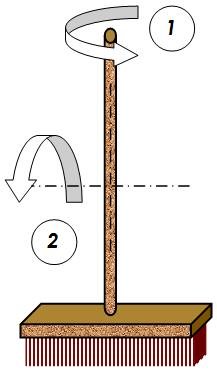
manino said:which way is harder to turn?
Well that depends on the accuracy of the diagram, especially the height of line #2 above the broom head, the length and weight of the broom head and the diameter and the weight of the handle. Not to mention if it is being manipulated by one of the 7 dwarfs or Andre the Giant.
Simon,
That is a very interesting note and one with an extraordinary amount of relevance! Thanks for sharing it with us!
Your point about the frequency "range" especially, if we have our rotating anything with a frequency so low that we run straight past it without it causing us a problem it seems to be fine, maybe what happens with the Heavy crank? and the tuning fork is funnily enough what I was thinking about an hour or so ago while trying to explain my points in my own mind and that Shattering glass!! never seen an old heavy decanter going pop in any of these experiments, just delicate little wine glasses with very high but very damaging frequencies, Again, maybe our light crank?
Fantastic points and thanks for sharing them! often things at extremes are easier to fathom and then relate to our own very basic problems with more understanding.
Davo,
Or if Harry Potter is in contol of it
That is a very interesting note and one with an extraordinary amount of relevance! Thanks for sharing it with us!
Your point about the frequency "range" especially, if we have our rotating anything with a frequency so low that we run straight past it without it causing us a problem it seems to be fine, maybe what happens with the Heavy crank? and the tuning fork is funnily enough what I was thinking about an hour or so ago while trying to explain my points in my own mind
and that Shattering glass!! never seen an old heavy decanter going pop in any of these experiments, just delicate little wine glasses with very high but very damaging frequencies, Again, maybe our light crank?Fantastic points and thanks for sharing them! often things at extremes are easier to fathom and then relate to our own very basic problems with more understanding.
Davo,
Or if Harry Potter is in contol of it
D
Davo
Guest
julian said:Davo,
Or if Harry Potter is in contol of it
I wasn't going to go there but now that you bring it up we must also take into consideration other factors such as wind speed, torsional forces while cornering especially during sudden direction changes, the harmonics of the handle and how they come into play at various velocities, and friction. It is a very complex process this formula for balancing things methinks, with many inertial forces to be taken into consideration.

KERMIT1200
Hero member
- Location
- Worcester,UK
Great information lads.
Of course there's also the gyroscopic effect of the crank on the general handling of the bike,a lighter crank would have less effect .
Its like life - its a compromise!
Andy
Of course there's also the gyroscopic effect of the crank on the general handling of the bike,a lighter crank would have less effect .
Its like life - its a compromise!
Andy
KERMIT1200
Hero member
- Location
- Worcester,UK
Lovely work Red
Stage 2 - Balancing?
Enjoy the drink
Andy
Stage 2 - Balancing?
Enjoy the drink
Andy
J
jlo
Guest
KERMIT1200 said:Great information lads.
Of course there's also the gyroscopic effect of the crank on the general handling of the bike,a lighter crank would have less effect .
Its like life - its a compromise!
Andy
Things are already complicated enough
 , I'd say that the gyroscopic effect of the crank is unsignificant on a transversal triple!
J
jlo
Guest
Very nice Red! How much weight did you take off?

so far have lost 2.09 kgs
to check on my Balance factor
Julian, Piet, Keith, Scott, one of you lot confirm I have this correct
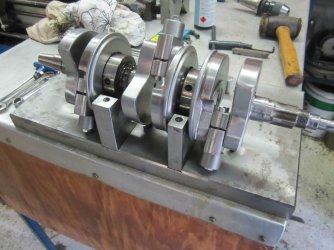
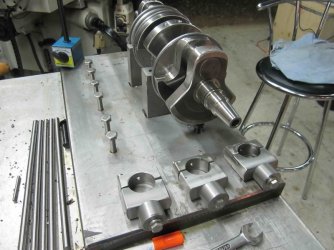
In the photo you can see 3 x bob weights at the front, they get bolted onto the big end pin
their weight is calculated as
rotating weight of the conrod + big end bearing + 60% of ( reciprocating weight of conrod + piston weight + rings + gudgeon pin + circlips ) = 533.5 grams
bob weights are within 0.1 grams of required weight at the moment
is that correct
Thanks
Red
Attachments
Dellortoman
Hero member
- Location
- Tasmania, Australia
Simon
Most things have a natural frequency of vibration, whether rotating or not. Something like a gas turbine rotor will have a lot of natural frequencies. Bang the shaft with a hammer and it'll ring at one frquency, bang a turbine blade and it'll ring with another frequency. Spinning the thing up in bearings and allowing gas to flow through it simply provides the exitation input. If it's the right frequency then it'll get the bells ringing.
My boat has a 3-blade propellor. It's a solid lump of brass and is balanced about its axis, but at certain revs it rings like a bastard. I get this godawful singing noise all through the boat. Not to mention that the blades must be deflecting quite a bit to make such a loud noise, so they could conceivably snap off if allowed to continue. I try to avoid the shaft revs that set it off. Fortunately it's at an intermediate speed so easily avoided.
I could probably get a different propellor with a natural frequency outside my operating range, but I'm too stingy
Julian
One of my pet peaves is the facile and often quoted statement that something works in theory but not in practice. The bumblebee is a classic example - theory says it can't fly, yet it does. My usual response is that there's obviously something wrong with the theory. If we can't explain why something happens in the physical world, that doesn't mean it shouldn't happen. It just means we haven't understood what's going on.
You're correct in your (unstated) assumption that I'm a theorist rather than a practitioner. I would like to be able to do interesting experimental stuff with engines but I don't have the facilities, machining skills or financial resources. I have a reasonably good grasp of Newtonian physics and engineering but some dynamic systems are a pain in the arse to analyse, so I'm likely to miss some obscure and unexpected effect. Quite often the only practical way to find out what happens in a dynamic system is to build it and experiment. Experimentation is proof. So I take my hat off to guys like you who actually do it.
BTW, the 270/450 vertical twin is not such a mystery. The crank throws at 90o give a better primary balance than a 360 twin, and not so much rocking couple or uneven firing impulses as a 180 twin. So it's a compromise between two extremes. A poor man's Ducati
Valentino Rossi had a cross plane crank in his Yamaha. Now he has a different one in his Ducati.
Cheers,
cam
laverdakeith
Hero member
Sounds about right Red, looking forward to reading the results
Keith.
Keith.

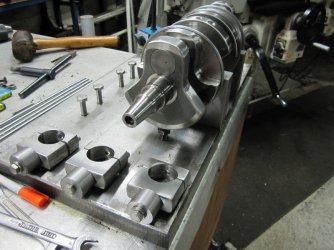
crank trued up now, running within 0.03mm across all webs
good enough for me
bob weights now installed, off to the balancing works tomorrow
AF spanner is for my jacking bolts, small AF Fine bolts I have for spreading the webs apart if required
good enough for me
bob weights now installed, off to the balancing works tomorrow
AF spanner is for my jacking bolts, small AF Fine bolts I have for spreading the webs apart if required