Balance factor

julian said:
PS.

Anything with mare than 2 cylinders in line is Gay,
Unless it has 4 wheels! then the more the better! But not 3!  :D

Until I have my 3c then its back to 180s!  You see how fair I can be  :P

Julian

???
 
I wonder if any of this fascinating info re vib control will have any effect on real world riding in the 3500 to 6500 range.Not to mention the engine is going into a differant frame,still keen to see what happens especially the origanal balance factor,intersting times
 
vince, it can and will with the right factor
yet it is entirely possible that the factor for this rev range in a std frame
and a different frame may not be the same dependent on the resonant frequency of the chassis

the triumph triples of the day had less displacement than the laverda
i'm inclined to think the amplitude of the vibration was lower

i, too, look forward to red's dyno being operational
i have a hard time accepting that identical engines with different firing orders make different peak power
the delivery curves will be different. . enough so to be a tuning variable for the track
on the other hand, the 120 track bikes have reported lower lap times than comparable 180 versions
but, as julian points out, the rider is a big factor

if i could provide two identical race prepped bikes, one each 120 and 180
i'd haul them to a vintage race meeting where someone like doug polen hangs out
and say hey, i'll buy you a beer if you can help settle a bet  :D

my own, not very well thought out, factory baffle theory:
they were developed in the 750 during endurance racing and once the casting was done for homologation they stayed
the 180 was designed for the more affluent owner (the 3C cost more than a SFC) and hey, they already had a proddy race bike
so no sweat not to include the extra design and cost and weight (a 3C is a hair lighter than a 750SF).
the triples really don't begin to see serious track use until '76 or so and they aren't going to change the casting
(just did that at the end of '75 adding two more studs) so it gets incorporated into newer designs across the range

so, does the series 2 180 have the bosses cast for the baffle?


thinking about sound...wonder how delicious that morbidelli V-12 might be

cheers,
scott

 
Hi Scott ,
You don't need Doug Polen, we have some pretty good riders over here in li'l ol' Europe! :D :D Regarding the reliability of comparing the lap times between the 180 and the 120 crank I think Gijs van Dijks is in a unique position to provide an objective opinion. He has two identical 3C race bikes, one of which has had its crank re-phased to 120 . The engines were both built by Gijs, the bikes weigh the same and the riders who share the bike] are comprised of an ex 500GP pilot and a Le Mans 24 hour winner so feedback from them can be taken seriously .
I believe the 120 crank bike is 3 secs a lap quicker than the 180. It's a fairly convincing argument that the 120 crank configuration is superior for racing [and I reckon a 120 sounds even better than a 180] .

And this gives me an excuse to post of my favourite Laverda racing pics  :D
This is Dirk at the Spa 4 hour classic when Team van Dijks came 2nd
 

Attachments

  • Dirk Brand Spa 2007.jpg
    Dirk Brand Spa 2007.jpg
    48.3 KB · Views: 38
Thanks, Bob.

Was just about to mention Gijs and his bikes.  

His 120 is definitely quicker but has also reached certain mechanical limits, crankcase, etc..... constantly breaking cylinder and lower case studs, something a 180 just doesn't manage with the regularity a 120 can. :D  He's replaced them with stronger items, I also have a set to try out, although I've never had problems in that area.  Guess it won't do any harm, the originals are now 37 years old!

piet
 
Think so, Phil.

The cam covers are fixed with M8 bolts and iIrc carry a breather exit.

I've used the redundant tach drive aperture on the racer for an extra breather too.  Even my GTL (800-odd cc) benefits from extra crankcase ventilation!  Reckon as stock it's quite OK for sane speeds and revs but is a bit limited when the going gets hot.

piet
 
bob, gijs told me the same and spa favours horsepower. 3 seconds is a big spread.
i'd love to look at the telemetry of the two bikes around the course  :P

he is doing some interesting engine mounts on the new race bike
(a 3C with 180 cases and 120 crank) using silentbloc type mounts
apparently he needs to stay with the 180 cases for his race class
the advantage i see with the 180 case is the availability of different ratios
so a particular gearset could be used for each track

my own inclination leans to the 180 having more grunt coming out of the turns...
which will pull harder coming out of mallory's hairpin?

porsche had a problem with cylinder studs many years ago
they went from a 10mm stud
to one with 10mm threaded ends and waisted to 8mm in between
ultimately they changed the alloy
seems the studs were not stretching as much as the engine grew when hot
VW experienced a similar problem with the 1600 switching from 10mm to 8mm
 
Hey Scott, purely from a subjective seat of the pants perspective I reckon my 120 spaceframe could easily out grunt a 180 out of Mallory's hairpin. This was probably down to Phil's tuning on the motor but I reckon every 120 I've owned or ridden [120 Jota Motodd, SFC 1000, RGS] would outperform a 180 [having owned a Mirage and a Jota spec 3C] .
The only situation I think  180 crank would be beneficial might be in the wet. Phil's done a lot of racing on 180s so he will be able to give a much more informed opinion than I on the subject.


As if by magic here's a pic of the old girl grunting out of that very hairpin! I can't remember whether I did a cheeky dive on the brakes  under that R1 or whether I'm simply getting in his way  :D :D
MalloryHairpin.jpg
 
bob said:
Hey Scott, purely from a subjective seat of the pants perspective I reckon my 120 spaceframe could easily out grunt a 180 out of Mallory's hairpin. This was probably down to Phil's tuning on the motor but I reckon every 120 I've owned or ridden [120 Jota Motodd, SFC 1000, RGS] would outperform a 180 [having owned a Mirage and a Jota spec 3C] .
The only situation I think  180 crank would be beneficial might be in the wet.  Phil's done a lot of racing on 180s so he will be able to give a much more informed opinion than I on the subject.


As if by magic here's a pic of the old girl grunting out of that very hairpin! I can't remember whether I did a cheeky dive on the brakes  under that R1 or whether I'm simply getting in his way  :D :D
MalloryHairpin.jpg

Bob,

I reckon the smoother, more predictable power delivery of the 120s is far superior in the wet over the 180s.... :D

Looks like a very cheeky dive to me!! ;)  The R1 rider looks as if he's suffering from an over-dose of orange.

piet
 
Hi Bob and Piet - My 2 racing 1200 Motodd's were both 180's - the 1st one I had on the dyno and it gave 2 distinct torque peaks- one at around 3500rpm and one  (larger one)around 6000 -  I would guess the later motor is similar as it felt the same - they were very easy to ride and made great road engines. I fitted the 1st 180 racing  motor that I built in the eighties in my MklV Saxon/Motodd and had a direct comparison with the 120 degree motor that i fitted originally - that was also 1200cc  (1134cc actually). I used the 120 motor extensively at Goodwood track days - it was immensly fast and  pulled out of all corners like a train.
        The 180 was a doddle to ride in bad conditions - at one Cadwell meet we had snow, sleet, hail, rain - then damp and sun ( bit like Snetterton) - I got 3 wins and a 2nd i think - I could use the high torque at low RPM to get the power down smoothly and not wheelie or have the back step out - was great at Lydden as well. So I still can't say which I would prefer to race.  To those who race (or have raced) - will know 3 seconds a lap is a lifetime - even at such a long track as Spa. So evidence supports the superior performance of the 120's. I did a very unusual head job that I'd tried for the 1st time  on Bob's space frame motor and i 'd like to explore that avenue further at a later date. - Sorry to blunder off subject again - Regards - Phil
 
I'd just like to concur that Phil's head jobs are fantastic, which is probably why Motodd customers kept cumming in Phil's shop again and again and again........
 
bob said:
I'd just like to concur that Phil's head jobs are fantastic, which is probably why Motodd customers kept cumming in Phil's shop again and again and again........

wonderfully politically incorrect Bob  :o

Speaking of Phil's headjob's I think the one he does with the bathtub is by far the best  :D
 
I always like an extra breather on my racers - here's one on my 750 proddie racer gearbox - uses a triple breather hose with a Morini 350 baffle in it venting into a catch tank - Regards - Phil
 

Attachments

  • 750 breather,.jpg
    750 breather,.jpg
    129.6 KB · Views: 41
Phil,
Is there any kind of formula that can be applied to calculating breathers? I'm thinking displacent versus surface area of the outlet...I've got a redundant rev counter outlet in my Atlas cam cover and I was considering running an extra breather from it.
Bob
 
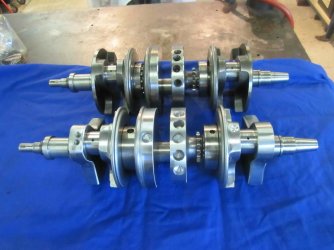
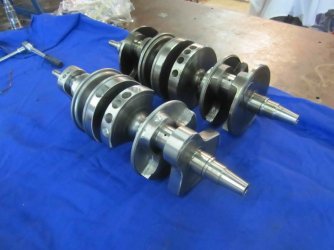
picked up the cranks from the Balancing works today
they mounted the stripped Series 2 crank first and worked out what balance factor it had.
Alternator side was 62%, primary side was 55%.
Guy was saying heavy side is seeing the effect of the heavier web on the middle cylinder.

So race crank is now balanced at 60%.
Had to start somewhere.
Next race meeting will let us know if it worked or not.

Will strip it and finish it tomorrow, get it ready to go and get it's oil shedding coatings on Monday.

Tchau
Red


Attachments

  • Finished crank 1.jpg
    Finished crank 1.jpg
    181.2 KB · Views: 50
  • Finished crank 2.jpg
    Finished crank 2.jpg
    168.7 KB · Views: 42
That's sterling work and no bullshit, I'm green with envy, so much mystique taken out of the whole thing and you've shared the findings. Top man and thanks !!
 
Hi Red,

top job it looks, but wouldn't it be better (in general) to balance it with the rods and according weights that simulate the pistons?

You have to press it apart now again I guess to fit the rods. Does that affect the coating? Will that coating be Teflon or...?

Are you thinking about maybe carbon-coat some parts, too, like the cam buckets, the cams, maybe the clutch push rods and balls? What about other parts being oil-shedding-coated like the primary drive and cam sprockets? Maybe even coat gear selector drum and -forks? Phosphate-coat the gears (all modern gear-boxes at Car manufacturers are phosphate coated I just learned...)? There is so much power of the engine lost in friction, you won't believe...

Just some thoughts
 
Back
Top