

Dellortoman
Hero member
- Location
- Tasmania, Australia
Paul's mention of handlebar end weights in his Moto Giro Bike thread piqued my interest, so I've been trying to fire up a few rusty old brain cells on vibration theory.
The weight (or rather the mass) of bar end weights is an important consideration when you're trying to control vibration, but very few products on the market actually say what they weigh. They just call them bar end weights and leave it at that. So most of the time you're buying an unknown product. That seems ridiculous to me. It's like going to buy shoes and the salesman not asking what size feet you have. It would be more helpful if they just called them bar end plugs.
If anyone is in the market for bar end weights for vibration control, I'd suggest you stick with the brands that actually state the weight, so you at least have some clue as to whether they'll be effective.
The weights are usually given for the pair, so 500g is 250g on each bar end. Weights up to 500g are easy enough to find on line. There's plenty on eBay for reasonable prices. Weights above 500g are a bit less common. The heaviest weights I've seen so far are 890g/pair labelled Magazi for sale on eBay. They're 4 times the price of most of the others, but they look stylish, which is the most important consideration.
Knowing what weight you need is a mystery that you can really only solve by experimentation. I haven't actually done any research on the resonance of motorcycle handlebars, but I have worked in the area of vibration and acoustics, so I know it's not something that has a predictable answer. There are too many variables to be able to make any sensible calculation of what weight is required for a specific bike. However, there are a few basic principles that may serve as a guide as to whether to go heavier or lighter than what you've already got.
I did find one article that sounded like total rubbish. The author was under the impression that bar end weights were there to "balance your handlebars" to make the bike track in straight line. He asserted that if one weight was heavier than the other, then the bike would pull to the heavy side. I thought about asking him why it doesn't pull the other way because of counter-steering, but decided not to stir up an argument. If his theory is true, then bikes with only one mirror are in trouble. Here's the article for anyone who wants a laugh.
 www.bikesmedia.in
The most sensible information I've found so far is a post on the Aprilia forum by a bloke called Bob Walker. I have no idea who Bob Walker is, but he at least seems to have a few brain cells.
The weight (or rather the mass) of bar end weights is an important consideration when you're trying to control vibration, but very few products on the market actually say what they weigh. They just call them bar end weights and leave it at that. So most of the time you're buying an unknown product. That seems ridiculous to me. It's like going to buy shoes and the salesman not asking what size feet you have. It would be more helpful if they just called them bar end plugs.
If anyone is in the market for bar end weights for vibration control, I'd suggest you stick with the brands that actually state the weight, so you at least have some clue as to whether they'll be effective.
The weights are usually given for the pair, so 500g is 250g on each bar end. Weights up to 500g are easy enough to find on line. There's plenty on eBay for reasonable prices. Weights above 500g are a bit less common. The heaviest weights I've seen so far are 890g/pair labelled Magazi for sale on eBay. They're 4 times the price of most of the others, but they look stylish, which is the most important consideration.
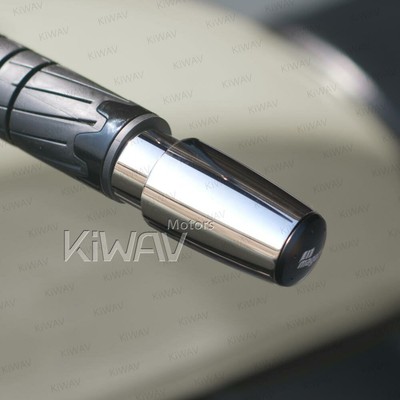
KiWAV Stainless Steel Heavy Bar End Weights for 6mm Motorcycle Bars (1 Pair) ε | eBay
Find many great new & used options and get the best deals for KiWAV Stainless Steel Heavy Bar End Weights for 6mm Motorcycle Bars (1 Pair) ε at the best online prices at eBay!
www.ebay.com.au
Knowing what weight you need is a mystery that you can really only solve by experimentation. I haven't actually done any research on the resonance of motorcycle handlebars, but I have worked in the area of vibration and acoustics, so I know it's not something that has a predictable answer. There are too many variables to be able to make any sensible calculation of what weight is required for a specific bike. However, there are a few basic principles that may serve as a guide as to whether to go heavier or lighter than what you've already got.
- Bar end weights don't actually dampen vibration. They just change the resonant frequency of the bars.
- A heavier weight will reduce the resonant frequency of the bars. Lower frequencies tend to be less bothersome to the hands.
- Short handlebars will have a higher resonant frequency than long ones. Clip-on bars will resonate at a higher frequency than full width bars.
- You could make the vibration worse if the weights bring the bars' resonant frequency into a range that's stimulated by your normal cruising speed/revs.
I did find one article that sounded like total rubbish. The author was under the impression that bar end weights were there to "balance your handlebars" to make the bike track in straight line. He asserted that if one weight was heavier than the other, then the bike would pull to the heavy side. I thought about asking him why it doesn't pull the other way because of counter-steering, but decided not to stir up an argument. If his theory is true, then bikes with only one mirror are in trouble. Here's the article for anyone who wants a laugh.
Importance of Motorcycle Handlebar End Weights » BikesMedia.in
Bike reviews of all Indian motorcyle brands by experts and users. Latest bike reviews by experts, full road test reviews with star ratings for performance, milage, features and comfort
www.bikesmedia.in
The most sensible information I've found so far is a post on the Aprilia forum by a bloke called Bob Walker. I have no idea who Bob Walker is, but he at least seems to have a few brain cells.
Bar End Weights
AF1 Racing is an authorized dealer for Aprilia, Moto Guzzi, Moto Morini, MV Agusta, SWM, Triumph, Pre-Owned
www.apriliaforum.com


 There’s no way I’m going anywhere near Uranus to get the uranium.


