Bottom Engine Mount problem, Jota 120

The mount threads are now repaired, so I thought I'd do a test to see if they held.
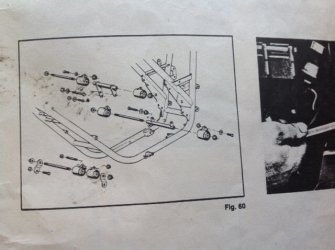
According to the green book the frame to engine mount torque for M8 X1.25 is given as 40-50Nm or 30-37lbft.

So I started to tighten towards this, but started to think it felt like a helluva load and far more than I would have tried just using what I instinctively felt right for this size fixing , so I stopped, checked the manual to see if I'd made a mistake- but , no, it definitely says 40-50Nm. Or 30-37lbft.

Puzzled I googled it and came up with a number of charts, they varied a bit, but I found the recommendation for M8x1.25 for an 8.8 bolt was about 25Nm, ie half what the green book is telling me!

I then put an M8 bolt and nut in the vice, and stripped the hell out of it at just over 30Nm

I tightened one to what "felt" right and then tested it and got 20Nm.

So the green book is wrong, then, unless I'm misunderstanding something.

 

Attachments

  • image.jpg
    image.jpg
    158.7 KB · Views: 15
The green book doesn't cover 120s.
The figures quoted are for the solid engine mounts on 180s.
 
Max. torque for an average M8 thread in steel is 22-25Nm.  M10 is 40-44Nm.

Lots of little errors in the Green Book...

piet
 
sfcpiet said:
Max. torque for an average M8 thread in steel is 22-25Nm.  M10 is 40-44Nm.

Lots of little errors in the Green Book...

Also depends whether you lubricate the thread, the calibration of the wrench and the grade of bolt.
If you stick a really slippy lubricant in there then knock roughly 25% off the dry torque.

Good job you caught it before there was a cat arse trophy!

*EDIT: Thinking about it that is probably how your original threads got stripped by the previous owner - if he used the green book figures.
 
Grant said:
The green book doesn't cover 120s.
The figures quoted are for the solid engine mounts on 180s.
The green book I have definitely covers this sort of mount, so, as Piet says, it's just wrong.
sfcpiet said:
Max. torque for an average M8 thread in steel is 22-25Nm.  M10 is 40-44Nm.

Lots of little errors in the Green Book...

piet
I guessed about right, then. Just goes to show, there's nothing like "the mark 1 calibrated forearm"
 

Attachments

  • image.jpg
    image.jpg
    87 KB · Views: 224
SimonR501 said:
Good job you caught it before there was a cat arse trophy!
Thinking about it that is probably how your original threads got stripped by the previous owner - if he used the green book figures.
As started to tighten it I thought , no I've gone as far as I want to, I then put the bit in the vice to see what 40Nm felt like, and I thought , no way will it take that. So, yes, it occurred to me, too that's why the original repair had taken place.
Long and short, though, is it looks like the inserts have worked, just have to see if they stay put in use.
 
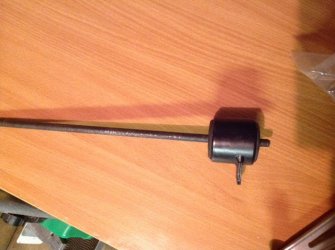
Still need a top tip from someone about freeing off the seized stud in one of the ISO mounts.
Can I soak the whole thing in kerosene without knackering the rubber?
 

Attachments

  • image.jpg
    image.jpg
    103 KB · Views: 12
I could probably hunt out a chemical to different seal materials (incl rubber) - it's a work thing, hydraulics and pneumatics.  Trouble is, we do not know what the rubber is, unless anyone else does, any "rubber" experts ????

Andy
 
find a solid steel plate with a 10mm hole in it, slide the mounting stud through the plate, drop it all in a hydraulic press and just press it out
that is what I would do and have done in the past on those mounts

get rid of your ballast resistors as well while you are working on the bike

 
redax5 said:
get rid of your ballast resistors as well while you are working on the bike

I know they were intended to limit the current through the coils but were often a source of starting problems when due to a slightly below par battery, they would result in too weak a spark while the starter was turning

Has long term experience shown that the coils can survive without them?
I have in the past put a relay in that bypasses them while the starter is engaged but leaves them in circuit during normal running.
 
Ppuxley said:
The green book I have definitely covers this sort of mount, so, as Piet says, it's just wrong. I guessed about right, then. Just goes to show, there's nothing like "the mark 1 calibrated forearm"
index.php

In the pic you quoted in that message, that's an RGS frame.  Sure it's not the factory RGS Workshop Manual?  The RGS uses normal M8 bolts and nuts to attach mounts to frame.  Different kettle of fish.
 
breganzane said:
In the pic you quoted in that message, that's an RGS frame.  Sure it's not the factory RGS Workshop Manual?  The RGS uses normal M8 bolts and nuts to attach mounts to frame.  Different kettle of fish.
Agreed, but surely 40-50Nm isn't the correct torque, even for an M8 nut and bolt arrangement, is it? You need to go a 12.9 grade bolt before you get to that sort of value....maybe they are on the RGS
 
Ppuxley said:
Agreed, but surely 40-50Nm isn't the correct torque, even for an M8 nut and bolt arrangement, is it? You need to go a 12.9 grade bolt before you get to that sort of value....maybe they are on the RGS

Just looked at the RGS manual, and agree.  They quote around double the normal torque for an M8.  Shows the value of a well calibrated elbow. :)

I don't know the actual history, but heard that ironically the factory RGS manual was based on the green book.  It is certainly odd that they quote ft-lb for all the torques, when Italy is such a heavily metricated country.  At least it only talks about one model at a time.  The (actual) green book jumps back and forth between triple and twin all the time. It does have good info in there but it helps to already know what you're doing before referring to it! :)
 
Normal 8.8 M8 bolts at the RGS/RGA engine mounts. 

The factory RGS manual is bi-lingual, the torques specified in the italian section are metric.  Most of the english speaking world back then was still imperial...

piet
 
I was having a chat to Wolfgang recently about bolt torque setting and he told me the workshop manual had a lot of mistakes in the bolt torque settings. He said that the person who did the translation got the calculation wrong.

I have noted a lot of discrepancies in this area, if you look at the different model workshop manuals there are some differences, and a lot of differences if compared to the owners hand books.

Will     
 
Jugs_S said:
I was having a chat to Wolfgang recently about bolt torque setting and he told me the workshop manual had a lot of mistakes in the bolt torque settings. He said that the person who did the translation got the calculation wrong.

I have noted a lot of discrepancies in this area, if you look at the different model workshop manuals there are some differences, and a lot of differences if compared to the owners hand books.

Will   

Yes, seems clear. I certainly won't trust any torque values I read in them now after what I've learned here. Use of a table off the web and a well calibrated forearm from now on
 
Maybe we should compile a list of correct torque settings for future reference and then make it a sticky at the top of the Technical section.
Would save mistakes and there is always someone asking head stud torque values from time to time.
 
One of the odd bits of info I did find in a Lav manual was that the Laverda torque values are for greased thread and washer. So if you are looking up torques it is greased value.
Jugs
 
Grant said:
Maybe we should compile a list of correct torque settings for future reference and then make it a sticky at the top of the Technical section.
Would save mistakes and there is always someone asking head stud torque values from time to time.


I downloaded a list of recommended torque ranges for all bolt sizes and thread pitches from an engineering site some years ago and keep the printed copy with my torque wrench. Can't remember where I got it from but I am sure it will be still out there somewhere. Have changed computers several times since so I don't have a copy any more.
 
Back
Top