Breaking the 40-year-old virgin

Claudio57

New member
Location
Switzerland
Gents

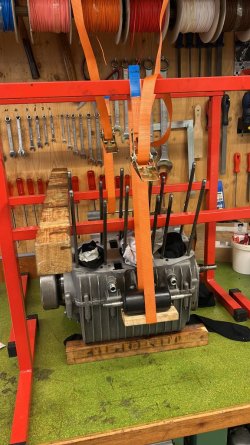
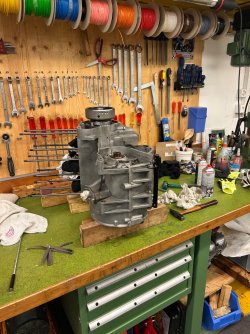
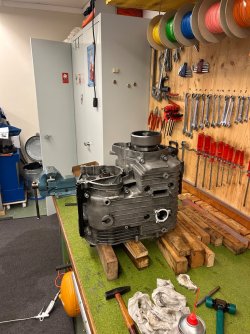
To fix the highly unlikely bearing damage (yes, there are lovely balls and metal shavings in the oil filter), I have now calmly removed the engine from my 120 (1983) and am carefully (trying) to opening it up. I left the rotor in place out of laziness.
The 40-year-old sealant is proving very stubborn. I’m taking it very patiently and have been working on this for three weeks now. At the front of the manifold, I’ve already got a gap of 0.06 mm; on the other four sides, the casing is still stuck fast. I’ve sprayed the part with every chemical imaginable – it just won’t soften. Heating it up and tapping it lightly with a hammer hasn’t worked either. Before I chuck the part in the scrap metal bin – does anyone have any advice for me? .... Luckily, I’ve still got an old English 750cc bike (there’s only one ton...) that I can reliably ride this spring :D

Thanks for your input and creative ideas
Claudio
 

Attachments

  • Jota_Ölsieb_062025.jpeg
    Jota_Ölsieb_062025.jpeg
    104.4 KB · Views: 46
  • IMG_6004.JPG
    IMG_6004.JPG
    139.8 KB · Views: 45
Have you removed the nut under the starter motor?

Even a 40-year-old virgin pops open with a couple of whollops with a soft mallet.

Laziness is not a good attitude when working on engines...

piet
 
Dear Andy and Piet

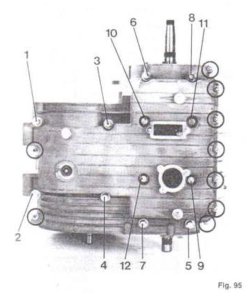
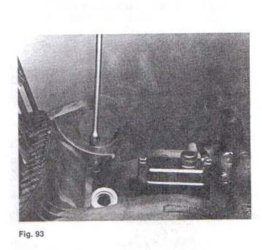
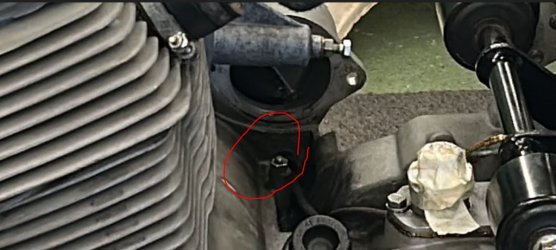
Thanks for your feedback. Yes, I’ve loosened the nut under the starter motor, as well as all the bolts listed in the manual – mechanically, all the connections are loose. The sealant is rock-hard. Using a feeler gauge, I can get into the gap in some places – but in the wider area around the bearings – on both the primary and secondary sides – there’s no getting through.

Piet: the rotor is sitting so damn tight on the crankshaft, I tried to press it off, but stopped because I had to use an enormous amount of force (it’s not the first rotor I’ve pressed off; this one is extremely tight; here too, I tried using heat of about greater >100 degrees Celsius and chemicals to help) – I’ve never come across anything this tight before... Massimo knows what kind of sealant or putty was used here... this 120 is driving me crazy... actually iam really out of ideas... tried to hang the engine block up and let the gravity do the job over time.... 3weeks later ... not one 100`mm......In the meantime, I’d rather go on a weekend break with the Prince of Darkness than have dinner with the Italian beauty... :D
 

Attachments

  • TZYG8934.JPG
    TZYG8934.JPG
    169.1 KB · Views: 55
  • engine_screws.JPG
    engine_screws.JPG
    55.5 KB · Views: 54
  • under_starter_screw.JPG
    under_starter_screw.JPG
    36.4 KB · Views: 53
  • Under_Starter_Nut.JPG
    Under_Starter_Nut.JPG
    80.7 KB · Views: 56
Last edited:
... Massimo knows what kind of sealant or putty was used here...
I'm not sure about the white cement looking stuff, but I'm trying to figure out if it may be Arexons Better or Loctite Superapido 573, or something else. At least these two alternatives read on Laverda 1000-1200 Workshop Manual, page 7.
The first stuff is probably white, possibly the colour would match. The latter stuff is said to be green on the current datasheets, may not be it or the colour may be changed.

Always have got them eventually nicely opened, but sometimes needed some serious patience.
Have you checked if there is aluminium extruding tightly on the studs?
The cone of the rotor used to eventually pop out when left in tension for a couple of hours using M16 x 1.5 bolt and periodically retightening when it starts to loosen in small steps. And take care it often pops out at almost random moment.

Check also all of the retaining rings if any has been assembled wrong way around and started to chew metal. Also the one under the rotor.
 
The whitish gasket goo ("Mothers" something iIrc...) used by the factory remains semi-pliable for decades. Sticks like shit on a blanket for sure, but doesn't adhere so well that the cases do not seperate. I've opened dozens of these virgins without issue. If you're getting a 0.6mm gap and it's not budging, there's still something grabbing somewhere. The sealant will put up a real fight when you try to remove it from the sealing surfaces.

Jouni has a point, often the alloy has collapsed under pressure, pinching a stud thread or 2, mainly because the factory chose to use far too flimsy washers under the nuts. This is far more common on cases that have been apart several times with those flimsy washers being re-used. Place the engine on one side supported on a couple of wooden blocks and hit the ends of the studs with an alloy drift and a decent-sized hammer, the cases should seperate bit by bit quickly.

piet
 
Piet: the rotor is sitting so damn tight on the crankshaft, ... I tried using heat of about greater >100 degrees Celsius
Hi Claudio. I'm guessing you already know this because you mentioned a limit of 100°C, but in case others don't: Be careful using heat on the alternator rotor. You can destroy the magnets in the rotor if you get them too hot. The temperature limit varies depending on the type of magnet (rare earth magnets are particularly sensitive and will only tolerate about 80°C). Being a 50 year old design, I suspect the Laverda alternator magnets are ferritic, which may be OK up to 200°C. An electric hot air gun can easily exceed that temp.

A hot air gun may help soften the sealant if that is what's holding the case halves together.

Cam
 
Jouni, Piet, Cam

Thank you very much for your comments.
Jouni, the adhesive used is green.

I hadn’t considered the possibility that something might have become slightly jammed mechanically. That’s a good point, which I’ll check, and I’ll follow Piet’s suggestion to split them in half that way.

Cam, thank you for your input regarding the temperature on the rotor. Actually, I wasn’t aware that there are magnets that can only withstand 80 degrees Celsius. I do know that they can’t tolerate heat, but I always assumed it was +120. I didn’t apply any heat directly to the rotor. I’ll press it off, be patient again, and remove it cleanly as well.
I’ll keep you posted....

Enjoy the weekend
 
Claudio,

If the sealant is green, it's not original. In over 45 years of mucking around with these engines, I've never come across anything other than white sealant on virgin cases. Loctite 5xx was in widespread use on Laverdas for quite some time, it had a nice light green hue. It could close gaps of up to 0.3mm iIrc.

piet
 
Piet, thanks for this valuable input.

‘Loctite 5xx was in widespread use on Laverdas for quite some time; it had a nice light green hue.’ -> Light green is spot on.

The Jota has been with me, or rather with my father, for a very long time.. sind 199x. Given the mileage at the time of purchase (around 18,000 km), we assumed that it had, of course, never been opened.

It’s getting more and more interesting.
 
The Jota has been with me, or rather with my father, for a very long time.. sind 199x. Given the mileage at the time of purchase (around 18,000 km), we assumed that it had, of course, never been opened.

It’s getting more and more interesting.
It must be remembered that when these bikes hit the market, most were mercilessly thrashed, their (mostly) young owners fired by the journalistic ravings of the time! Very few were properly maintained because Hondas and Kawasakis were the benchmarks upon which all others were measured, resulting in loads of mishaps and blow-ups, nose-diving their reputation in many places. Not at all uncommon to find low-mileage engines that have previosly been opened for surgery.

piet
 
unfortunately this is the truth piet —my dad bought his identical 120 in burgundy/black—like the one we have to repair now—in 1983 from Walter (Whisky) Steiner in Windisch (CH). A few years later, he switched back to Ducati and regretted selling the 120. Years later—sometime in the 1990s—we visited Whisky together, and he had this 120 for sale. The frame number was only three or four numbers higher than the one he had bought in 1983. He made up for his previous sale and bought the same model again :)
 
Back
Top