Broken Spokes, WHY

The conversation keeps coming back to quality of spoke material (see my earlier post). As David points out, there are many factors affecting durability, but for my money, spoke quality is departure point A. There are obvious correlations between moto spokes and bicycle spokes and cheap imports posing and something worth using: 'looks like a stainless spoke, smells like a stainless spoke, shines like a stainless spoke'. Unless you (or your wheelwright) know the origin of your base material you're cactus.

Absolutely true about 'if they start to break, replace them all pronto'. I've just done a conversion at the shop from crap black stainless to nice silver Sapim for a hefty guy who's pissed off after already paying four times to have individual breaks replaced.

In terms of 'maintenance' it's very hard to ascertain the integrity of a spoke in situ. Generally you need it to break to know it's no good - they don't show cracks over time then fail (unless you remove each one and scour it under a microscope!) so the failure is effectively catastrophic. I'd probably accept a single break as an anomaly - anything happening after that is an indication of a compromised wheel and I'd look at a total rebuild.

Build practice dictates that you always replicate the previous spoking pattern, ie the spokes will face the same way they did previously (as Maurizio has pointed out on that total dodge job Grant posted). BTW, Mauriz, do you know what brand/origin of spoke were in that front rim and spokes I've bought off you??!!  :o :o My own words: Unless you (or your wheelwright) know the origin of your base material you're cactus. I might be breaking my own rules with that build!
 
Just to add to the confusion here is a section from Road and Race website, a local Bevel and early belt specialist. The last line is the interesting bit
Quote
Cadmium Plated from $110.00 per set; with larger than std nipples $120.00; with special bends add $20
Stainless spokes from $160 per set
Stainless spoke sets - double diameter bent - $205
Stainless spoke sets - straight - double diameter $190 (eg Ducati SS750/900)
(European spokes only - no English or American)
 
maurice turner said:
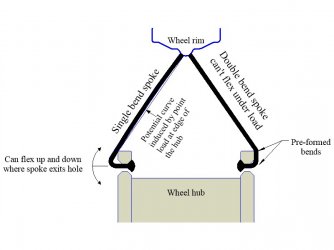
then extend the outer spoke hook length to minimise the point load at the edge of the flange.

Sorry Maurice, but I think that's a bad idea. If the hook is long enough to allow the spoke to clear the outer edge of the flange, the short length of spoke sticking out of the flange hole will be loaded sideways, not in tension. That means it'll have a bending moment applied to it. It'll bend back and forth with the cyclic loads that are applied as the wheel rotates, and will eventually snap off. As far as I can tell, that's how the factory built the original 3C wheels, and that's my theory as to why they are prone to breaking the spokes at the bend in the hook.

The hook length needs to be as short as possible so the spoke can lay hard against the flange. If that means it has to bend around the edge of the flange, so be it, but the bend should be pre-formed by the wheel builder so there's no lateral point load on the spoke at the edge of the flange. The whole length of the spoke is in tension except the short piece of hook, which is in shear load.

I posted a diagram of what I'm talking about last time we had a discussion on this. I've just added some notes to make it a bit clearer what I'm talking about.

A good wheel builder should be able to make custom bends in the spokes. Inner and outer spokes will obviously need different bends.


PS: My brother Tim had his 3C rear wheel built by Lightfoot Engineering in Melbourne with custom made spokes that had a pre-formed double bend as shown on the right side of the diagram below. He reckons it eliminated the handling instability at speed and he hasn't broken any spokes since having it done (he was always breaking spokes before).


Attachments

  • 3C spokes.jpg
    3C spokes.jpg
    53.9 KB · Views: 31
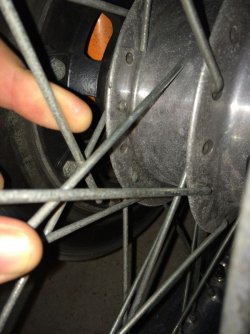
I discovered half a dozen or so busted spokes about 5 years ago after a Reefton Spur run.
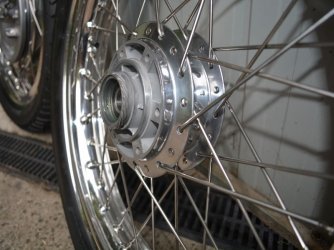
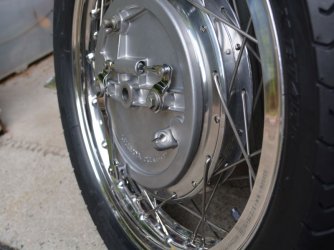
Had both rims rebuilt at Lightfoot Engineering here in Melbourne.
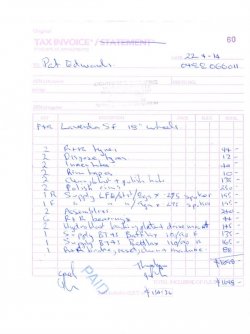
The spokes and rebuild aspect of the invoice totalled about $650
No issues thus far.
 

Attachments

  • busted spokes.jpg
    busted spokes.jpg
    95.7 KB · Views: 25
  • rebuilt rim front.jpg
    rebuilt rim front.jpg
    138.1 KB · Views: 32
  • rebuilt rim rear.jpg
    rebuilt rim rear.jpg
    130.9 KB · Views: 29
  • Borranni rebuild invoice.jpg
    Borranni rebuild invoice.jpg
    63.1 KB · Views: 42
As mentioned, Phil at Lightfoot does fine work. What would you prefer, pay to have it done multiple times or may $650 once? Pat, did that bill include polishing?

As for preforming - I do it on every bicycle wheel I build. Sometimes the spoke looks very similar to the one in your diagram, Cam. Makes perfect sense.

Tieing and glueing or soldering at spoke x-over points is an old bicycle wheelsmiths trick as well, especially with track racing wheels - the theory being that you effectively create a shorter spoke or if you like, two strong smaller triangles (=stronger).
 
The purpose of this thread is to find best practice so that having a wheel collapse can be avoided, do it once and do it right. My last wheel rebuild that resulted in 12 broken spokes cost me $700 including the rim cost. This is getting expensive fast. That motivated me is hearing about another 3C rear wheel braking spokes on more than one time, that bike is now in a container heading from Australia to England for the 70th-anniversary event and the owner has concerns about the wheel lasting. This is getting a bit crazy if you go to all that trouble and have this worry.
We need to find the root cause and eliminate it before it brakes a bike or a rider. I was doing considerable speed on the ride before I discovered all those broken spokes, not happy with that at all.
 
Piranha Brother 2 said:
As mentioned, Phil at Lightfoot does fine work. What would you prefer, pay to have it done multiple times or may $650 once? Pat, did that bill include polishing?

No, polishing was extra as per the invoice above.
Spent over $1600 all up including new tyres.
 
rowdypat said:
No, polishing was extra as per the invoice above.
Spent over $1600 all up including new tyres.
in the seventies my old 3ce would do a rear spoke every year.. But since putting s/s spokes of i think 9 gauge some 10 years ago I've never had a problem. In fact I have done all 4bikes with wire wheels and never had a problem. I do however check the spokes every year and carry spare spokes and a wheelwright spanner.
  But looking at the prices your paying I'm going to give up my job in the oil industry and start doing wheels.
Should be a millionaire in 12 months
 
If you have to custom drill a rim, then the labour involved in a wheel build is way more than simply lacing and truing. I'm still very glad I can do all this stuff myself - I've never been in a position to afford to pay to have everything done on my cars or motos. You really have to know what you're doing though. We have seen many attempts at 'home mechanics', usually DPOs, on this forum!
 
Vince said:
another 3C rear wheel braking spokes on more than one time, that bike is now in a container heading from Australia to England for the 70th-anniversary event and the owner has concerns about the wheel lasting.
We need to find the root cause and eliminate it before it brakes a bike or a rider.
Stainless spokes on that bike and the way they are fitted, too much tension at the nipple so are  breaking there. ( no not that nipple ) 

Toms_wheel.JPG
 
Brett said:
Stainless spokes on that bike and the way they are fitted, too much tension at the nipple so are  breaking there. ( no not that nipple ) 

Is the spoke itself breaking at the nipple end or is the head breaking off the nipple? Correct spoke length has the thread engaged all the way through the spoke nipple; if the thread doesn't reach fully into the bulb part of the nipple that sits inside the rim well, then it has no inherent strength and will most likely break heads off - very important detail.
 
maurice turner said:
I believe all of the failures are breaking at the bend to the hook not the nipple, well that's where mine have been breaking "in the past" on the rear wheel on my red 3C.
Yeh that's what I meant dang how could I have got the wrong....

I remember the Radiator days very well as used to be a roadie  8) oh now that was them were the days  8)

 
Any thoughts on butting spokes guys? Maybe not to decrease/lighten the main spoke length, but to bolster the bend area.

My SF rear spokes are constant ?4,0 (8 gauge). if that is the standard size (I think it is), maybe anyone worried about breaking spokes could butt up to 7 gauge ?4.3mm at the bend.

6 gauge is 4,87mm

Hag
 
Butting is a good idea. I have butted stainless in my 17x4.25 rear wheel. The idea of butting is not to increase the gauge at the stress riser (the bend) but to transfer flex to the middle part of the spoke.

Obviously retaining the std gauge at the bend is also important. Again - you must be sure of the quality of the spoke.
 
Back
Top