
You are using an out of date browser. It may not display this or other websites correctly.
You should upgrade or use an alternative browser.
You should upgrade or use an alternative browser.

G
Grant
Guest
No, that's just silly!  :-*
:-*
Cosi
Hero member
- Location
- Kingscliff
CLEMTOG said:or you could do this
CLEM
And then put them round the right way...
R
Reggie3cl
Guest
or you could do this
CLEM
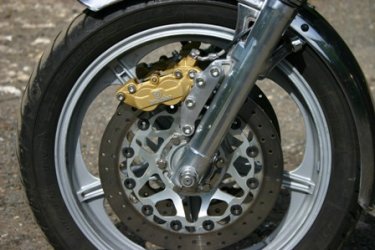
Er, no. The thing about upgrading the wheels, brakes, ignition, carbs, switchgear etc is to bring all these things into line with when the bike was sold- as standard it is an eighties bike with seventies running gear, and calipers in the eighties go behind the fork sliders. Mind you, I don't like them in front even on bikes of TOG's vintage...
G
Grant
Guest
Especially when they were designed to be located behind the fork leg, otherwise why have 30/34mm pistons giving a sort of servo effect if you use them in the right orientation.
R
Reggie3cl
Guest
According to one source, the reason for different sized pots is evening out the pad wear- same sized pistons (older Brembo 4 pots) make the pad wear to a wedge shape.

motoddrob
Hero member
- Location
- S/W Australia
That's interesting Reggie! Wonder why 2 even sized pistons would apply different pressure to the pads?? Sounds like a question for Dr Cam.
As for mounting the calipers, being quite heavy units, I'd have thought having them behind and lower would be the way to go. Never seen them mounted in front.
As for mounting the calipers, being quite heavy units, I'd have thought having them behind and lower would be the way to go. Never seen them mounted in front.

andrew112_uk
Senior member
Those calipers just look wrong to me.. makes the conversion look too obvious. With RCGBOB's Jota they are subtle.
But what do I know? Maybe obvious is good.
But what do I know? Maybe obvious is good.
R
Reggie3cl
Guest
That's interesting Reggie! Wonder why 2 even sized pistons would apply different pressure to the pads??
Something to do with the way the disc rotor turns- the 'leading' edge of the pad needs less pressure to stabilise wear, hence the smaller piston.
from the BuyBrakes Brembo FAQ:
Are Brembo calipers directional?
Brembo's calipers are directional, due to the use of differential piston sizes. The leading pistons are smaller in diameter in order to combat uneven wear of the brake pads. Upon close examination of the caliper, you will find a small arrow cast in place which denotes the direction of disc rotation. Additionally, when mounted on the vehicle, the bleed screw(s) must be at the top of the caliper.
https://www.buybrakes.com/brembo/faq.html#q12

Dellortoman
Hero member
- Location
- Tasmania, Australia
Reggie3cl said:Something to do with the way the disc rotor turns- the 'leading' edge of the pad needs less pressure to stabilise wear, hence the smaller piston.
Exactly. Just think about it ... Imagine a brake pad as a block of wood being pushed against an upturned belt sander or linisher table. The dynamics are exactly the same as a brake pad pressing against a moving disk.
Let's assume you have one hand against the end of the wooden block to stop it taking off across the room (just as the caliper body holds the pad in position), and you press down on the back of the wooden block (as a caliper piston would press a brake pad). If you press with a finger in the middle the block to push it against the sandpaper, the moving sandpaper will drag against the block, tending to tilt it so that the leding edge digs into the sandpaper belt harder than the trailing edge, so more material will be worn off the leading edge than the trailing edge. Pretty soon the block will become wedge-shaped. To counter the tendency for the block to tilt, you need to move your pushing finger away from the leading edge so that you're pushing harder on the trailing edge than the leading edge. The block should then wear down evenly.
The same thing happens with the brake caliper. The centre of clamping effort is moved away from the leading edge by making the leading piston smaller than the trailing piston.
The calipers will still work if installed backwards, but the centre of clamping effort is closer to the leading edge, which will actually exacerbate the tendency for the pads to tilt and wear into a wedge shape. As the pads wear unevenly, the backs of the pads will become angled in relation to the pistons, so the pistons will only make contact with the pad on one side. That means there will be a tilting force on the pistons, increasing the friction between piston and bore. This will reduce braking efficiency and tend to wear the pistons and/or bores.
Best advice is to install 30/34 calipers the way they were designed to go - behind the fork leg.
Cheers,
Cam
motoddrob
Hero member
- Location
- S/W Australia
Well Cam, that makes sense, thanks for the explanation.

Simonr501
Hero member
- Location
- Lympne, Kent. UK
Yer, thanks Cam.
What sort of wood is most suitable for brake pads? I reckon Jarrah is pretty hard wearing.
Looks like Clem may end up swivelling his calipers.
What sort of wood is most suitable for brake pads? I reckon Jarrah is pretty hard wearing.
Looks like Clem may end up swivelling his calipers.
R
Reggie3cl
Guest
Looks like Clem may end up swivelling his calipers.
Nah, he likes them just where they are. :-X
motoddrob
Hero member
- Location
- S/W Australia
"What sort of wood is most suitable for brake pads? I reckon Jarrah is pretty hard wearing."
Nah, Jarrah is soft compared to Wandoo, but with Wandoo pads the brakes may feel a bit wooden!
Nah, Jarrah is soft compared to Wandoo, but with Wandoo pads the brakes may feel a bit wooden!
sonicboom500
Hero member
I think one of the local members eventually settled on ash for his vintage bike.
Something about the ideal mix of availability and aroma.
Something about the ideal mix of availability and aroma.