Camshaft turning freely - not

Naranja

New member
Location
Sweden
Hi
I wish you all a good new Laverda year and take also the opportunity to beg for some technical input 😊.

I am reinstalling my 3CL cylinderhead (see my previous post) but the inlet camshaft is binding a bit much. The shaft freed up a little after replacing a bent long M9 stud but I still need 2 hands to turn it. The exhaust cam is fine and can be turned by one hand. Question is if this is critical? I didn’t notice any binding before removing camshafts and assume this binding maybe could be resolved by gentle running in (at least that’s how I used to deal with tight transmission in slotcars 🙄). Alternatively I have to take it apart and look for more bent studs or whatever. Maybe someone had similar experience with tight camshafts?

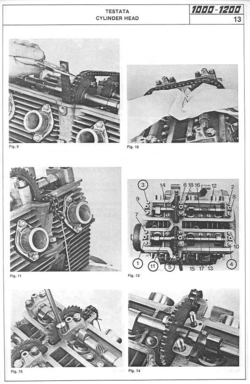
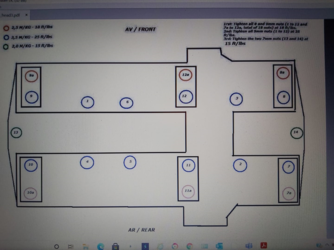
Btw, the Workshop manual does not describe how to tighten the M8 bolts so what sequence do you use to tighten the M8 studs? Do you tighten them at the same time as the M9 studs following that sequence?

Thanks

Axel
 
It is critical. Don't run it like that. How was it when you took the cam off? You'd have noticed if it was binding like that.
Is the head flat, is the camshaft straight?
This is for untightening, tighten in reverse.
Paul
1673473731683.png
 
Thanks Paul for confirming! I was afraid that it was critical. It seem to be mostly related to tightening of the central support. In my engine there are no locating pins between the half’s - not even a hole - as shown in the fig 14 in the manual so maybe that could cause some misalignment. The head was decked about 1500 kms ago but I guess it could still be skewed on the upside, but no apparent rolling resistance was noticed when I took them off.

I will release and retight the head following the fig 12 pattern to see, hopefully, improvements
 
It doesn't take much, the tiniest sliver of alloy picked up off the head as you move the block down. Seen this happen to even the best. You need to find the issue and fix it.
 
The sticky cam needs acurate checking, (i.e. mounted in a lathe) to be sure that it is 100% straight, frequently they are not. Tightening the six bearing studs down very gently, (oiled first with clean engine oil from a clean oil can, or assembly lube) using a short ring spanner, on 180's you can do this without compressing any valve springs, and go down slowly and gently, you might find that the outer bearings "bottom" first and you can nip them up with the centre one not fully seated on its mate below, tighten beyond finger tight might produce the sticky feeling, it can tell you something but can confuse, the cam could be bent, the bearings differring heights (longer ones are available) or as Paul says the tiniest particle of cack preventing proper seating, plus other factors.

Do your cam bearings have the 22 square abutment or are they located to the head with dowels, (early type head you never know when one is going to turn up on a bike from a different period) your queer centre cam bearing may be for an RGS, something that I do not know very much about, someone will chip in here

CLEM
 
Thanks, but not sure what you mean with 22 square abutment? Anyway, there’s no dowel (or metal cylinder type) to locate the lower half to the contact surface of the head and no pins to connect the halves together (in contrast to what is shown in the workshopmanual). Could this be an bearing from a 120 degree machine?
My current hypothesis is that this bearing may cause binding problem since its not sufficient fixed during tightening.
 
The original bearing blocks are made of cheese and are prone to collapse. Maybe that's your problem. You can buy new bearing blocks machined from billet from Red (forum name Redax5) or Keith in Scotland (Google Laverda Scozia)
 
The original bearing blocks are made of cheese and are prone to collapse. Maybe that's your problem. You can buy new bearing blocks machined from billet from Red (forum name Redax5) or Keith in Scotland (Google Laverda Scozia)
Might explain the bent 9mm stud. Or it's been taken out to take the head off with engine in the frame.

Paul
 
22mm abutments
this is a square, machined, male profile under the bearings where they sit on the head, centre one included for its lower half, the head has the female to match and recieve it, they are VERY VERY acurately machined and VERY VERY easilly damaged, if you just plop them on and tighten, you would not even feel the shaving of metal if they were not properly introduced into their recieveing parts, as the sliver being scraped off would be less than a quarter of the thickness of kitchen foil (probably), if this has happened to your engine, removal and very carefull de-burring and re-instalation might well save things, but not always, take the cam off and take a butchers.
CLEM
 
Hi
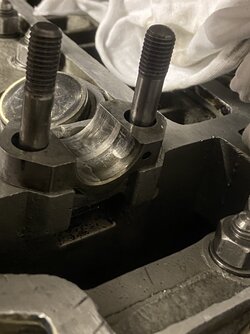
Cams been now checked for straightness. Inlet not more than 0.02 mm, exhaust less than 0.01 mm deviation at the centre. So i think that’s pretty straight. I tried different positions of the bearings (i.e. exhausted right to inlet left etc) but the only thing that helped was to exchange the bottom part of the centre bearing but now the exhaust cam is binding so I think the culprit is the centre bearing bottom half. I wonder if the placement in the photo is correct? I can’t see in the parts book since my bearings are different but it makes sense to have the small oil hole located on the m9 studs (It was the other way around when I took it apart). There is shallow indent in the head where these go and the half does seem to bottom fully when placed. Btw there’s no dovel for this and no connecting pin between the half bearings (which is in contrast to what’s shown in the parts book). It is visible to the eye that the end bearings lifts when placed on the middle bearing half. So the plan now is to do some clean shave on the bottom half using a straight file. But I would like to be sure the half is in correct position.

Thanks
Axel
 

Attachments

  • 0B4C9C95-E5DB-4484-8822-2B11C6166224.jpeg
    0B4C9C95-E5DB-4484-8822-2B11C6166224.jpeg
    116.7 KB · Views: 58
Have you checked how warped/bent/otherwise distorted the head is? Not at all uncommon to find hills and valleys along the length of the head.

You have the earliest version of cam bearings, located solely with a hollow dowel. Nothing wrong with that, apart from the fact they're probably worn well over service limits. Starting to file on these is akin to opening Pandoras Box, you're going to run in circles, chasing your tail, and when you're finished, valve clearance will have diminished.

By all means, have the head skimmed by the absolute least amount possible, you only need the bearing surfaces to be in the same plane, slight dips along the cam cover sealing surfaces can be ignored. This will reduce your shim sizes slightly, but, for a bodge, the (stock!) valve stems can be tipped by almost 0.5mm before you get into grave trouble. Restoring shim sizes properly and retaining spring pressure, etc, means fitting either shorter valves and/or valve seat inserts. For the surface to remain straight and even after installation, the lower deck mating to the cylinder block needs to be flat as well. Getting these straight will reward you with easy-spinning cams, first try.

Laverdas do not like shortcuts.

piet
 
Yeah! Easy-spinning cams is a wet dream I have. Not sure though if I ever get there using this head. The head was flattened by p.o but need to check also upside for flatness but not sure how to when the head is mounted. I guess it’s not very flat on the upside.
 
I've never fiddled around with Laverda camshaft bearing heights so I'm just theorising here. If you're looking for a quick and easy bodge while the engine is in the bike with the head on, I reckon putting some brass shim material under the low bearings might be a better approach than filing the bottom of the high one. You won't diminish your valve clearance that way, and at least it's reversible if it doesn't work. Shim stock is available in a bunch of thicknesses. Typically, in 0.1mm (.004") increments starting from 0.1mm.
 
Thats an alternative. I have som thin copper plates/foils around I could use. Btw it’s actually the outer bearings needing shimming since the cam rests on the centre bearing and lifts the outer a tiny bit. I had a conversation with Keith Nairn about new blocks, but following that route still there’s some machining needed to make them align as most old Laverda heads are skewed on the upside.
 
Back
Top